| Key Takeaways |
|---|
| • Zones rank winter cold: Plant hardiness zones group locations by their average annual extreme minimum winter temperature so you can pick perennials that survive your winter. • The 2023 map warmed up: The USDA's updated map shifted about half the country into a warmer half-zone, opening new planting options. • A zone is a starting point: Sunlight, soil, summer heat, and microclimates also decide whether a plant thrives, so use your zone alongside other conditions. |
Plant hardiness zones tell you which plants can survive winter where you live, so they help your yard by steering you toward perennials, shrubs, and trees that come back year after year instead of dying in the cold.
The USDA’s Plant Hardiness Zone Map, which was updated recently, is the tool behind those decisions. This guide explains what the zones mean, how to find yours, how to use it to choose plants, and what the recent map update changed.
Because of the update, your local gardening zone may now fall within a warmer category, opening the door to new planting possibilities. When the planning gets overwhelming, LawnLove’s gardening services connect you with a local pro.
What are USDA hardiness zones?
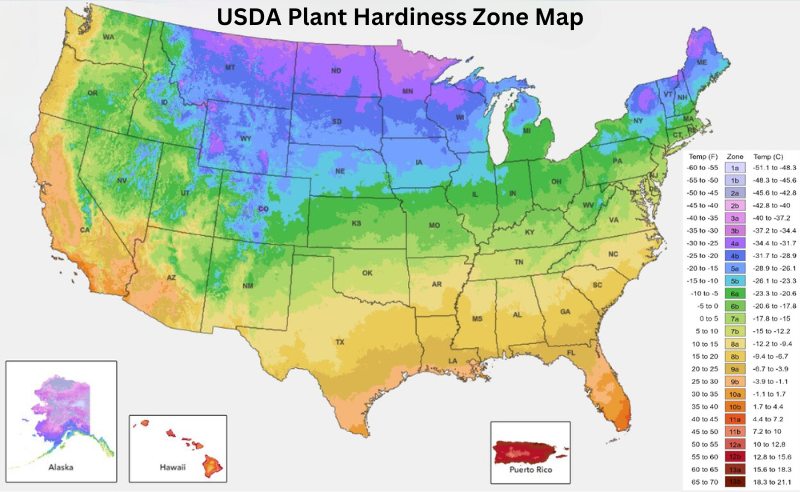
USDA hardiness zones are geographic bands that rank locations by their average annual extreme minimum winter temperature, showing which plants can survive as perennials there. Created by the U.S. Department of Agriculture (USDA) in 1960, the map covers climates across the U.S.
On the map, the United States is divided into 13 plant hardiness zones, designated “1” through “13.” Each zone represents a 10-degree range of average annual minimum winter temperatures. The zones are then broken into two subzones of 5-degree increments noted as “a” and “b.”
The temperature scale spans from -60 degrees in Alaska (zone 1, region “A”) to 70 degrees in Hawaii and Puerto Rico (zone 13, region “B”).
| Zone | Average annual minimum winter temperature (degrees) | Example U.S. area |
| Zone 1 | -60 to -50 | Interior Alaska |
| Zone 3 | -40 to -30 | Northern Minnesota |
| Zone 5 | -20 to -10 | Idaho Falls, Idaho |
| Zone 7 | 0 to 10 | Central Virginia |
| Zone 9 | 20 to 30 | Central Florida |
| Zone 11 | 40 to 50 | South Florida, Hawaii |
| Zone 13 | 60 to 70 | Puerto Rico |
The updated 2023 USDA Plant Hardiness Zone Map (PHZM) reflects the climate shift gardeners, landscapers, and farmers are experiencing, demonstrating changing times and the need for adaptability.
Changing season temperatures are reshaping landscapes across the country, influencing the varieties of plants that thrive in certain areas and how we tend to them.
Why are plant hardiness zones important?
Hardiness zones matter because they tell you, at a glance, whether a plant can survive outside through your winter. All plants are hardy to a certain degree, meaning they can survive changes in temperature or precipitation, but cold hardiness varies wildly.
The USDA created the map to help gardeners choose plants for their landscape. For example, an annual or perennial may thrive in one region but struggle or die in another.
What’s the difference between annuals and perennials?
Annuals grow for only one season, dying off as temperatures drop in winter. They need to be replanted yearly.
Perennials survive through the winter (although they may die back to the ground) and regrow each spring.
A plant grows as a perennial if it is rated for a specific hardiness zone number, meaning it can typically survive the minimum annual winter temperature. If it isn’t rated for a zone, the cold will likely kill it, making it an annual there.
How to find your hardiness zone
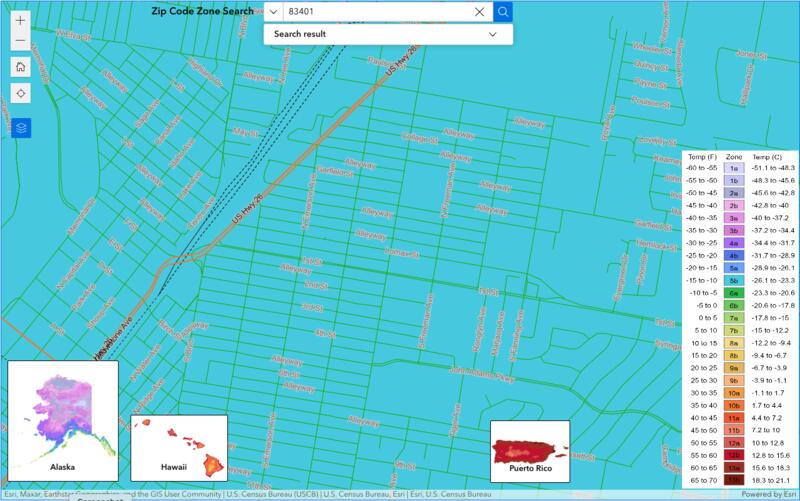
Finding your garden zone is straightforward with an internet connection. The USDA Plant Hardiness Zones Map is an easy-to-navigate interactive map based on a Geographic Information System (GIS). Just click on your state or type your ZIP code into the search box.
Once you key in your ZIP code, you’ll see your hardiness zone and the average annual coldest temperature for your location. For example, the ZIP code for Idaho Falls (83401) shows Zone 5b, with minimum temps between -15 and -10 degrees.
You can then click to zoom, then pan and pinch to find your home’s location and double-check the map’s color against the legend on the right side of the page.
Pro Tip: The ZIP code feature gives the most common zone. It’s always possible you live in a spot slightly warmer or cooler than the surrounding areas because of elevation changes, higher wind speeds, and similar factors.
Using hardiness zones to choose plants for your yard
Now that you know your USDA zone, you can use it to select plants suited to your area’s winter climate that should survive as perennials.
Finding plants is typically easier at your favorite local nursery, especially a smaller, family-owned business. These stores usually stock only plants rated for your planting zone, because they want your gardening to succeed.
Shopping from a catalog or online retailer gets a little more complicated. This is where you must do more work and match plants to your hardiness zone.
The catalog or online plant description should list basic growing conditions, including “hardiness zone” or “zone.” You’ll often see a range, such as 8 to 10 or 5 to 9. The plant should fare well if your zone is within that range.
For example, Jackmanii clematis vine is rated for hardiness zones 4 through 9. Since Idaho Falls, Idaho, is designated 5b, this climbing flowering vine can thrive there, even with below-zero lows and moderate snow.
On the other hand, one of my favorite flowers, the gerbera daisy, is listed for hardiness zones 8 through 11. There’s no way that beauty survives the winters here. It’s more suited for the warmest zones, like those in Florida or Georgia.
If I want to grow them in my yard, I’ll have to resign myself to replanting new ones each spring, knowing they’ll only be annuals.
Looking beyond your hardiness zone
A hardiness zone tells you the average lowest winter temperature a plant is expected to survive, says Tamra Reall, a horticulture field specialist with the University of Missouri Extension. It doesn’t promise the plant will bloom well, stand up to summer heat and humidity, cope with your soil and drainage, or make it through an extreme freeze event or survive a late spring freeze, she says.
Summer heat and humidity
In the South, summer can test plants as much as winter does.
“In truth, hardiness zones say nothing about heat and humidity,” says Mark Weathington, director of the JC Raulston Arboretum at North Carolina State University. A North Carolina summer is much different from a Southwest or Mediterranean climate, he says.
Microclimates in your yard can help. An open spot with good air circulation can ease some of the effects of high humidity, Weathington says, and very well-drained soil can sometimes help plants that handle cold but struggle in heat.
Soil and drainage
“Soil and moisture can make a huge difference between what your neighbor and you can grow,” Weathington says. Your neighbor may have amended their soil, built raised or mounded beds that drain well, or planted where the house or nearby shrubs shelter it in winter.
To find out what your own soil needs, he recommends starting with a soil test, which your local Extension office can usually help you arrange.
Drainage is often overlooked. Lavender is hardy in Missouri, but Reall says many local gardeners lose it to soggy soil and wet winters, not to cold.
“In Missouri, drainage is often a better predictor of lavender success than the zone number on the label,” she says.
Cold spots and late freezes
Conditions vary across a yard, says Rachel Anderson, an extension educator in horticulture with the University of Nebraska–Lincoln. Cold air settles in low spots, so keep tender plants out of these frost pockets. South-facing slopes, areas sheltered from wind by walls or fences, and soil next to brick or concrete stay warmer, she says, giving less hardy plants a better chance.
The exception is early-blooming, tender-flowered woodies like magnolias, forsythia, or fruit trees, Anderson says, because their flower buds can be damaged by a late frost. Plant them on the north or east sides, she recommends, which warm up more slowly in spring and delay budbreak until frost danger passes.
Before you buy
Check the plant tag or product description for:
How much sunlight the plant needs
The maximum temperature it can tolerate in summer
Precipitation requirements
What type of soil it prefers
It’s critical to match a plant’s care requirements to your yard so it gets the right amount of sun and the soil type it likes. Just because a plant can survive the winter in your climate zone doesn’t mean it will thrive in your landscape.
Notable changes to the 2023 hardiness zones map

The 2023 map represents a collaboration of the USDA, the Agricultural Research Service (ARS), and Oregon State University’s (OSU) PRISM Climate Group. It draws on a much larger data set, using temperatures from 13,412 weather stations, up from 7,983 for the 2012 map.
The updated map is considerably more accurate and detailed than prior versions.
One advantage of this larger data set is the improved resolution for Alaska, which now renders at a much finer scale of detail than the previous map.
But Alaska’s improved rendering isn’t the most prominent change on the updated map.
What has people talking is that this version shifts about half of the United States to the next warmer half-zone. That bump means almost 50% of the country warmed between zero and 5 degrees.
The other half of the country stayed in its previous subzone. That doesn’t mean winter temperatures there haven’t changed. These areas, primarily in the South, just didn’t warm enough to bump to a warmer zone.
Chris Daly, a researcher at Oregon State University’s PRISM Climate Group, found winter lows across the lower 48 states are now 2.5 degrees warmer than when the last map was published in 2012.
What areas are affected the most?
When you toggle between the 2012 and 2023 maps, a band of states across the Intermountain West, the Great Plains, the Midwest, and up through the Mid-Atlantic shows a noticeable change in zone coloration.
The colder zones marked by deep blues and purples are shifting north, replaced by softer shades and even a wide swath of green. Changes in states such as Idaho, Wyoming, South Dakota, Indiana, Pennsylvania, Massachusetts, New Hampshire, Vermont, and Maine quickly caught my eye.
Daly has also noted that Arkansas, Kentucky, Missouri, and Tennessee saw the most prominent changes, warming as much as 5 degrees compared with the previous map.
What do the hardiness zone changes mean for gardeners and growers?
A 5-degree subzone shift may not seem like much, but this small bump in winter lows is being noticed.
Gardeners and farmers are seeing less winter damage to their plants, letting them reassess what they grow. Landscapes are turning green earlier in spring, giving way to longer growing seasons.
Over the last 5 years, I’ve seen sage and thyme successfully overwinter in my vegetable garden as perennials. In the early 2010s, when I first started growing herbs, winters in Southeast Idaho decimated them, and they had to be planted as annuals.
But this slight shift in temperatures also brings challenges that must be addressed.
Wider opportunity for more species
A noticeable change is in areas such as Omaha, Lansing, and Boston, which switched from 5b to 6a, going from blue to green. While it seems small, this opened the door to what gardeners can now grow as perennials. Plants known for the warmer South may now survive winters in Nebraska, Michigan, and Massachusetts and gardeners across the country are testing new limits.
In North Carolina, Weathington says homeowners are trying plants that were once marginal there, such as pomegranates, pineapple guava, a wider variety of palms, and tropical plants like bananas and ginger lilies.
In Missouri, Reall says some gardeners are experimenting with certain Southern magnolias, gardenias, and crape myrtles. Some have done well in mild winters, but temperature swings, late freezes, soil, and summer stress still decide long-term success.
In Lincoln, which made the same jump from 5b to 6a as Omaha, Anderson is more cautious. “In general, our plant palette in Lincoln has not changed with the zones as much as one might think,” she says.
One plant many people are interested in is the Chicago Hardy fig, which is marketed as hardy in zone 6. “But this plant still requires significant winter protection to avoid topkill in Lincoln, unfortunately,” Anderson says. Its roots survive down to -10 degrees, but its top growth doesn’t, so without protection it dies back to the ground and resprouts, which may not leave enough time for fruit to ripen before the next frost.
Longer growing seasons for more harvests
In regions experiencing this zonal warming, gardeners and growers may have the chance to expand their harvests.
Consider northern gardeners, who have historically been limited to two harvests per season. With warmer conditions, they might now enjoy longer seasons conducive to a third harvest, similar to their counterparts in warmer climates.
Increased pressure from weeds and invasive species
On the downside, warmer zones may encourage the spread of lawn pests and invasive species previously kept in check by cold temperatures.
Insects, diseases, weeds, and non-native pests that used to die off in cold winters may now survive and wreak havoc come spring. They can push out native plants and pollinators, disrupt local ecosystems, and compromise traditional farming and gardening.
One noteworthy example is the aggressive Callery pear. These fast-growing, foul-smelling trees are detrimental to native grasses and other species.
For many years, Callery pears could not produce viable seeds, which contained their spread. With warming winters, these ornamental pears may successfully reproduce and threaten landscapes.
Fewer chill hours for fruits
Warmer zones may also mean reevaluating fruit cultivars grown in certain areas for decades. Take blueberries as a prime example.
The beloved berry bushes have particular “chill hour” requirements, the periods of cold needed for the bushes to set fruit. Growers who previously had perfect chill conditions for varieties like the Northern Highbush now see fewer chill hours and disappointing yields.
To adapt, growers and gardeners must replant with varieties that thrive on fewer chill hours.
Will this affect the transition zone boundaries for growing turfgrass species?
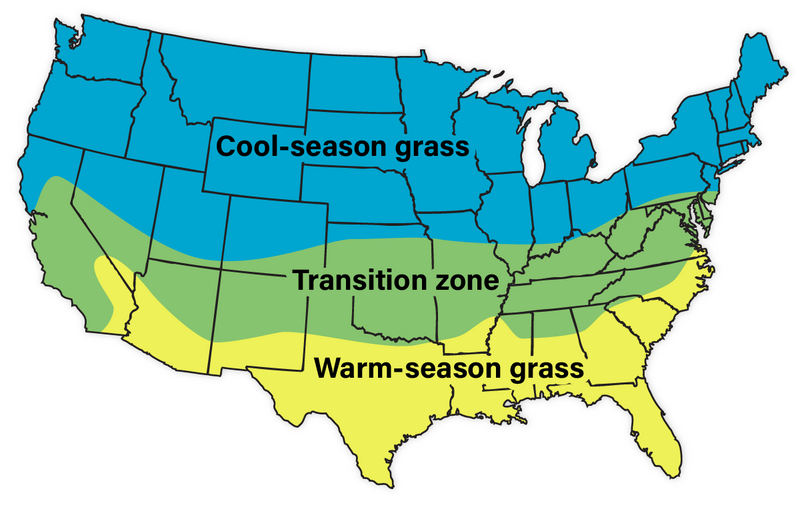
The transition zone is an area across the central United States where warm air from the South swirls with colder northern temperatures. That “not too hot” and “not too cold” climate makes it hard for homeowners to choose between warm-season and cool-season lawn grasses.
As it stands, the transition zone boundaries appear fluid depending on the map. In some cases, Iowa is firmly north of the boundary; in others, the southern part of the state is included.
Little has been said about whether the updated hardiness map will affect the turfgrass cool-season, warm-season, and transition zone boundaries.
However, if minimum winter temperatures keep rising in the northern part of the country, it wouldn’t be surprising to see the transition zone move to higher latitudes. As more locations can grow southern plants, those same places may soon be able to grow southern grasses, too.
FAQs
No. Hardiness zones tell you whether a plant can survive your average winter cold, while frost dates tell you when it is safe to plant in spring and when to expect the first freeze in fall. Use zones to choose plants and frost dates to time your planting.
Yes, though it isn’t recommended for beginners. You can grow them as annuals and replace them each spring, or try them as perennials with extra winter protection. Creating a microclimate helps: grow them in raised garden beds, cold frames, or under thick mulch.
The most frequent users are the roughly 80 million American gardeners and growers. The USDA Risk Management Agency also uses it to set crop insurance standards, and scientists studying the spread of weeds and insect pests use hardiness zones as a data layer in their research models.
Need help with choosing plants for your yard?
Change can be hard to adjust to. In the case of this updated hardiness zones map, the change may be favorable and let you plant something new and exciting.
If you need a hand navigating plant hardiness ratings or choosing plantings for your newly warmer zone, reach out to LawnLove. We’ll put you in touch with LawnLove’s local gardening pros who can select the right plants for your hardiness zone and create the yard of your dreams.
Main Photo Credit: U.S. Department of Agriculture
Related Posts: