| Key Takeaways |
|---|
| • Mississippi spans 4 zones: The state falls in USDA Hardiness zones 7b through 9a, with the Gulf Coast being the warmest. • Warm-season grasses rule the state: Bermudagrass, Zoysiagrass, and centipedegrass thrive statewide and are best planted in May and June. • Zones shifted warmer in 2023: Most of Mississippi moved from zone 8a to 8b, meaning slightly milder average winter lows than the 2012 map showed. |

The planting zones of Mississippi span U.S. Department of Agriculture (USDA) Hardiness zones 7b to 9a, meaning winter lows reach 5 to 10 degrees Fahrenheit in the north and stay milder on the Gulf Coast. Plant cool-season grasses in late August and September, and warm-season grasses from May to June.
Knowing your planting zone helps you choose plants that thrive in your climate and understand how to care for them. This guide breaks down each zone across the state, the best grasses and plants for each, and when to plant them.
If you would rather skip the guesswork, Lawn Love’s local gardening service can handle the planting for you.
Mississippi planting zone map
Zones 8a and 8b cover most of the state in between the far-north 7b and the Gulf Coast’s 9a.
The USDA Hardiness zone map assigns zones based on each area’s average annual minimum temperature over a 30-year period. Each full zone differs by 10 degrees Fahrenheit, and the “a” and “b” subdivisions split that into 5-degree bands.
This information tells you which plants can survive in your area, plus when to expect the first and last frosts of the year.
Because Mississippi spans 4 zones, frost dates and planting windows shift as you move south. The Gulf Coast’s zone 9a sees its last frost as early as February, while north Mississippi’s zone 7b can see frost into April.
Here’s a map of Mississippi with the planting zones clearly marked:
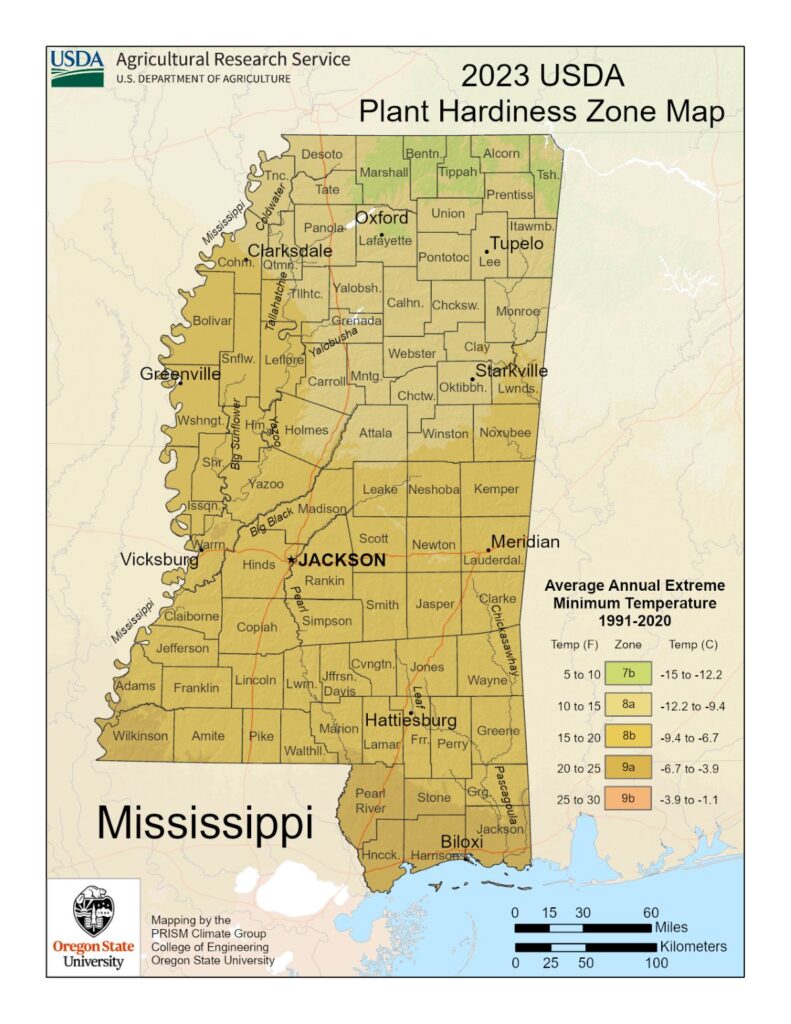
Here’s a quick look at the minimum temperature and location of each Mississippi zone:
| Zone | Winter low | Where it falls |
|---|---|---|
| 7b | 5 to 10 degrees | Some parts of north Mississippi |
| 8a | 10 to 15 degrees | Most of north Mississippi, Golden Triangle |
| 8b | 15 to 20 degrees | East central, Capital Region, southwest, Pine Belt |
| 9a | 20 to 25 degrees | Gulf Coast |
Read more: How the Hardiness Zone Helps with Your Yard
Zone 7b: Some parts of north Mississippi
Zone 7b features hot summers and mild winters, with extreme minimum temperatures ranging from 5 to 10 degrees Fahrenheit. The last frost in spring is generally between March 22 and April 3, and the first frost in fall is from Oct. 29 to Nov. 15.
The growing season in this zone is medium to long, and winters usually don’t reach the minimum temperatures.
Best grasses for zone 7b
Both cool-season and warm-season grasses perform well in this zone.
Cool-season grasses:
- Kentucky bluegrass
- Perennial ryegrass
- Tall fescue
Warm-season grasses:
- Bermudagrass
- Centipedegrass
- Zoysiagrass
Read more: The Best Grass Seed for North Mississippi
Best plants for zone 7b

From annuals to perennials, you can grow a variety of plants in zone 7b. Some of the best options include:
Flowers:
- Calla lily
- Dahlia
- Iris
- Rose
- Peony
Trees and shrubs:
- American elm
- Azalea
- Hydrangea
- Japanese maple
- Eastern redbud
Zone 8a: Most of north Mississippi and the Golden Triangle region
Zone 8a experiences hot summers and mild winters, with extreme minimum temperatures ranging from 10 to 15 degrees Fahrenheit. The last frost in spring generally occurs between March 13 and March 28, and the first frost in fall is between Nov. 7 and Nov. 28.
This zone enjoys a long growing season and can host a variety of plants.
Best grasses for zone 8a
Zone 8a is a warm zone, which is ideal for warm-season grasses. May to June is ideal for planting these grasses.
- Bermudagrass
- Centipedegrass
- Zoysiagrass
Read more: The Best Grass Seed for Mississippi Lawns
Best plants for zone 8a

Zone 8a’s long growing season supports many flowers, trees, and shrubs. Top options include:
Flowers:
- Abelia
- Mexican petunia
- Oleander
- Salvia
- Yarrow
Trees and shrubs:
- Crape myrtle
- Queen palm
- Green ash
- Southern magnolia
- Juniper
Zone 8b: East central, Capital Region, southwest, and Pine Belt
Zone 8b is a warm zone with hot summers and mild winters, with minimum winter temperatures of 15 to 20 degrees Fahrenheit.
Like zone 8a, the last frost in spring is generally between March 13 and March 28, and the first frost in fall falls between Nov. 7 and Nov. 28.
This zone has a long growing season, and winters usually don’t reach their minimum temperatures.
Best grasses for zone 8b
Warm-season grasses perform best in zone 8b:
- Bermudagrass
- Centipedegrass
- Zoysiagrass
Plant these grasses between May and June.
Best plants for zone 8b

Zone 8b’s warm climate supports a wide range of flowers, trees, and shrubs. Top options include:
Flowers:
- Phlox
- Iris
- Dahlia
- Begonia
- Gladiolus
Trees and shrubs:
- Live oak
- Southern red oak
- Monkey puzzle
- Queen palm
- Southern magnolia
Zone 9a: Gulf Coast
Zone 9a has warm summers and mild winters, with extreme minimum temperatures ranging from 20 to 25 degrees Fahrenheit. The average last frost in spring occurs between Feb. 6 and 28, and the first frost in fall is generally between Nov. 25 and Dec. 13.
If you live in this zone, you have a variety of plants to choose from because of the long growing season.
Best grasses for zone 9a
Zone 9a has a warm climate, which is ideal for warm-season grasses like:
- Bermudagrass
- Centipedegrass
- Zoysiagrass
- St. Augustinegrass
May and June are the best times to plant these grasses.
Best plants for zone 9a
Here are some plants that thrive in this zone:
Flowers:
- Begonia
- Hibiscus
- Peony
- Angelonia
- Iris
Trees and shrubs:
- Silver wattle
- Pineapple guava
- Bottlebrush
- Camellia
- Crape myrtle
FAQs
Hardiness zones are a reliable starting point, but not a guarantee. They show which plants can survive winter cold in your region, yet they don’t account for soil type, rainfall, summer heat, or snow, all of which also affect whether a plant thrives.
The USDA does not follow a fixed update schedule. The map was revised in 2012 and again in 2023, with each new version drawing on a longer and more complete set of weather station records and improved mapping technology for sharper local accuracy.
Enter your ZIP code on the USDA Plant Hardiness Zone Map website for the most precise reading, since zones can shift within a single county. Local garden centers and county extension offices can also confirm which zone your yard falls into.
Sometimes, depending on the direction of the shift:
• Warmer-zone plants: Often workable with sheltered spots, movable containers, or extra winter protection.
• Colder-zone plants: Riskier, since Mississippi’s summer heat and humidity can stress them. Plants rated for your own zone give you the best odds.
When to hire a professional
Knowing your planting zone is just the beginning. If you need help choosing the right grass and plants, or with an ongoing lawn treatment service, Lawn Love’s Mississippi lawn care pros can transform your yard without you breaking a sweat.
Ready to get started? Get a free estimate and let Lawn Love‘s local lawn care providers handle the mowing, planting, and upkeep for you.
Read more:
Main Photo: Victorian house with green lawn and trees. Photo Credit: Amiratp1 | Wikimedia Commons | CC BY-SA 4.0
Related Posts:


