| Key takeaways |
|---|
| • Grinding is the fastest method, removing small‑to‑medium stumps in under an hour. • Chemical herbicide is the best option if you don't want to rent equipment. • Epsom and rock salt are low-effort but slow and often ineffective on their own. • Always call 811 before digging because underground utilities are a real hazard. |

The fastest way to remove a tree stump is grinding. Rent a grinder for $180–$360 per day and reduce any stump to wood chips in less than an hour (large ones can take longer). If you don’t need speed, chemical herbicides can kill the stump over several weeks, manual digging works best for stumps under 13 inches, and covering with a tarp is the lowest-effort option (though it takes months).
If you’d rather skip the work, check professional stump removal costs or get a quote from Lawn Love’s yard cleanup pros.
Before you start any method, call 811 to have underground utilities marked. Every method below involves digging, and hitting a gas or water line is a serious hazard.
Stump removal methods at a glance
Before you choose a method, check two things: your local regulations and what the method does to your soil and air.
- Open burning: Many cities and counties either ban stump burning outright or require permits and specific weather conditions because of wildfire and air-quality risks.
- Herbicides: Systemic herbicides are effective, but label instructions usually restrict use near water, wells, or desirable trees to prevent drift and root-graft injury.
- Salts: Rock salt and even Epsom salt can raise soil salinity if overused. This kills grass and ornamentals around the stump and potentially affects your soil structure long-term.
| Method | Cost | Time required | Difficulty | Effectiveness |
|---|---|---|---|---|
| Stump grinding | High | 30–120 minutes depending on size | Moderate | High |
| Chemical herbicide | Around $30 | Several weeks to a few months | Easy | High |
| Manual removal | Free | 4-8 hours | Hard | High |
| Cover with tarp | Less than $20 | 6 months to 2 years or more | Easy | High |
| Controlled burn | Low | Hours | Moderate | High |
| Rock salt | Low | Several months to a year or more | Easy | Low to moderate |
| Epsom salts | $23 | 6–12 months or longer | Easy | Low to moderate |
| Caution: All these methods require some level of digging. Before you remove the stump, call 811 to mark the location of underground utilities like power, gas, and water lines so you don’t accidentally hit them.Steve Rice, owner at Lawn Kings, in Valencia, CA, says that even grinders carry this risk. “A standard stump grinder usually doesn’t go deep enough to hit properly buried utility lines, but shallow irrigation, older gas lines, or poorly marked utilities can absolutely still be at risk,” Rice explains. “I’ve uncovered lines less than a foot down.” |
Grind the stump

Grinding is the quickest way to remove a tree stump. You can rent a stump grinder from your local home improvement store for around $200 per day, but you can’t fit a tool this size in the back of your car. You either need a pickup truck or a trailer to transport it.
However, DIY grinding requires strict safety protocols.
“When you ask about stump grinding safety, the biggest mistake I see first-timers make is underestimating how aggressive the machine is,” Rice says.
“They don’t clear rocks, debris, or even check for hidden metal before starting. I’ve seen a rented grinder hit a buried chunk of concrete and kick hard enough to scare the operator off it for good,” he continues.
What you’ll need
- Stump grinder
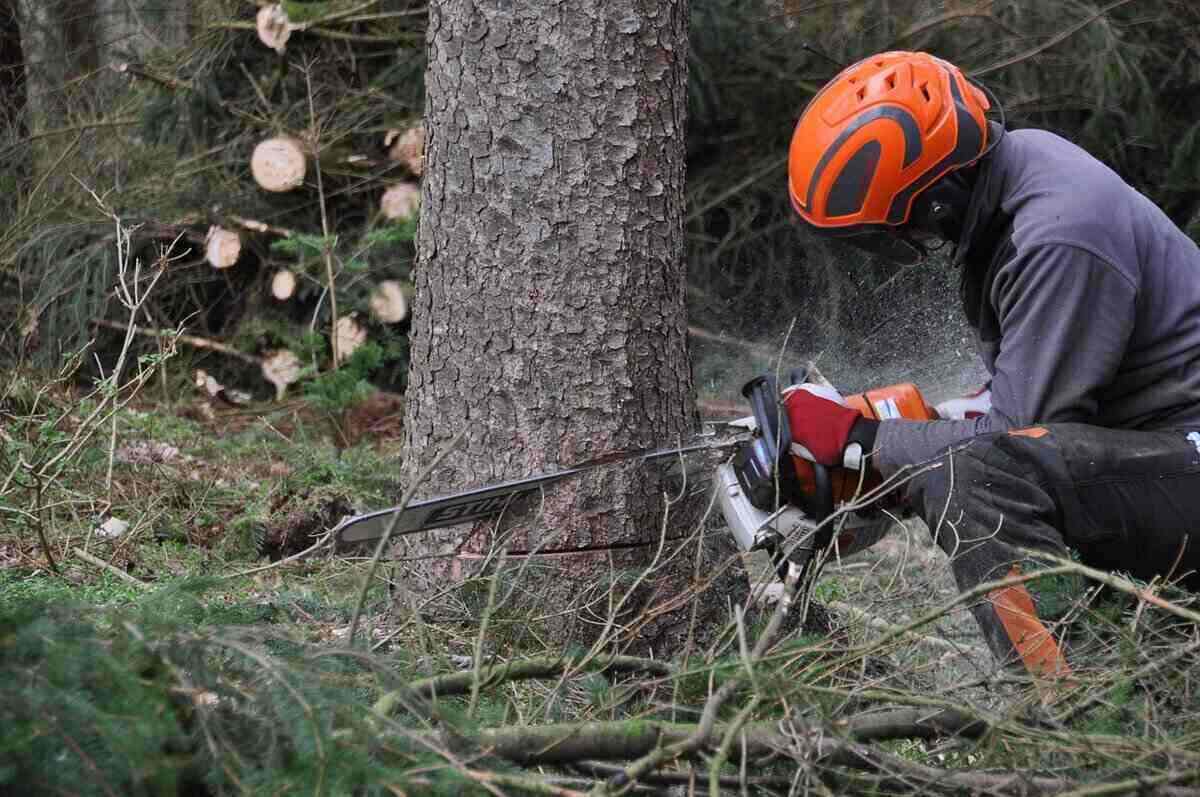
- Chainsaw
- Shovel
Always wear safety gear when handling a heavy-duty tool like a stump grinder.
- Goggles
- Dust mask
- Ear protection
- Long sleeves and pants
- Steel-toe boots
How to grind the stump:
- If the stump is taller than 15 inches, cut it down with a chainsaw first so you can roll the machine over it.
- Clear debris around the stump with a shovel.
- Position the grinder over the stump and turn it on. Lower the grinder and move it back and forth slowly, as per the manufacturer’s instructions, until you reduce the stump to ground level.
- Continue grinding below the ground level. Rice says that going 4 to 6 inches below the soil line works for grass, but if you’re replanting a tree, you need to go 8 to 12 inches deep.
- Shovel out the wood grindings and fill the hole with soil. You can repurpose the shavings as mulch.
Keep children and pets far away, as the grinder sends rocks and wood chips flying.
Prefer to hire it out? Professional stump grinding averages between $120 and $210 per stump, with most pros charging between $2 to $5 per inch of diameter.
Stump grinding cost by diameter
| Stump Diameter | Pro Cost (at $2–$5/inch) | Typical Total with Minimum Charge |
| 12 inches | $24–$60 | $120–$210 (minimum applies) |
| 18 inches | $36–$90 | $120–$210 (minimum applies) |
| 24 inches | $48–$120 | $120–$210 (minimum applies) |
| 30 inches | $60–$150 | $130–$250 |
| 36+ inches | $72–$180+ | $150–$300+ |
Use herbicide
An herbicide containing triclopyr or glyphosate can kill a stump over several weeks to a few months, but the wood will still take additional time to soften and break down before removal is easy.
“The key is targeted application,” Rice says. “Paint it directly onto freshly cut stump surfaces rather than spraying. I’ve seen root grafting carry chemicals to nearby healthy trees when people overapply or broadcast spray. Keep it controlled and localized to avoid collateral damage.”
What you’ll need
- Herbicide containing triclopyr or glyphosate
- Drill with a ½-inch drill bit
- Foam paint brush
- Shovel
- Heavy rope
How to use herbicides:
- Drill multiple holes across the surface of the stump, spacing them about 3 inches apart. Each hole should be ½-inch wide and at least 5 inches deep. If you just cut down the tree, skip drilling and apply the herbicide over the fresh cuts. The liquid will work its way down to the roots through the wounds.
- Pour the herbicide directly into the holes or dip a foam paint brush into the liquid and apply it across the surface of the stump.
- After a few weeks, check if the stump shows signs of dying (bark drying out, no new green shoots). Once it’s fully dead (usually 4-8 weeks after treatment), give it additional time to soften. It may take several more weeks to months before it’s crumbly enough to dig out easily.
- Dig around the stump with a shovel and use a heavy rope to pull it out. Remove any remaining roots, and then fill the hole with soil.
Dig out the stump manually

If your stump is smaller than 13 inches in diameter, you can dig it out, but it is hard work. Expect to spend around 4-8 hours digging and chopping.
What you’ll need
- Chainsaw
- Mattock
- Hand saw
- Heavy rope
- Shovel
- Safety glasses and steel-toe boots for protection
How to dig out the stump manually:
- Cut the stump as low to the ground as possible with a chainsaw.
- Use a mattock to loosen the soil and expose the roots. Stop digging once the roots are exposed. “The tool most people forget, but I never go without, is a sharp mattock,” Rice notes. “It’s far more effective than a shovel for cutting through roots and breaking compacted soil.”
- Chop through the roots with a hand saw. Keep digging around the stump to loosen the soil further. Try pushing the stump to one side to create more working space.
- Once the taproot is exposed, sever it with the sharp edge of the mattock.
- Remove the stump and its root ball from the ground. If it’s a large stump, you can use a heavy rope to pull it out.
- Once the stump and roots are out, use a shovel to fill the hole with soil.
Cover with a tarp
Covering the stump with an opaque, waterproof tarp is the simplest and most eco-friendly way to remove it from your yard. It kills the stump by blocking sunlight, which stops any remaining regrowth, while the trapped warmth and moisture underneath actually accelerate decomposition. However, it can take a year or even longer for the stump to die completely.
What you’ll need
- Opaque, waterproof tarp
- Heavy rope
- Hand pruners
- Mattock
- Shovel
- Nitrogen-rich fertilizer or compost (optional, to speed decay)
How to cover the stump with a tarp:
- Before covering the stump, you can accelerate decay by drilling holes into it and filling them with nitrogen-rich material like fertilizer or compost. “Keep it moist under the tarp, and you’ll encourage fungi and bacteria to do the heavy lifting faster,” Rice says.
- Place the tarp over the stump. Secure it by tying a heavy rope tightly around the stump and placing heavy rocks on the corners to hold it in place.
- It can take 6 months or even longer for the stump to die. Remove the tarp once a month to check the progress. If any saplings sprout from the base of the stump, cut them off with hand pruners.
- After 6 months, check if the stump feels soft and crumbly to the touch. If so, dig it out with a mattock. If not, cover it again.
Burn it

Burning a stump is only permitted in certain areas. Check with your local government and fire department to confirm whether it’s legal in your area and if you need a permit.
“Controlled burning becomes especially dangerous in dry, sandy soils or areas with extensive lateral root systems because fire can travel underground through roots and resurface unpredictably several feet away,” Rice says. “I’ve seen small burns turn into yard-wide flare-ups hours later.”
What you’ll need
- 1 quart of kerosene
- Charcoal
- Drill with a ½-inch drill bit
- Long match
- Mattock
- Shovel
- Safety glasses, respirator, and steel-toe boots
How to burn the stump:
- Rake away leaves, sticks, and other debris around the stem. Inspect the area, and if there’s anything flammable within a 20-foot radius, get rid of it. Keep a garden hose and fire extinguisher nearby throughout the process.
- Drill ½-inch holes across the stump surface, at least 8 inches deep. The deeper the holes, the easier it will be for the fire to break down the stump.
- Pour kerosene into all holes and over the surface until fully saturated. You’ll need 1-2 quarts of kerosene, depending on the size of the stump.
- Wash your hands and change clothes if any kerosene spilled on you.
- Pile charcoal on top of the stump and ignite it with a long match. Keep your face as far as possible while lighting.
- Monitor the stump as it burns. Never leave the fire unattended.
- Once the fire is completely out and the stump has burned down, shovel the ashes into a metal container and dispose of them only when they are completely cold to the touch. Use a mattock to dig out any remaining roots.
- Use a shovel to add fresh soil to the hole. Keep adding until it’s level with the rest of the ground.
Use Epsom salt or rock salt
Both salts work by drawing moisture out of the stump to dry it out. They’re cheap and low-effort, but results are slow and inconsistent.
“I’ve tested them on old stumps and they technically speed up decay, but the process is so slow and inconsistent that it’s more of a patience test than a practical solution,” Rice says.
What you’ll need
- Epsom salt or rock salt with no added ingredients
- Drill with a ½-inch drill bit
- Opaque, waterproof tarp
- Heavy rope
- Shovel
- Safety glasses and steel-toe boots
How to use Epsom salt or rock salt:
- Drill multiple holes across the surface of the stump about 3 inches apart. Each hole should be ½-inch wide and at least 8 inches deep.
- Fill each hole three-quarters full with salt. Pour a small amount of water into the remaining space in the hole to moisten the salt so it soaks into the stump.
- Cover the stump with an opaque, waterproof tarp to block sunlight and rain. Tie a heavy rope around the stump and place heavy rocks on the corners to secure the tarp.
- Check the stump once in a while to monitor progress. Depending on the size and species, it can take 6-12 months or longer before you see significant decay.
- Once the stump has died, it’ll feel soft and crumbly to the touch. Use a shovel to dig the soil around the stump and pull it out with a rope. Remove the root ball and any remaining roots. Fill the hole with soil.
Rock salt vs. Epsom salt: Rock salt poses a greater risk to surrounding soil. Avoid it near garden beds or any lawn you want to keep.
Read more: How to Repair Salt Damage on Your Lawn
FAQs
The stump itself won’t regrow, but new shoots can sprout from roots underground. Cut them back whenever they appear.
“After stump removal, I typically recommend cutting large surface roots below grade and backfilling with clean soil rather than chasing every root, because over-removal can destabilize surrounding soil,” Rice says.
Read more: What to Do With Tree Roots Growing Above Ground
You can let a stump rot naturally, but it usually takes up to a decade. During that time, the dead wood can attract termites, carpenter ants, and wood-boring beetles, which can multiply and migrate to your house.
Old stumps also can grow harmful fungi that spread to nearby healthy trees, and they can also be a tripping hazard and wreck your lawnmower if you accidentally run over them.
This is a piece of folklore mostly found in the United Kingdom, where people hammer coins into the bark of fallen trees or old stumps in exchange for good luck, healing, or a granted wish.
These are often called wishing trees, and the practice is very similar to tossing a coin into a wishing well.
Save your back and hire a professional
Removing a stump from your lawn is a time-consuming and labor-intensive task. If you realize a stump is too close to structures or utilities, or if it starts shifting unpredictably during cutting or grinding, stop immediately. “That’s when things can escalate fast and cause real damage,” Rice says.
If you don’t want to deal with the hassle and safety risks, Lawn Love can connect you with top-rated yard cleanup pros who can safely grind away your stump at prices you will love.
Main Image: The stump of a freshly cut tree in a yard. Photo Credit: Virynja / Adobe Stock
Related Posts: