| Key takeaways |
|---|
| • About 15% of Americans say lawn care leaves them exhausted, and another 14% call it frustrating. • The average homeowner spends close to 384 hours of their life mowing, or about 16 days total. • Fall adds extra tasks like leaf removal, aeration, and overseeding right when people are already tired of mowing. |
Spring starts with new equipment and fresh motivation, summer turns into months of mowing in sweltering heat, and by September, the enthusiasm is gone and most homeowners are dealing with massive yard work burnout.
The great irony is that cooler fall temperatures are when lawn care actually gets easier and more effective, but that’s exactly when most people mentally check out.
Fall is the worst possible time to let that burnout win. A handful of quick, low-effort tasks now do more for a lawn than months of summer mowing ever did. If the motivation just isn’t there this year, Lawn Love’s local pros can knock out fall tasks and finish out your lawn care season.
Why burnout peaks right before the easiest season
Spring arrives with such optimism: a new mower still smelling of fresh paint, unopened fertilizer bags in the garage, the first warm weekend pulling everyone outside. Summer tests that optimism. The mowing never stops, the heat turns an hour outside into three, and the mower itself keeps breaking down — one more thing to fix before you can finish the job.
Lawn care burnout is real. Here are some actual comments from homeowners on why they signed up for lawn care:
- “I damn near passed out about 2 or 3 weeks ago… I’m not 25 no more… I’m pushing 64.”
- “My back is shot.”
- “I get too hot, I feel like I’m gonna have a heart attack or something someday.”
- “For 2 or 3 days I’m in agony, pain, muscles cramping… it’s not worth it.”
- “I’m burnt out in lawns. … The older you get, the less you want to do what you’ve done for years.”
According to the Journal of Urban Ecology, a typical homeowner mows around 21 times a year and waters roughly 24 times each summer alone.
By the time September arrives, most homeowners have already put in a full season of labor and just want that time back to relax instead of pushing a mower.
A 2025 survey from Golf Course Lawn of more than 800 lawn owners found that 65% name weeds as their biggest lawn challenge, ahead of drought, disease, or anything else.
Fighting fall weeds like dandelion, white clover, and creeping Charlie, plus other fall chores like raking, dethatching, and winterizing sprinklers, makes it easy to see why people feel worn out right after a long season of mowing.
The numbers behind the burnout
Time is the real problem behind the burnout. The Tractor Supply survey found that 36% of homeowners feel they don’t have enough time for their lawn, and 43% struggle to keep weeds under control.
On top of that, most Americans still don’t know basic mowing and watering rules. The same survey found 58% don’t know which direction to mow, and 47% do not know that morning is the best time to water.
| Homeowner sentiment | Share reporting it |
| Feel happy about lawn care | 25% |
| Feel motivated | 20% |
| Feel exhausted | 15% |
| Feel frustrated | 14% |
| Feel drained | 11% |
That means roughly 4 in 10 homeowners land somewhere between tired and totally done, and fall tends to push people from tired into the done category.
With homeowners spending close to 384 hours of their life mowing (about 16 days total), and the average American logging around 70 hours a year on lawn and garden care overall, who can blame them for wanting a break?
According to U.S. Bureau of Labor Statistics, men average about 94.9 hours a year on lawn and garden care, while women average around 47.5 hours.
Why fall is the most important season for lawn care
For cool-season lawns (Kentucky bluegrass, tall fescue, perennial ryegrass, and fine fescue), the dominant grass types across much of the country, fall is the busiest time of the year.
Late summer through mid-fall also happens to be the best window for establishing cool-season turfgrass. Virginia Cooperative Extension notes that warm days and cool nights create ideal conditions for seed germination and establishment.
Virginia Tech turfgrass specialists frame fall as an important transition period for turfgrass growth and development. How you manage your lawn in the fall matters a great deal for how it performs the following spring.
Here’s what fall does for a lawn that summer can’t:
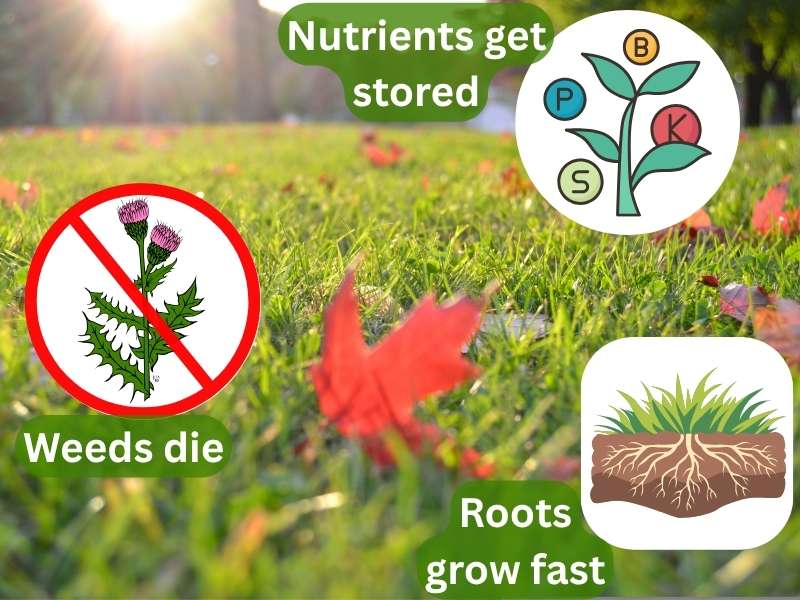
- Roots grow faster: Fall is one of the most active root-growth periods of the year for cool-season grass, right next to spring.
- Nutrients get stored: Cooler temperatures direct fertilizer energy underground into the roots instead of pushing excess top growth, which just means more mowing.
- Weeds die at the root: Perennial weeds pull nutrients into their root systems to survive winter, so anything applied now travels with that flow.
Weed control also works differently in the fall than in summer for this exact reason. Mary Helen O’Leary, owner of Heroes Lawn Care in Omaha, Nebraska, explains it this way:
“Fall is one of the best times to control weeds because they’re pulling nutrients down into their roots to prepare for winter. When you apply weed control, they pull the treatment down too, which helps kill the weed all the way to the root.”
Aerating in early fall for cool-season grass relieves soil compaction and reduces thatch, typically using a hollow-tine or core aerator that pulls real plugs of soil rather than just poking holes.
There is still work to be done for warm-season lawns. In the deep South, Bermudagrass, St. Augustinegrass, centipedegrass, and Zoysiagrass lawns still need regular mowing well into fall, plus dormancy-prep tasks like a final fertilizer and weed control need to be done before the first frost.
What coasting into winter actually costs you
Skipping fall lawn care doesn’t just mean a slightly worse-looking yard over the winter. It means starting behind in spring.
Homeowners who skip a season of care typically pay 1.5 to 2 times more the following year to bring the lawn back to where it was, according to Sprout Lawn & Landscape.
The damage adds up real fast:

- Reseeding costs between $0.07 and $0.23 per square foot.
- A lawn neglected badly enough that it needs a full reseed, meaning old growth removed, soil prepped, and new grass established from scratch, costs $0.67 to $1.33 per square foot.
- Professional aeration averages $104 to $195, and leaf removal averages $170 per visit. Both climb fast once a lawn needs emergency-level cleanup instead of routine upkeep.
A lawn that goes into winter thin, compacted, or full of weed seed doesn’t recover on its own. Most common lawn diseases like the brown patch, dollar spot, and red thread are driven by maintenance mistakes like uneven watering, the wrong nitrogen levels, or a thick layer of leaves on the lawn rather than bad luck. Fixing an outbreak means paying for fungicide plus reseeding any dead patches.
As an example, moss and fungus control treatments run $105 to $325 per application.
The short list: Fall tasks worth the effort
You don’t have to spend all your fall weekends working in your yard. Time your tasks so they benefit your lawn and don’t kill you at the same time.
| Fall tasks at a glance | Time investment | Why it matters |
| Aerate | ~1 afternoon, once | Relieves compaction from a summer of heat and traffic |
| Overseed thin/bare patches | ~1 afternoon, once | Late August–mid October so grass establishes before frost |
| Fertilize (right formula, right time) | One application | Builds root reserves for winter and next spring |
| Adjust mowing height | No extra time. Same mow, different setting | Prevents stress from cutting too much or too little; winter protection |
| Manage leaves | ~15–30 min./week | Prevents smothering and disease vs. one big cleanup |
For cool-season lawns:
- Aeration: Aerate with a core machine in September or early November to relieve compaction from summer heat and foot traffic.
- Overseed: Overseed thin or bare patches from late August through mid-October, when soil temperatures are still warm enough for germination.
- Fertilize twice: Once in early-to-mid fall to build root growth, then again in late fall (October through November) to harden the grass off before winter.
“You don’t want to push a bunch of new growth right before a freeze. You’re trying to get the lawn ready for winter, so something with more potassium makes more sense than spring fertilizer that’s designed to make everything grow,” O’Leary says.
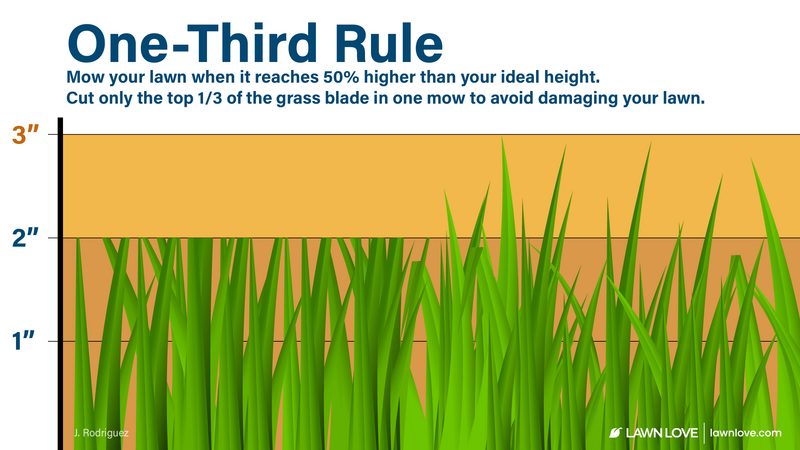
- Adjust the mower: Lower the mowing height gradually, following the one-third mowing rule, so no more than a third of the blade comes off in one cutting.
- Weed control: Apply post-emergent herbicide now. Perennial weeds are pulling nutrients into their roots to survive winter, so treatment travels down with it and kills the plant at the root.
For warm-season lawns:
- Fertilize: Fertilize early in fall only, if at all, and skip nitrogen entirely once the grass starts heading toward dormancy. “With warm-season grasses, fertilizing too late can be a problem because you can push new growth when the grass should be preparing for winter,” O’Leary says.
- Adjust the mower: Raise the mower a half-inch to an inch before the first frost to help the grass hold more leaf area and build energy reserves.
- Skip overseeding: Warm-season grass is shutting down, so the priority is easing off maintenance rather than pushing new growth.
For every lawn, regardless of grass type:
- Stay on top of leaves weekly: A light leaf layer can sit for about a week without harm, but heavy cover left for weeks blocks enough light to kill grass underneath, according to UNH Cooperative Extension. A weekly leaf cleanup pass with a rake or mulching mower beats one exhausting cleanup in late November.
How to beat the burnout without overhauling your weekend
You don’t have to spend all your fall weekends working in your yard. Time your tasks so they benefit your lawn and don’t kill you doing them.
Aeration and overseeding are one-and-done tasks for the season. Fertilizing is a single application, not a weekly commitment. None of it demands the recurring time investment that summer mowing does.
And if the motivation genuinely isn’t there, hiring a pro to handle the two or three tasks that matter most like aeration, overseeding, or fall fertilization, is a completely reasonable alternative to pushing through it yourself.
FAQs
For cool-season lawns, fall aeration paired with overseeding gives the most visible improvement, since fall is the best window for both root recovery and seed germination.
For warm-season lawns, it’s fertilization. The best move you can do is to time your last fertilization correctly, cutting it off roughly 6 to 8 weeks before the first frost, so the grass isn’t pushed into new growth right as it should be hardening off for winter.
Yes, and it’s tied to soil temperature rather than the calendar.
“Once the soil gets down around 50 degrees, it may already be cold for seeds to grow before winter. The seed may just sit there, or it may start to germinate, or it may start growing and end up weak when the first hard frost hits,” O’Leary says.
A basic soil thermometer, sold at most garden centers, is the most reliable way to check before spending money on seed.
Keep mowing as long as the grass is actively growing, rather than picking a fixed date, and make any final height adjustments gradually.
Don’t quit at the finish line
Yard work burnout is completely natural after a long, grueling summer. The heat breaks you down, and by September, parking the mower in the shed feels like a relief.
This is the moment your yard needs you the most. If you’d rather hand it off than push through, Lawn Love’s local pros can handle aeration, overseeding, and fall fertilization in a single visit, no mower required.
Main Image: A senior man savors a steaming cup of coffee while relaxing in his lush backyard garden after a day of hard work. Photo Credit: La Famiglia / Adobe Stock, created using Canva Pro
Related Posts: