| Key takeaways: |
|---|
| ● Mast years come periodically: Oaks have a mast year roughly every 2 to 5 years, and the next year’s crop is often smaller. ● Neighbors’ yards can differ: Oak species don’t all mast on the same schedule, so one yard can be buried in acorns while the next is nearly bare. ● Clear acorns before mowing: Rake, blow, or sweep away dense patches first, since acorns can dull mower blades or become projectiles. |
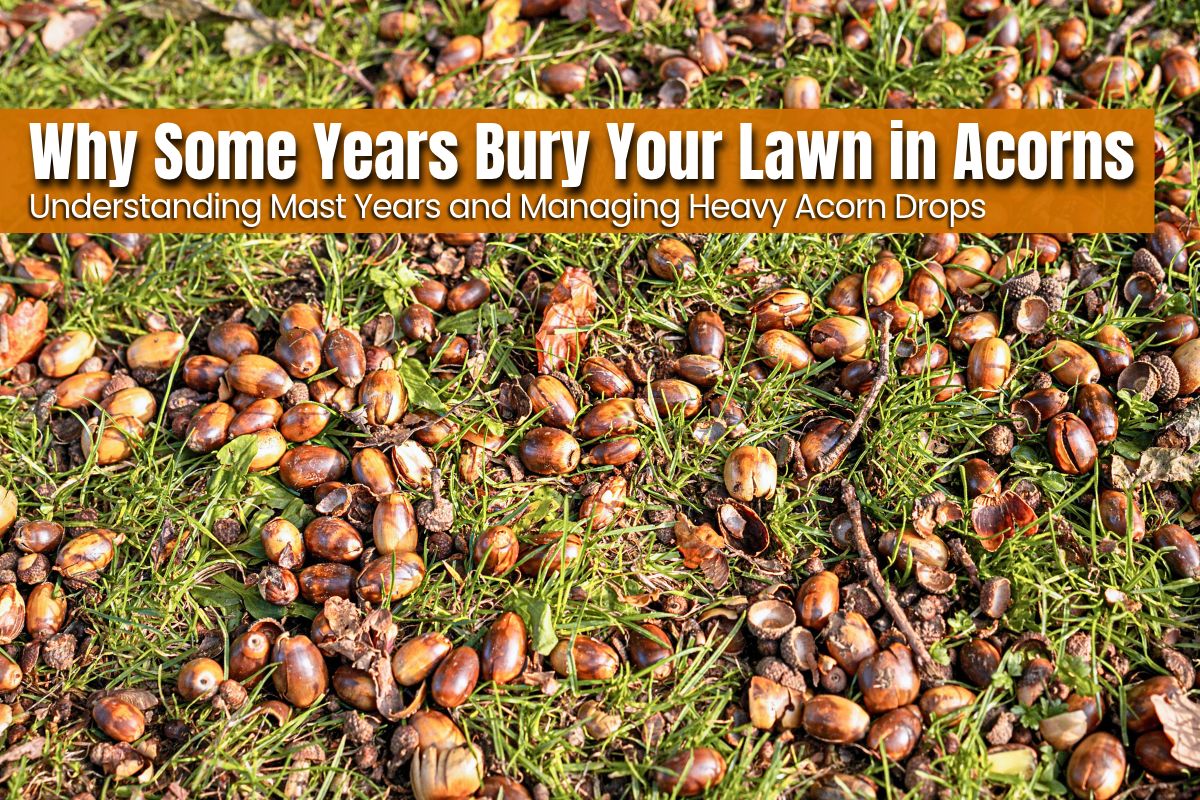
Acorns and your lawn can usually coexist. But in some years, oaks drop so many acorns that mowing gets harder and seedlings may sprout.
We’ll explain why some years bury your lawn in acorns (the reason is masting) and how to safely clear them. If the cleanup drives you nuts, local leaf removal pros can clear acorns and fallen leaves for you.
What is masting?
Walt Koenig, research zoologist emeritus of the University of California, Berkeley, describes masting, or mast-fruiting behavior, as “the variable and synchronous production of seeds by a population of plants.”
For oaks, “variable” means acorn crops rise and fall from year to year. A year with an exceptionally large crop is called a mast year. Oaks have one roughly every 2 to 5 years, which is why your lawn may be buried one fall and nearly bare the next.
“Synchronous” means masting happens across a plant population over a wide area, not just in one tree or group of trees.
Fun Fact: A single large oak can drop up to 10,000 acorns in a mast year.
What triggers oak trees to drop acorns all at once?
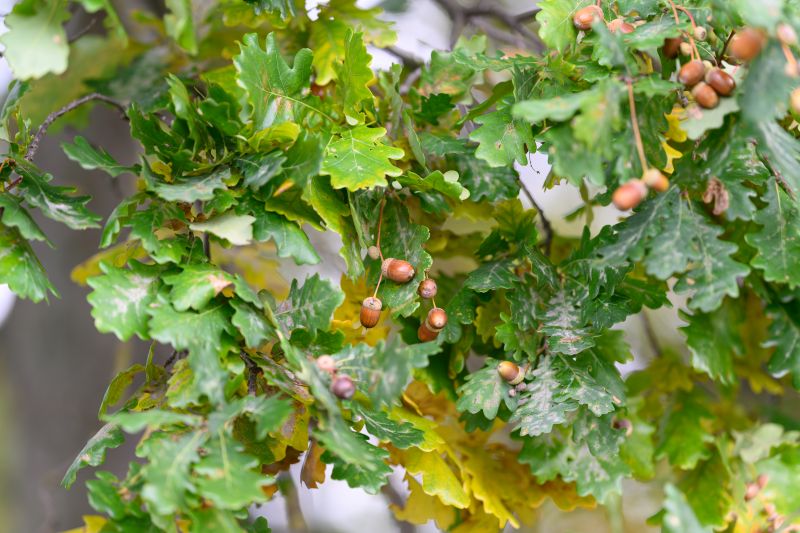
“We don’t fully understand masting or what causes it,” says Theresa Crimmins, director of the USA National Phenology Network. “But what we have ascertained is that weather plays an important role.”
Koenig agrees. “Most evidence supports environmental factors — temperature or rainfall during critical periods of seed development — as a key mechanism driving masting behavior.”
In an 18-year study, Koenig and Johannes M.H. Knops tracked acorn production in two California oak species at sites up to about 460 miles apart. Their results strongly supported shared environmental conditions as a key reason the two species’ acorn crops rose and fell together.
“There is, however, an important role for pollination also, particularly in synchronizing reproductive effort among wind pollinated trees such as oaks, among which masting is particularly prevalent,” Koenig says.
Why do mast years occur?

Scientists don’t know exactly why masting occurs. Two leading hypotheses are predator satiation and pollination efficiency.
Predator satiation
The idea is that if oaks produced the same number of acorns each year, populations of acorn eaters, such as squirrels, chipmunks, and deer, would grow until they could eat most of the crop, leaving only a few acorns to grow into new trees.
Masting may solve this problem by making acorn production irregular. In lean years, oaks produce few acorns, which keeps predator populations small. In a mast year, oaks produce far more acorns than those smaller populations can eat, so more survive to sprout.
Crimmins explains there’s an evolutionary benefit to oaks producing abundant acorns in the same year.
“If every so often, they all generate far more fruits than is typical, seed predators become overwhelmed and at least some of the fruits are left alone and are able to germinate into the next generation of trees.”
Pollination efficiency
As Koenig notes, pollination helps keep oaks in sync. That timing may also pay off. Oaks rely on wind to carry pollen from tree to tree, and according to a 2002 review of masting research, flowering heavily in the same years may improve pollination in wind-pollinated plants.
In a 2020 study of holm oaks, trees that flowered in sync with their neighbors produced about twice as many acorns as trees that flowered out of sync.
Why your yard may have more acorns than your neighbor’s
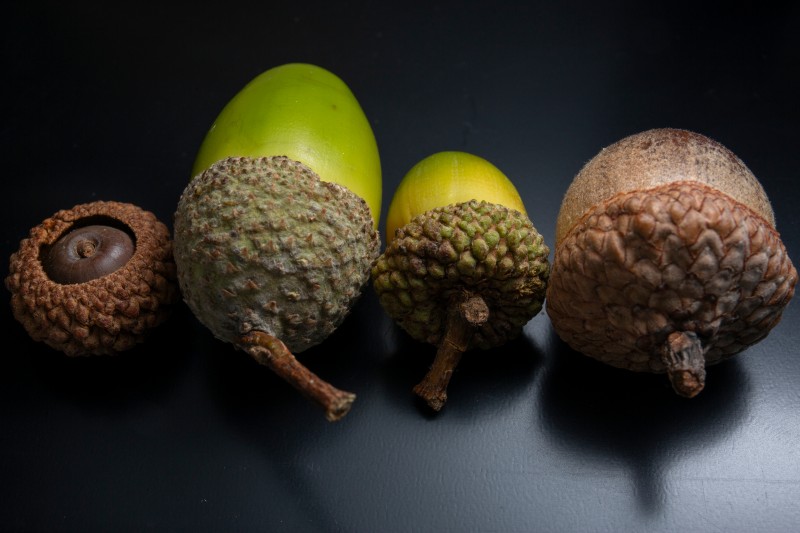
“Although masting behavior can be synchronous over large geographic areas, the factors correlating with mast years differ among species, and thus the conditions resulting in a large acorn crop in one place may not affect acorn production in another where the oak species differ,” Koenig says.
- Oak group matters: Trees in the white oak family tend to produce more and larger acorns than trees in the red oak family.
- Cycles vary by species: The gap between mast years can vary from one oak species to another, and from year to year.
- The same year can be big for one oak and small for another: Virginia’s 2026 acorn survey found white oak production above average and red oak production below average in the same season.
- Individual trees differ: Koenig notes that “Although most trees of the same species may have a good crop in a mast year, a ‘good’ crop for many individuals may only be a small number of acorns.”
Not sure which oak you have? Your local extension office can identify it.
What acorns do to your lawn
A light scattering of acorns usually won’t harm your lawn. According to the Nebraska Statewide Arboretum, squirrels and other wildlife usually collect them before they become a problem.
In a mast year, though, too many acorns can cause problems:
- Acorns may hurt your mower: The Nebraska Statewide Arboretum notes that a lawn mower can break down a few small acorns, such as those from red oaks. Larger acorns, like bur oak acorns, are more likely to damage your mower.
- Thick piles can smother grass: Like fallen leaves, a thick layer of acorns can block sunlight and oxygen from turfgrass.
- Seedlings can sprout: White oak acorns tend to sprout in fall soon after dropping, while red oak acorns usually wait until the following spring, according to UConn Extension.
- Mast years attract more wildlife: A heavy acorn year can bring more squirrels digging in your lawn and raiding your bird feeders, plus more deer, which can eat your plants and carry ticks.
- Acorns can affect seeding: If you’re seeding or overseeding, keep new-seed areas clear of acorns during heavy drops.
How to clear acorns from the lawn
- Wear closed-toe, grippy shoes: Acorns underfoot can be slippery on pavement and decks.
- Rake, blow, or sweep: Gently rake the lawn or use a lawn sweeper or lawn vacuum, and use a leaf blower on hard surfaces. For heavy drops or acorns nestled in grass, a nut gatherer can collect large numbers quickly.
- Clear dense acorn patches before mowing: Acorns can dull mower blades or become dangerous projectiles. A lawn mower (or mulching mower) can break down a few scattered small acorns, but mowing over them regularly is hard on your equipment.
- Expect more than one pass. Acorns keep falling throughout fall and early winter.
- Keep up with leaves too: Acorns and fallen leaves tend to arrive together. See How to Clean Up Wet Leaves in Your Yard and What to Expect from a Leaf Removal Service.
How to dispose of acorns
Here are 4 ways to dispose of gathered acorns:
- Compost them: Crush the acorns before adding them to the compost, otherwise they may sprout.
- Leave them for wildlife: If you don’t mind visiting squirrels and deer, pile them at the edge of your property, away from the house and bird feeders.
- Donate them: Local farmers who raise animals that can safely eat acorns, such as pigs, may be able to use them.
- Toss them in yard waste: Check whether local waste management accepts acorns in yard-waste bins.
How to remove oak seedlings
If oak seedlings sprout in the lawn, regular mowing usually keeps them from establishing. If they’re growing in your garden beds, pull them early before they’re hard to remove.
Will the next year be quiet?
Often, yes, though acorn crops are hard to predict.
“The most general finding is that when trees invest a lot in acorn production, it depletes their resources and they tend to produce few acorns the next year,” Koenig says.
“Beyond that, it’s difficult to predict acorn crops, especially since a majority of years are intermediate and neither notable ‘bust’ or ‘boom’ years.”
FAQs
“There’s no quantitative definition of what constitutes a mast year,” Crimmins says. “It is more like — when you see an awful lot of acorns or seeds on the ground, when you feel like you are walking on marbles — that is a mast year.”
“Nature’s Notebook is a great way for homeowners to document what they are seeing,” Crimmins says. Observers can log whether acorns are ripening and dropping, and how many they see.
“This is highly variable by location and by species,” Crimmins says. “Generally, peak acorn drop occurs between late August and mid October.”
It may be.
“Some models predict little or no effect of climate change, but several recent studies have found significant decreases in both annual variability and synchrony in seed production by some species due apparently to rising temperatures,” Koenig says.
In other words, some trees may be producing more similar crops from year to year and masting less in unison. Koenig notes this could weaken the benefits that likely make masting worthwhile, such as producing more acorns than wildlife can eat and improving pollination, with potentially major effects on forests.
“What we can say is that the impacts of climate change are likely to vary by species,” Crimmins says.
According to Texas A&M’s College of Veterinary Medicine, acorns aren’t usually toxic to dogs, though a few cases have been linked to liver or kidney damage.
Serious illness is uncommon, since most dogs would need to eat a large amount to get sick. But even one or two acorns can upset some dogs’ stomachs and cause vomiting or diarrhea.
Acorns can also make a dog choke, block its digestive tract, or damage its teeth. If your dog picks up an acorn, gently remove it if you can do so safely and call your vet if problems develop.
Hire a local lawn care pro
Removing fall acorns and leaves takes sweat and energy, the right equipment, and time you may not have. If you’d rather hand it off, Lawn Love makes it simple: Get an instant quote, pick a time, and a vetted local pro will handle the rest.
Main Image: Fallen acorns and autumn leaves cover a grassy lawn. Photo Credit: Waldemar / Adobe Stock
Related Posts: