| Key Takeaways |
|---|
| • Most homeowners only need 2 or 3 tools: The right combination depends on yard size, budget, and how much time someone wants to spend, not on owning every tool on the list. • Leaf vacuums double as compost makers: These 3-in-1 tools blow, vacuum, and mulch leaves into a compact bag, shredding them down for use as garden compost instead of curbside trash. • Tow-behind sweepers suit 1 to 3 acres: These brush-powered collectors hook up to a riding mower and hold 20 to 25 cubic feet of leaves, making them ideal for larger properties where raking by hand isn't practical. |

Fall cleanup is easier on your schedule and your back with the right leaf collection tools. From budget-friendly rakes and tarps to powerful vacuum systems and riding mower attachments, the right combination depends on your yard size, budget, and how much time you want to spend.
Most homeowners need only two or three of these 12 tools for leaf cleanup. Pick the ones that work best for you — and that will fit in your shed or garage.
Once you’ve gathered your leaves, decide what to do with them — our guide on “What to Do With Fall Leaves on Your Lawn” covers whether to compost, mulch, or bag them. Or hire a Lawn Love pro for leaf removal and spare your back entirely.
- Which leaf tool fits your yard size and budget?
- 1. Ergonomic leaf rake ($15-$60)
- 2. Leaf scoops ($25-$35)
- 3. Heavy-duty tarp ($20-$80)
- 4. Leaf chute ($15-$45)
- 5. Leaf blower ($50-$600)
- 6. Leaf vacuum ($100-$500)
- 7. Mulching mower ($300-$4,000)
- 8. Tow-behind leaf sweeper ($300-$800)
- 9. Mower bagging attachment ($800-$1,500)
- 11. Utility cart ($200-$500)
- 12. Push lawn sweeper ($150-$400)
- FAQs
Which leaf tool fits your yard size and budget?
The best tools for leaf removal depend on your yard size: hand tools for small lots, power and tow-behind gear for big ones. Most homeowners need only 2 or 3 of these 12 and there are tools for every budget.
For small to medium lots, a rake, leaf scoops, and a tarp handle the job, and a complete kit often costs under $100. Medium yards benefit from adding a leaf blower or mulching mower.
For large acreage of 1 to 3 acres, tow-behind sweepers, bagging attachments, or a walk-behind leaf vacuum do the heavy lifting, especially if you own a riding or zero-turn mower.
Use the table below to match tools to your lot, then read each section for details to determine the right tool for you.
| Tool | Price range | Best for |
|---|---|---|
| Ergonomic leaf rake | $15-$60 | Small yards, manual |
| Leaf scoops | $25-$35 | Any yard, manual |
| Heavy-duty tarp | $20-$80 | Any yard, manual |
| Leaf chute | $15-$45 | Any yard, manual |
| Leaf blower | $50-$600 | Small to large, powered |
| Leaf vacuum | $100-$500 | Medium to large, powered |
| Mulching mower | $300-$4,000 | Medium to large, powered |
| Tow-behind leaf sweeper | $300-$800 | 1-3 acres, riding mower |
| Mower bagging attachment | $800-$1,500 | Large, riding mower |
| Utility cart | $200-$500 | Large, riding mower |
| Push lawn sweeper | $150-$400 | Small to medium, manual |
| Complete small-yard kit | Under $100 | Small yards, manual |
1. Ergonomic leaf rake ($15-$60)
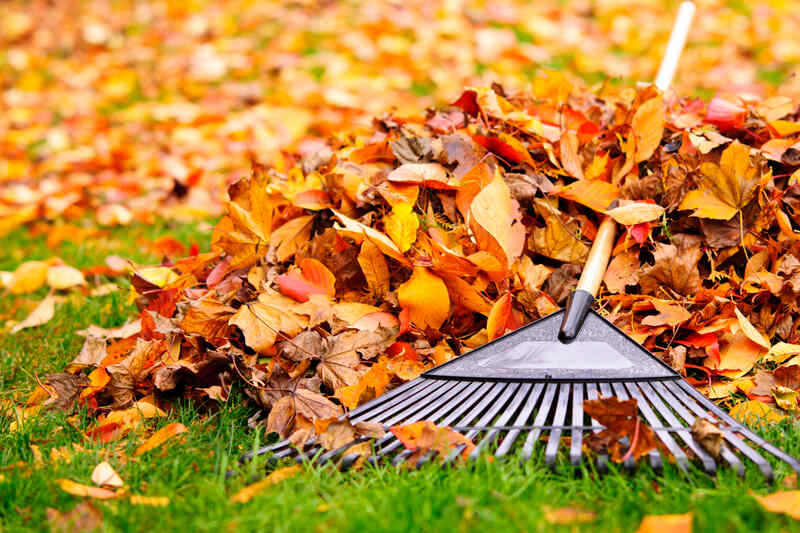
A good rake isn’t your grandpa’s metal-tined torture device anymore. Today’s designs feature adjustable handles (54 – 66 inches), lightweight aluminum or fiberglass construction, 24 – 30 flexible tines, and cushioned grips to prevent blisters.
These rakes work best for small to medium yards, precision work around plants, and tight spaces between garden beds where power tools can’t reach effectively.
Read more:
How to Choose the Right Rake for Leaf Removal (and More)
2. Leaf scoops ($25-$35)

Basically, giant bear claws for your hands. They feel ridiculous at first, but they let you grab a huge armful of leaves at once.
- Faster bagging: They speed up the bagging process and cut down how often you bend over.
- Wet or dry: They work well with both dry and damp leaves.
- Budget-friendly: Quality pairs cost on average under $30.
They’re perfect for moving piles into bags and working around obstacles, and they reduce the strain on your back.
3. Heavy-duty tarp ($20-$80)

Use tarps to drag piles of leaves where you want them without making a dozen trips that’ll have you questioning your life choices. You can haul hundreds of pounds of leaves easily. Make handles with wooden dowels to make picking up and maneuvering the tarp easier.
4. Leaf chute ($15-$45)
These funnel-shaped devices hold the bags open, preventing the leaf explosion that happens when you stuff leaves into a bag. They’re especially useful when you’re working alone or in the wind.
- Standard fit: They fit standard lawn and leaf bags.
- Adjustable height: Many adjust for comfortable, back-friendly work.
Choose from basic plastic funnels, adjustable stands that save your back, or heavy-duty clamping models that keep bags secure on windy days.
5. Leaf blower ($50-$600)

From handheld electric units to powerful backpack blowers, you have plenty of options to match your leaf removal needs and budget.
- Handheld electric: Works well for under 1/2 acre.
- Battery-powered: Adds mobility for medium-sized yards.
- Gas backpack: Handles heavy leaves across large spaces.
They’re best for moving leaves to collection areas, blowing grass clippings off patios, and clearing soft snow off driveways and sidewalks.
Shawn Banks, county extension director and horticulture agent at North Carolina State University, says yard size is the main factor on deciding between battery-powered units and gas blowers.
“A battery-powered blower should have enough charge in the battery to blow off most areas in that size of a yard without running out of power. However, in areas where the average lot is an acre or more, a battery-powered blower will likely run out of power a couple of times before the job is completed,” Banks says.
“If there isn’t a second or third battery to swap out in the case of the larger yard, then the gas-powered equipment will likely be the better choice as the tank can be refilled and the machine started back up without waiting for the battery to charge.”
Gas backpack blowers deliver the most power, but they also give off smog-forming pollution, so many homeowners choose battery or corded electric models.
Read more:
6. Leaf vacuum ($100-$500)

These 3-in-1 powerhouses blow, vacuum, and mulch leaves into a compact collection bag, eliminating most bagging headaches while creating valuable compost material. They shred leaves down to a fraction of their original volume, turning yard waste into garden gold instead of curbside trash.
These work great for medium to large yards. They’re perfect if you like to compost or if your yard has different types of waste like leaves, twigs, small branches, pine needles, and seeds.
Composting those mulched leaves pays off, too. As gardening writer Jo Ellen Meyers Sharp of The Hoosier Gardener in Indianapolis notes, you’re “keeping leaves out of the waste stream.”
Yard trimmings such as leaves make up about 12.1% of the municipal solid waste Americans generate, so composting keeps that material out of the trash.
7. Mulching mower ($300-$4,000)

Lawn mowers with specialized blades that shred leaves into tiny pieces, creating natural fertilizer for your lawn. If you’re not ready to trade in your old trusty mower, mulching kits can transform it into a leaf-chomping machine. They perform best when leaves are dry.
According to the University of Connecticut, “no more than 20% of the turfgrass lawn should be covered by tree leaves after each mulching event” to prevent blocking sunlight and limiting grass growth. So, it’s best to mulch leaves often during fall instead of waiting until your lawn is completely covered.
Banks says if you’re trying to decide between a leaf vacuum or mulching mower, consider the size of the yard and volume of leaves.
“For larger areas a mower with a bag attachment to catch the leaves is probably the better investment,” he says.
Read more:
8. Tow-behind leaf sweeper ($300-$800)

These brush-powered collectors hook up to your riding mower and do the heavy lifting while you cruise around your property. Models range 42-52 inches wide with hoppers that hold 20-25 cubic feet of leaves before you need to dump. They work on wet or dry leaves.
Perfect for homeowners with riding or zero-turn mowers and 1-3 acres who’d rather not spend their weekend making endless trips with a rake.
“If the leaves are going to be dumped into the woods or used as a mulch to suppress weeds in a bed, then the tow-behind sweeper may be the better option,” Banks says. “The mower can be driven over to the area where the leaves need to be dropped and, in most cases, a lever or rope can be pulled to dump the leaves out of the sweeper where they can be spread over the area.”
9. Mower bagging attachment ($800-$1,500)

The most common mower attachment, baggers collect grass clippings and leaves as you mow. They are available in 6-bushel twin or 9-bushel triple configurations to match your lawn size. They’re pricier but let you mow and collect in one efficient pass.
They’re ideal for owners of compatible riding mowers or zero-turns who want maximum efficiency.
Banks says baggers are great if you have a compost pile in your backyard.
“If the leaves are going to be used in a compost pile, a bagger attachment may be the way to go. The bagger attachment will allow the mower blades to chop the leaves up into smaller pieces for faster decomposition,” he says.
11. Utility cart ($200-$500)
Utility carts are large dump carts that trail behind your riding mower. Load them up with raked or blown leaf piles, then dump with a foot pedal. They hold 10-25 cubic feet and can handle 300-800 pounds of debris. They’re the budget-friendly option.
Great for homeowners who want to move serious quantities of leaves or other yard debris at a time.
12. Push lawn sweeper ($150-$400)
This is the manual option that works like a push mower but collects instead of cuts. These rotating-brush units are quiet and need no fuel. They’re slower than powered options but perfect for detail work around flower beds and tight spaces.
Perfect for eco-conscious homeowners or anyone who doesn’t want to start a fight with their neighbors on a Saturday morning.
Read more: Benefits of Fall Yard Cleanup
FAQs
Late morning, once the dew dries, or the afternoon when it’s warmer. Pick up leaves when they’re dry if you can, since they’re lighter and easier on your tools. Dress in layers and take breaks to spare your back and arms.
That’s not a good idea. A shop vac isn’t built for the outdoors, so you’ll end up with clogs, possible motor damage, and a lot of frustration. Leaf vacuums have stronger suction and bigger capacity designed for exactly this job.
For occasional use, a corded or battery electric blower is usually the better value since it needs no fuel, less maintenance, and stores easily. Gas models make sense only if you have a large property or run the tool for long stretches.
Stop dreading fall cleanup
The right leaf collection setup doesn’t have to break your back or your budget. Whether you’re dealing with a suburban postage stamp or several acres of leaf-dropping trees, there’s a combination of tools that’ll work for your situation and your wallet.
If you have a small to medium yard, a rake, leaf scoops, and a tarp will do the trick. For bigger areas, a leaf blower or mulching mower comes in handy. And if you’ve got a really large property with tons of leaves, you might want to look into tow-behind sweepers and bagger attachments.
If you’d rather trade your rake for the remote, contact Lawn Love to connect with local lawn care pros who can handle leaf removal, bush trimming, and even lawn mowing, so you can get out of the cold and back to whatever you really want to do.
Read more:
- How to Winterize Your Lawn
- How to Protect Your Lawn From Winter Damage
- How to Repair Winter Damage in Your Lawn
Main Image: Leaf blower. Photo Credit: Sergey + Marina / Adobe Stock
Related Posts:


