| Key Takeaways |
|---|
| • Grass spiders are harmless to people in nearly all cases and help control insect populations. • They build flat, sheet-like webs with a funnel at one end for hiding that are most visible when wet. • Removing shelter and food through regular mowing, dethatching, and clearing yard clutter is the best prevention. |

Those funnel-shaped webs strung low across your lawn on a dewy morning are made by grass spiders, and they’re not dangerous.
Grass spiders show up because your yard offers tall grass or dense plantings to anchor a web, and insects to eat. A few are harmless and even helpful, but a heavy population can make your yard look messy.
A well-maintained lawn keeps their numbers down, and Lawn Love’s lawn care pros can help if things get out of hand.
What is a grass spider?
Grass spiders are funnel-weaving spiders in the genus Agelenopsis. The Missouri Department of Conservation notes that 14 species live in North America, ranging from Canada to Mexico across every U.S. state. They’re especially common in the Western U.S.
When someone says “I have spiders in my lawn,” they are usually talking about a grass spider.
Quick facts:
- Scientific name: Agelenopsis spp.
- Family: Agelenidae (funnel-web weavers)
- Body length: about 10–20 mm (0.4–0.8 in); females larger
- Appearance: brownish-yellow with dark longitudinal stripes down the back and head
- Lifespan: about 1 year
- Behavior: incredibly fast — darts out of the funnel the moment an insect lands on the web
- Webs: large, flat sheet webs that narrow into a funnel tunnel where the spider hides
- Safety: venomous like nearly all spiders, but harmless to humans and rarely bites unless severely mishandled
What does a grass spider look like?
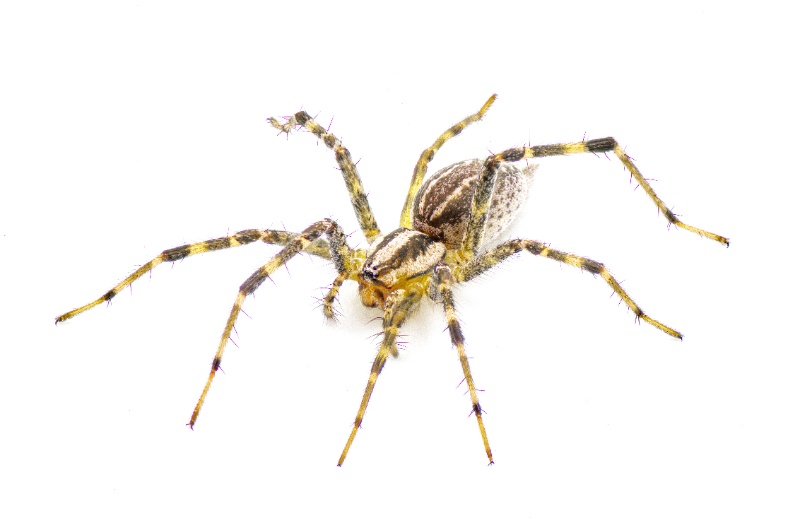
Grass spiders are medium-sized, typically the size of a quarter when their legs are spread. Females are generally larger than males. They are brownish-yellow, with 2 dark stripes running lengthwise down the head region and chevron (V-shaped) markings on the abdomen.
Key features:
- Color: tan to brownish-yellow
- Stripes: 2 dark bands on the cephalothorax (head/chest); chevrons on the abdomen
- Legs: long, slender, lightly haired
- Spinnerets: a pair of prominent spinnerets at the rear that look like short tails
- Eyes: 8 eyes in 3 rows (2, 4, 2)
The protruding spinnerets are the easiest way to identify a grass spider. Individual species within Agelenopsis, however, are nearly impossible to distinguish with the naked eye. Experts rely on microscopes to examine fine anatomical details for species-level identification.
The grass spider web
In many cases, homeowners notice the unique web before they see grass spiders.
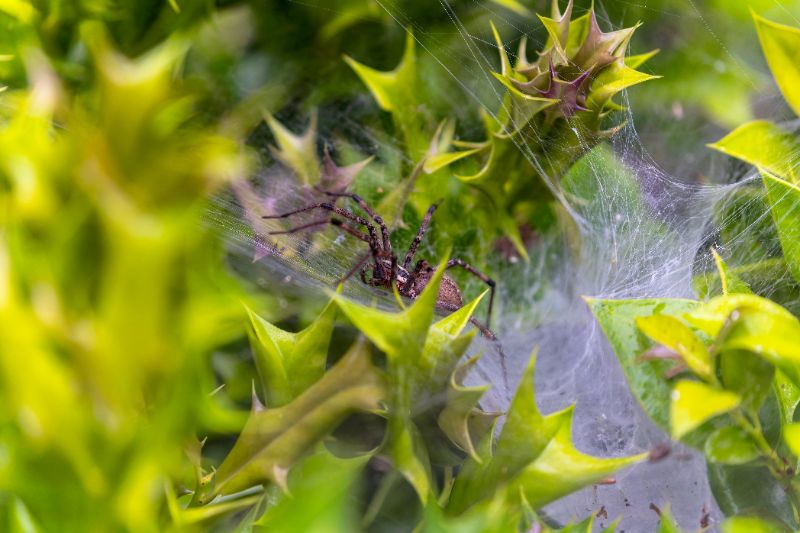
Penn State Extension describes the grass spider web as a flat, horizontal sheet of non-sticky silk that funnels into a tube where the spider hides. Sheets can reach up to 3 feet wide, with a funnel over a foot long, according to the Missouri Department of Conservation.
When an insect lands on the sheet, the spider feels the vibration and rushes out. The web itself doesn’t trap prey since insects can walk right off of it. It’s the spider’s speed that does.
Webs are most visible at dawn, when dew highlights the silk, or just after watering your lawn. Once dry, they nearly vanish.
Are grass spiders dangerous?
Grass spiders are technically venomous, but that is not the same as being dangerous to people. Like nearly all spiders, they use venom to subdue insect prey, not as a defense against humans. They are not poisonous, though. They are not harmful to touch or eat.
Bites are rare. Grass spiders flee rather than fight and usually only bite when trapped against skin. According to Penn State Extension, symptoms are typically minor:
- Slight redness, swelling, or itching
- Mild pain that fades within 1 to 10 days
One exception worth noting: A. aperta, a desert species found in the Southwest, has a rare report of a stronger reaction.
Grass spider vs. wolf spider vs. hobo spider
| Grass spider | Wolf spider | Hobo spider | |
| Web | Funnel sheet web | None (active hunter) | Funnel web |
| Body length | 0.4-0.8 in. | 0.25-1.5 in. | 0.3-0.6 in. |
| Leg span | Up to 1.5 in. | 2-4 in. | 2-3 in. |
| Spinnerets | Prominent | Not prominent | Visible |
| Abdomen | Chevrons | Center stripe | Herringbone |
| Bite risk | Very low | Low | Low |
| Dangerous? | No | No | Disputed |
| Range | North America | North America | Pacific Northwest |
Quickest tip: A funnel web near the ground means a grass spider or hobo spider, not a wolf spider, which builds no web.
Where grass spiders live and what attracts them
Grass spiders set up wherever they can anchor a web and find insects. That combination of structural anchor points and abundant prey is what draws them to yards and homes.
- Unmowed or tall grass: their main habitat, offering web anchors and insects
- Dense ground cover: ivy, pachysandra, and ornamental grasses provide shelter and hunting ground
- Low shrubs and hedges: ideal for stringing sheet webs between stems and branches
- Brush piles, leaf litter, and wood stacks: good habitat for both spider and insect prey
- Foundation plantings and window wells: sheltered spots close to structures where insects gather
- Exterior lights: light attracts insects at night
Males hunting for mates in late summer and fall may occasionally wander indoors. They don’t thrive inside, so their visits are brief.
Life cycle and seasonality
Knowing their pattern tells you when to expect them.
| What’s happening | |
| Spring | Egg sacs from last fall hatch; spiderlings begin building tiny funnel webs |
| Summer | Spiders molt and grow; peak web-building season |
| Late summer/Early fall | Adults mature; males roam for mates; females lay egg sacs in dense cover |
| Fall/winter | Adults die at first frost; egg sacs overwinter |
Peak visibility is August and September, when adults are largest, and webs are everywhere.
Are grass spiders beneficial?
Before you reach for the bug spray, understand grass spiders are worth keeping around. They eat lawn and garden pests, including aphids, leafhoppers, fungus gnats, and ants.
If numbers climb, try to manage them without wiping them out. A few dewy-morning webs are normal; a yard blanketed in webs means the habitat needs attention.
My experience: I’ve had grass spiders in my lawn as long as I can remember. When numbers are low, I don’t think twice about them. However, when I see them all over, I know I need to look at my yard and figure out the cause.
How to get rid of grass spiders
The best long-term fix is removing what draws spiders to your yard.
Keep your lawn maintained
Tall, dense grass is prime habitat for grass spiders. Mowing your grass regularly and dethatching your lawn as needed removes the conditions they need to build webs.
My experience: Grass spiders are a key sign for me that I’m getting a significant thatch buildup in my lawn. I notice a significant decrease in them as soon as I dethatch my lawn.
Remove shelter and food sources
Beyond the lawn, trim bushes, shrubs, and ground cover and clear brush piles, leaf litter, and wood stacks from your property. Clean up BBQ crumbs and pet food too, since they attract the insects spiders feed on.
Knock down webs
Sweep or hose away webs as you find them. It won’t kill the spiders, but it discourages re-webbing in the same spot.
My experience: I’ve found you need to knock down a web a couple of times before the spider will move to a new spot. I recently had one building its web at the edge of my daylily patch. I hosed it away 3 times before the spider moved on.
Reduce exterior lighting near doors
Nighttime lights attract insects, which attract spiders. Switch to yellow bulbs to deter insects or move lights away from entries to keep spiders from coming inside.
Try natural options
Food-grade diatomaceous earth is a good organic pest control option. It is non-toxic (if ingested) and can be applied outdoors around foundations to create a barrier. Avoid areas where kids and pets play or where they can breathe in dust.
Essential oil sprays are popular but have mixed results. Peppermint oil sprays have some research supporting their use as a spider deterrent, though studies are limited and don’t include funnel-web species. Citrus oils have less evidence behind them.
Pesticides (last resort)
Pyrethroid and pyrethin sprays are effective at reducing spider activity and are commonly used in home defense products. However, they are broad-spectrum sprays, meaning they harm pollinators too.
If you must use a chemical spray, apply it as a narrow band targeting the foundation or perimeter barriers rather than a lawn-wide treatment. Consider hiring a pro for more precise application.
Do you need a pro?
Call a lawn or pest professional when:
- Webs cover large areas and don’t respond to habitat cleanup
- You’re finding spiders indoors regularly
- You’re unsure whether it’s a grass spider or something more dangerous
They can identify what’s attracting spiders and treat the problem at its source.
FAQs
Most household pyrethrin or pyrethroid sprays paralyze and kill insects on contact. They are broad-spectrum, though, so they will harm any bug they touch.
Yes, grass spiders are a type of funnel web spider. The name “funnel weaver” refers to the distinctive funnel-shaped web they build. You may also hear them called sheet web spiders or ground spiders.
Grass spiders are not dangerous to pets. Their venom is designed for insects, not mammals, and a bite is unlikely to cause more than minor, temporary irritation. Watch for signs of an allergic reaction, but serious reactions are rare.
A tidy lawn is the best defense
A few grass spiders are nothing to worry about, but if webs are taking over, the fix is a tidier yard. Hand lawn care off to Lawn Love and a vetted local pro will mow, trim, and clear the habitat that attracts spiders.
Get a free estimate near you →
Main Image: A grass spider waits in its funnel web among dewy grass blades. Photo Credit: Samuel / Adobe Stock
Related Posts: