| Key Takeaways |
|---|
| Mow until growth stops. Stop mowing cool-season lawns by November, and stop mowing warm-season lawns when they stop growing. |
| Mulch leaves thin or bag them. Remove thick leaves off your lawn to prevent diseases and pests. |
| Apply a fall fertilizer. It helps roots recover from summer heat and protects your lawn from harsh winter weather. |

Fall is one of the most important times of year for your lawn. The work you do now, from the last mow to the final fertilizer, sets up a healthy, vibrant lawn come spring.
Proper fall lawn care prepares your grass to survive winter dormancy and bounce back strong when warm weather returns. Every fall lawn care task below is timed by soil temperature and grass type, so tasks differ between cool-season and warm-season grass.
This guide covers when to stop mowing and watering, how to handle falling leaves, fall weed control, aeration and overseeding, and fertilizing for winter. If you’d rather not spend your weekends on it, a local Lawn Love lawn mowing pro can take these chores off your hands.
Continue mowing until the grass stops growing


Stop mowing once the grass stops growing. For cool-season lawns, that’s usually October or November, or when soil temperatures drop to about 40 degrees. Warm-season grass simply tells you when it’s done: it stops growing.
It’s tempting to let the grass go uncut over winter, but overgrown grass mats down and invites fungal diseases. Mowing until growth stops also cuts down on winter damage and pests, too.
Don’t cut that last mow too short, though. P. Agustin Boeri, turfgrass specialist at the Texas A&M AgriLife Research and Extension Center in Dallas, warns that scalping the lawn backfires.
“If the turfgrass is cut too short, it may not recover, which increases the risk of winter kill and creates open spaces where winter weeds can germinate,” he says.
How short is safe? Stick to your normal mowing height for the final cut, right around 2 to 3 inches for most grasses.
A little extra length protects the crown through the cold. Crown refers to the base of the grass plant at the soil line where new growth emerges. Protecting it is what lets the lawn regrow in spring.
Read more: Last Mow of the Season
Adjust lawn watering
Stop watering your lawn in fall once temperatures drop. For cool-season grass, that means when daytime highs stay below 40 degrees and nights fall into the low 30s. For warm-season grass, stop once daytime highs drop below 50 degrees.
Grass still needs water in fall to build a strong root system for winter. But once temperatures dip below freezing, especially if the ground freezes, watering does more harm than good:
- When water hits frozen ground, it turns to ice, which expands and damages the grass roots.
- A layer of ice damages the blades and blocks the soil from absorbing moisture, leaving you with mud once it melts.
- Both cool- and warm-season grass go dormant in winter, and overwatering dormant grass invites fungal disease.
Read more: When to Stop Watering Your Lawn
Manage falling leaves

Here’s how to handle heavy leaf buildup without smothering the grass — mulch it thin enough to blend into the canopy or bag it once cover gets deep. Mulch a light layer with a rotary mower, which chops leaves into fertilizer.
A heavy blanket blocks sunlight and air, and decomposing leaves promote mold and fungus.
“Mulched leaves should blend into the turfgrass canopy,” Boeri says. “Leaving thick layers of mulched leaves on top of the turf can smother and kill it.”
In other words, if you can still see grass through the chopped leaves, you’re fine. If you see a mat of leaves, bag it.
Deal with leaves any time from September to December, depending on your climate and tree species, whenever the cover starts getting deep. For more on leaf handling, see what to do with fall leaves on your lawn and how to use a leaf blower.
Read more: 12 Tools to Use to Collect Autumn Leaves
Treat and control weeds
For fall weed control on both cool-season and warm-season grass, apply pre-emergent herbicides from late August to October, or whenever soil temperatures, not air temperatures, fall below 70 degrees.
Timing to the soil is what stops next spring’s weeds before they sprout.
Pawel Petelewicz, assistant professor of Turfgrass Weed Science at the University of Florida in Gainesville, Florida, says pre-emergent herbicides are key.
“From an herbicide standpoint, prevention is generally more important than reactive control; therefore, pre-emergence herbicides form the foundation of most weed management programs.”
In short, getting ahead of weeds now saves you a bigger battle come spring.
Make sure the herbicide is compatible with your grass type and formulated for the weeds you plan to target. If you’d rather skip chemicals entirely, hand-pulling and hoeing work well in fall too (see the FAQ below).
Note: If you’re battling crabgrass, skip the fall application. Crabgrass doesn’t develop until late spring or early summer, so apply between mid-March and May, or when soil temperatures hit 50 to 55 degrees.
Read more: What Are Pre-Emergent Herbicides?
Remove excess thatch
Dethatch cool-season grass between late August and early September. Dethatch warm-season grass in the spring.
A light layer of thatch isn’t a bad thing: That organic debris insulates the soil and conserves moisture. But too much thatch blocks water and fertilizer, plus creates a haven for pests and diseases.
Is your thatch too high? Use a trowel or spade to remove a plug of grass and soil. If the thatch layer is more than ½ inch, it’s time to act.
Be safe: Before using a power rake or vertical cutter, mark any sprinkler heads, water lines, and buried utility lines.
Read more: How to Dethatch Your Lawn
Aerate compacted soil
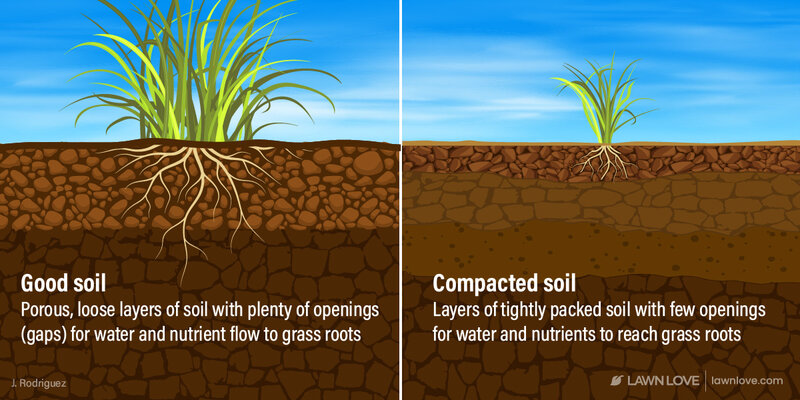
Aerate cool-season grass between mid-August and October, and warm-season grass from May to July. Compacted soil chokes off air, water, and nutrients, so the grass thins out and dies. Aeration pokes holes through the lawn so roots can breathe again.
Chelsea Morris of High-Class Grass in Virginia Beach, Virginia, says it is good to aerate your lawn regularly.
“A lot of properties have compacted soil, so I recommend aerating at least once a year.”
Not sure you need it? Run the screwdriver test. Push a screwdriver into the ground. If it slides in easily to the handle, you’re fine. If you meet resistance, it’s time to aerate.
Use a core (or plug) aerator, which pulls plugs of soil with hollow metal tubes, when the soil is moist — water the night before if needed, but not so much that the tubes clog.
If you’d rather hire out, check lawn aeration cost for current pricing, or rent a core aerator for a DIY session.
For those going the hired route, aeration is a task local pros handle routinely.
Read more:
Overseed thin spots
Overseed cool-season grass between mid-August and mid-September, or 45 days before the first hard frost. Overseed warm-season lawns for winter color between mid-October and early November. Either way, aim for soil temperatures in the 50 to 65-degree range.
For cool-season lawns, overseeding fills thin spots and crowds out weeds; keep the seedbed moist with light daily watering.
For warm-season lawns, overseeding with cool-season grass adds winter color. Boeri says it’s a common practice on sports fields and golf courses for Bermudagrass to be mixed with perennial ryegrass for its thick growth and deep color.
Overseeding is one of the most affordable ways to thicken a lawn. Lawn seeding costs between $0.07 and $0.23 per square foot.
Good seed-to-soil contact is essential, but go easy.
“Scalping the Bermudagrass to its lowest recommended height is a widely used method to create a good seeding surface,” Boeri says, “but (it) can stress warm-season grasses if done late in the season.”
Read more:
Fertilize for strong roots

Apply fall fertilizer to cool-season grasses between September and November, and to warm-season grasses between August and mid-September, no later than the end of September.
Use a complete, high-nitrogen and high-potassium fertilizer, guided by a soil test. A fall feeding helps grasses keep healthy roots and store energy to get through winter.
Timing matters, though. As Alec Kowalewski, PhD of Oregon State University in Corvallis, Oregon, says you want to make sure your grass isn’t stressed, is actively growing and well-watered.
“For cool-season turfgrass, don’t apply fertilizer during periods of drought stress.”
- For cool-season grass, use a complete fertilizer with a high ratio of both nitrogen and potassium.
- For warm-season grass, Boeri recommends 0.5 to 1 lb. of nitrogen per 1,000 square feet, with the soil test guiding the rate for other nutrients.
- Don’t fertilize before a heavy rain, which can wash fertilizer off your lawn and into storm drains. Instead, give the grass a light watering to help it soak in.
If you don’t want to deal with timing and rates, you can always leave the job to a lawn treatment pro.
Read more: When to Apply Fall Fertilizer to Your Lawn
FAQs
No, leave them in place. They break down within a couple of weeks and return nutrients and organic matter to the soil as they decompose.
Hand-pull weeds after a rain, use a hoe for seedlings and a dandelion puller for taproots, and reserve boiling water for cracks in the driveway or patio, since it kills any plant it touches.
Usually not the best call. Combination products are convenient but limited. “The timing of your pre-emergent and your last fertilizer application may not align,” Boeri says. “It is also difficult to match the correct fertilizer and herbicide rates in a single product. “
Let a pro handle all your fall yard care
Fall chores add up fast, and there’s a short window to get them done before winter. Lawn Love can help. We’ll connect you with local pros who handle mowing, aeration, overseeding, and leaf removal, all backed by our satisfaction guarantee.
Main Image Credit: Use a leaf blower with a bag. Photo Credit: Saklakova / Adobe Stock
Related Posts: