| Key Takeaways |
|---|
| • St. Augustinegrass leads statewide: It’s the most widely planted lawn grass in Florida and the top warm-season pick for shade and salt. • Your region narrows the list: South Florida favors St. Augustinegrass, Bermudagrass, and Zoysiagrass, while bahiagrass and centipedegrass work best inland in Central and North Florida. • Bahiagrass is the low-input choice: It handles sandy soil and drought with little water or fertilizer, but it won’t form a dense, manicured lawn. |

The best grass for Florida lawns is St. Augustinegrass for most homes, followed by Zoysiagrass, Bermudagrass, bahiagrass, centipedegrass, and seashore paspalum. All 6 handle Florida’s heat, humidity, and sandy, salty soil.
The right pick depends on where you live, how much shade you have, and how much upkeep you want. We compare each Florida grass type by region, maintenance needs, pests, and pros and cons to help you choose with confidence.
Once your new lawn fills in, LawnLove’s local lawn mowing pros can keep it cut at the right height for your grass type all season long.
Florida grass types at a glance
St. Augustinegrass is the best all-around grass for Florida lawns, especially for yards with some shade or a coastal location. Each of the 6 main Florida grasses has a different strength, so compare them before you buy seed, sod, or plugs.
| Grass type | Best for | Main drawback |
| St. Augustinegrass | Shade, salt, and a lush look | Chinch bugs and no seed option |
| Zoysiagrass | Soft, dense turf that handles foot traffic | Slow to establish |
| Bermudagrass | Full sun, heavy traffic, and fast recovery | Poor shade tolerance |
| Bahiagrass | Sandy soil, drought, and low inputs | Open growth invites weeds |
| Centipedegrass | Low fertilizer and mowing needs | Low salt and traffic tolerance |
| Seashore paspalum | Coastal lawns with salty soil or water | Few herbicide options |
Best grass types for Florida lawns
These 6 warm-season grasses are the most common choices for Florida yards. Each one trades off shade tolerance, salt tolerance, and upkeep in a different way.
St. Augustinegrass
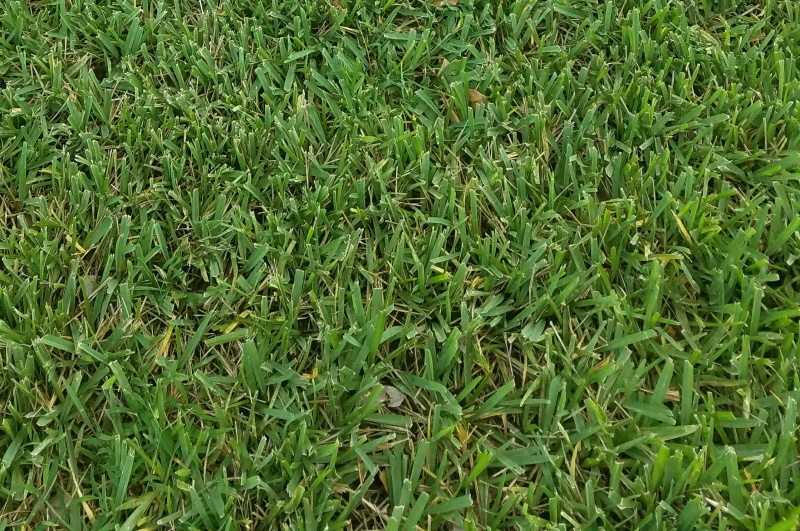
Native to the Gulf of Mexico coast, St. Augustinegrass is the most widely planted Florida lawn grass. It creates a dense, blue-green, coarse-textured lawn that establishes quickly from sod or plugs.
This heat-loving grass prefers mild winters and slows down in cool weather. It grows quickly but doesn’t tend to invade flower beds or gardens.
Pros:
Good shade tolerance, the best among warm-season grasses
High salt tolerance
Fast growth rate
Available as sod, sprigs, or plugs
Coarse, wide blades that form a thick turf
Crowds out most weeds
Cons:
Low cold tolerance
Susceptible to chinch bugs and fungal diseases
Not available as seed
Susceptible to thatch, especially if over-fertilized or overwatered
St. Augustinegrass cultivars for Florida: Floratam, Palmetto, and BitterBlue
Grass plug options:
Zoysiagrass

Native to eastern Asia, Zoysiagrass is a fine-bladed, dense, emerald turf used on home lawns, commercial properties, golf courses, and athletic fields.
It’s a slow-growing grass, which makes it low-maintenance and unlikely to invade gardens and flower beds. The trade-off is that it takes longer to establish.
Pros:
Soft to walk on
Crowds out most weeds on its own
Tolerates light shade
Good salt tolerance
Available in fine-bladed and wide-bladed varieties
Good traffic tolerance
Cold-tolerant
Drought-tolerant (may go brown but will survive)
Cons:
Slow grower
Slow to establish from plugs or seed, so we recommend sod
Goes brown during a drought
Slow to recover from damage
Seed is not recommended, so establishment can be costly
Thatch can be a problem, especially with too much nitrogen
Zoysiagrass cultivars for Florida: Empire, El Toro, and Zeon
Grass plug and seed options:
Zenith Zoysiagrass Seed (1/8 lb. of seeds)
Bermudagrass

Bermudagrass is a fine-textured, medium- to dark-green, densely growing grass that thrives throughout Florida. It’s common on residential and commercial lawns as well as golf courses and athletic fields.
Because it grows quickly, Bermudagrass rarely sprouts weeds, and weeds usually signal a turf problem. However, that aggressive growth means it can invade gardens and flower beds.
Pros:
High foot traffic tolerance
Recovers from damage quickly
Deep roots
Drought-resistant
Grows quickly
Low to moderate water needs
Improved common Bermudagrass feels soft underfoot
Good salt tolerance
Dense turf
Cons:
Low shade tolerance
Low cold tolerance
Can spread aggressively into gardens, flower beds, or other lawns
Needs frequent mowing
Low insect tolerance
Tends to develop thatch
Bermudagrass cultivars for Florida: Celebration, Tifway 419, and Latitude 36
Grass seed options:
Scotts Turf Builder Bermudagrass (10-lb. bag)
Hancock Seed Co. Bermudagrass (50-lb. bag)
Bahiagrass

Bahiagrass is a coarse-textured, light-green grass introduced to the U.S. from Brazil in 1914. Its deep, extensive root system makes it one of the best grasses for sandy soil.
Bahiagrass isn’t a picturesque turfgrass, though. Its open, sparse growth habit leaves room for weeds, so it’s most often used on large lawns and lawns without an irrigation system.
In Florida, actively growing bahiagrass needs frequent mowing every 7 to 14 days to a height of 3 to 4 inches. Its tough seed stalks also call for a sharp mower blade.
Pros:
Low water and fertilizer requirements
Low-maintenance
Deep roots
Does well in infertile and sandy soils
Ideal for large lawns that need a low-maintenance ground cover
Few insect and disease problems
Thatch is not generally a concern
Establishes from seed or sod
Cons:
Doesn’t produce a dense carpet of grass
Seed stems dull mower blades quickly
Seed heads can be an eyesore if not mowed regularly
Only a few varieties are available for home lawns
Lack of density (an “open growth habit”) may leave space for weeds to grow
Bahiagrass cultivars for Florida: Pensacola, Paraguay 22, and Argentine
Grass seed options:
Pensacola bahiagrass:
Hancock Seed Co. Pensacola Bahiagrass Seed (5-lb. bag)
SeedRanch Pensacola Bahiagrass Seed (10-lb. bag)
Argentine bahiagrass:
Scotts Turf Builder Argentine Bahiagrass (10-lb. bag)
Hancock Seed Co. Argentine Bahiagrass Seed Mix (25-lb. bag)
For more information, check out our bahiagrass guide.
Centipedegrass

Introduced to the U.S. from Southeast Asia in 1916, centipedegrass is an apple-green, medium-textured, smooth, slow-growing turfgrass. It’s common in Central and North Florida, particularly the Panhandle.
It’s nicknamed “the lazy man’s grass” because of its low fertilizer and mowing needs. Its low salt tolerance makes it a poor fit for beachside lawns.
Pros:
Low mowing frequency
Low fertilizer requirements
Tolerates infertile soils
Grows from seed, sod, plugs, or sprigs
Dense, stoloniferous growth habit crowds out weeds
Won’t invade flower beds or gardens
Cons:
Fewer options for chemical weed control
Accumulates thatch
Susceptible to insects, particularly nematodes and ground pearls
Low foot traffic tolerance
Centipedegrass cultivars for Florida: Tennessee Hardy, Common, and Oaklawn
Grass seed options:
Scotts EZ Seed Patch and Repair Centipedegrass (3.75 lbs.)
TifBlair Centipedegrass (5-lb. bag)
For more information, check out our centipedegrass guide.
Seashore paspalum

Native to the Americas, seashore paspalum is common on coastal Florida lawns and golf courses. It’s blue-green with fine-textured leaves and forms a dense, low-growing turf similar to Bermudagrass.
Some cultivars are salt-tolerant enough to handle brackish irrigation water, which makes this grass a strong pick for waterfront homes.
Pros:
Excellent salt tolerance
Excellent wear tolerance
Low water needs
Low fertility needs
Few insect or disease problems
Tolerates a wide pH range
Dense growth habit discourages weeds
Dense root system
Cons:
Poor shade tolerance
Needs frequent mowing
Few herbicide options for weed control
Requires dethatching, especially when over-fertilized and overwatered
Seashore paspalum cultivars for Florida: SeaIsle 1, Platinum TE, Salam, and Supreme
Grass seed and sod options:
Seed World SeaShore Paspalum Grass Seeds (various amounts)
Other places to purchase seashore paspalum sod
Read more:
How to choose the right grass for your Florida lawn
Choose a Florida grass by matching it to your region, sun exposure, soil, salt exposure, and the upkeep you’re willing to handle. Florida spans U.S. Department of Agriculture (USDA) hardiness zones 8 through 11, so a grass that thrives in Pensacola may struggle in Miami.
Key factors to weigh:
Sun and shade: St. Augustinegrass and Zoysiagrass handle some shade, while Bermudagrass and seashore paspalum need full sun.
Salt exposure: Seashore paspalum, St. Augustinegrass, Zoysiagrass, and Bermudagrass tolerate salt, but centipedegrass doesn’t.
Foot traffic: Bermudagrass and Zoysiagrass hold up best to kids, pets, and backyard games.
Irrigation: Bahiagrass survives without an irrigation system, while St. Augustinegrass needs extra water during droughts.
Upkeep: Centipedegrass and bahiagrass need the least fertilizer, while Bermudagrass needs frequent mowing.
Timing matters too. South Florida turf grows year-round, while North and Central Florida lawns grow from about March through October, which shapes your Florida lawn fertilizing schedule.
John Sorochan, Ph.D., a distinguished professor of turfgrass science at the University of Tennessee in Knoxville, Tennessee, notes that warm-season grasses “need about 100 days of warm weather to germinate, establish, and mature.”
Read more:
Best grass for each Florida region
The best grass for your Florida lawn changes from south to north as winters get cooler and soils change. Use these regional picks as a starting point.
Best grass seed for South Florida
St. Augustinegrass, Bermudagrass, and Zoysiagrass are the best grasses for South Florida, including Miami, West Palm Beach, and Fort Myers. They thrive in the heat and humidity while also tolerating salty soil and occasional flooding.
Bahiagrass is another good option if you live inland, and seashore paspalum is a solid coastal choice.
Best grass seed for Central Florida
St. Augustinegrass and bahiagrass are the best grasses for Central Florida, including Tampa, Orlando, and Daytona Beach. St. Augustinegrass is high-maintenance but more attractive. Bahiagrass is low-maintenance and hardier but not as picture-perfect as other grass types.
Zoysiagrass also works, but it grows slowly. Centipedegrass is another low-maintenance option if you live inland, since its salt tolerance is low. Seashore paspalum suits coastal lawns.
Best grass seed for North Florida
St. Augustinegrass, Bermudagrass, and Zoysiagrass are the best grasses for North Florida, including Pensacola, Tallahassee, and Jacksonville. All 3 suit the soil and climate. Homeowners often choose St. Augustinegrass for its looks, Bermudagrass for its hardiness, and Zoysiagrass for its low maintenance.
Bahiagrass is worth a look because it’s the most drought-tolerant. Centipedegrass is also common in North Florida, particularly in the inland Panhandle, because it adapts to many soils. For coastal homes, consider seashore paspalum.
Read more:
Best grass seed for a winter lawn

Perennial ryegrass is the best grass seed for a winter lawn in Florida. Overseeding adds cool-season grass seed that sprouts when your summer grass goes dormant, giving you a green lawn through winter.
You can also try overseeding with tall fescue or Kentucky bluegrass.
When to overseed by region:
North Florida: Overseed from October to November.
Central Florida: Overseed from October to early December.
South Florida: Overseeding isn’t common because temperatures don’t consistently drop low enough.
Wait until daytime highs fall to the low to mid-70s before you sow ryegrass, a key step in Florida winter lawn care.
If you’d rather not spread seed yourself, LawnLove’s overseeding service pairs core aeration with new seed for better seed-to-soil contact.
Read more:
FAQs
St. Augustinegrass is the best Florida grass for shady lawns, particularly the Palmetto cultivar. It handles more shade than other warm-season Florida grasses, though it still needs a few hours of filtered sun each day to stay thick.
Zoysiagrass is the best low-maintenance grass for Florida once it’s established from sod. Centipedegrass and bahiagrass are also excellent low-maintenance choices because they need little fertilizer and tolerate poor, sandy soil.
Bermudagrass is the best Florida grass for dogs. It withstands the wear and tear of running paws and recovers from dog urine damage faster than many other grasses, thanks to its quick growth.
Spring through early summer is the best time to plant warm-season grass in Florida, since new sod, seed, or plugs need warm weather to root in before growth slows. Avoid planting late in fall, especially in North Florida.
Read more:
• Tips for Growing Grass in Shady Areas
• Low-Maintenance Grasses and Grass Alternatives
• 6 Best Grasses for Dogs
Can I plant my own lawn or hire a professional?
You can plant your own lawn, but prepping soil, laying sod or seed, and watering daily until roots take hold is a lot of work. Finding a lawn company that’s reliable, affordable, and trustworthy can feel just as daunting.
That’s where LawnLove can help. LawnLove has researched and vetted local lawn care pros across Florida and will connect you with the right pro for you, your lawn, and your wallet. Enjoy the sun and your new lawn without breaking a sweat or the bank.
LawnLove participates in the Amazon Services LLC Associates Program, an affiliate advertising program. LawnLove may earn revenue from products promoted in this article.
Main Photo Credit: Summerlin House in St. Lucie Village, Florida. Tamanoeconomico | Wikimedia Commons | CC BY-SA 4.0
Related Posts:


.jpg)

.jpg)
