| Key takeaways |
|---|
| • The easiest cool-season grass to maintain is fine fescue. • The best low-mow grass for the dry Plains is buffalograss. • The easiest grass to maintain in the humid South is centipedegrass. • Pennsylvania sedge needs the least mowing. |

The best low-maintenance grass depends on where you live. Cool-season grasses like fine fescue mixes need mowing just once or twice a year. Warm-season options such as buffalograss, centipedegrass, or no-mow Zoysia require minimal upkeep. Not ready for grass at all? Try sedges, creeping thyme, and Dutch white clover that need little to no mowing.
To skip the preparation and planting and get to the low-maintenance part of lawn care, Lawn Love connects you with local lawn care professionals who can handle the entire transition for you.
What type of grass should I choose?
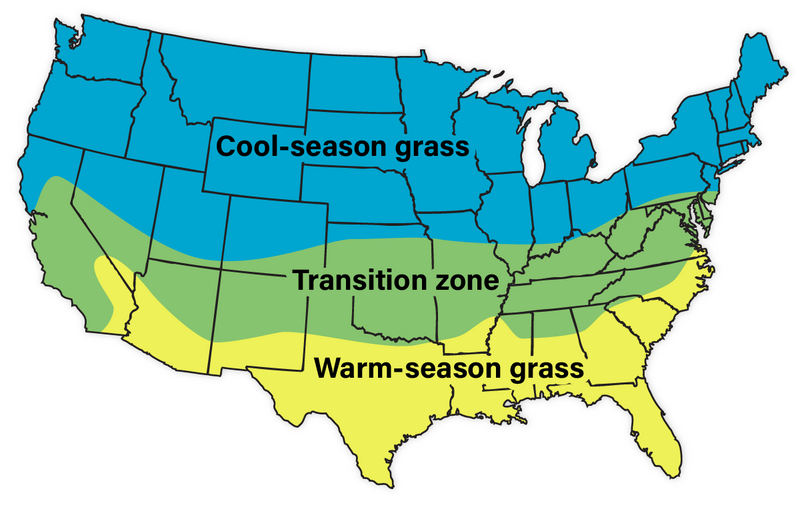
Your region’s seasonal temperatures will determine what type of grass will thrive in your lawn:
| Zone | Region | Best Options |
| Cool-Season | Northern U.S. | Fine fescue, hard fescue |
| Warm-Season | Southern U.S. | Buffalograss, centipedegrass, Zoysia |
| Transition Zone | Middle U.S. (CA to VA) | Mix of warm + cool season varieties |
How to prepare for the transition
Before making the switch to something more low-maintenance, there are some things you need to consider to ensure your new grass thrives:
Remove the old turf: You must completely eradicate the existing grass and weeds (using a sod cutter or non-selective herbicide) to prevent them from competing with your new low-maintenance plants.
Grade and level: Address any underlying drainage issues, slope problems, or uneven spots while the soil is bare.
Test the soil: Bennett Barrier, CEO at DFW Turf Solutions, in Dallas, says that skipping the soil test is the biggest mistake homeowners make.
“They pull the old turf, scatter new seed and expect results. But pH outside of the 6.0-7.0 range locks out the nutrients right at the root level and the grass just sits there and stalls,” Barrier explains. “Get a test from your local extension office; It costs about $15 and tells you what amendments exactly to add to the soil before you plant anything.”
Till carefully: Johannes Hock, president at Artificial Grass Pros, in Tampa, also warns against aggressive tilling at the wrong time.
“Tilling clay when wet also destroys the soil structure; it turns into a brick-like hard mass into which roots are not able to break.”
No-mow and low-mow grass

Hard fescue and fescue mixes (cool-season)
- Region/USDA zones: Northern and Transition Zone states (zones 4-9)
- Sunlight: Full sun to shade
- Soil needs: Tolerates poor, low‑fertility, and well‑drained soils
- Foot traffic: Moderate
- When to plant: Late summer to early fall
- Best low-maintenance varieties: Hard fescue, chewings fescue, red fescue
Fine fescue is the most popular low-maintenance cool-season grass, requiring only occasional mowings a few times per year. It’s the slowest growing grass for cool climates and the easiest grass to maintain.
“For strict HOAs one can’t just plant a wild meadow. I would recommend fine fescue blends because they resemble a nice manicured carpet and do not require daily mowing. They will pass inspection,” explains Hock.
Jimmy Patterson, president at TruScape LLC, in Irwin, PA, prefers a specific mix to achieve this look.
“We often choose a low-mowing blend of chewings fescue and creeping red fescue. These species are ideal for growing to a certain height and then gently ‘flopping’ over while still maintaining a uniform blade thickness appearance.”
Pro tip: “We often incorporate an annual ryegrass in with the hydroseeded blend to create some quick cover and soil stabilization while the fescues take their time to establish,” Patterson says.
| ✅ Pros | ❌ Cons |
| • Little to no herbicide, fungicide, or fertilizer required | • Can’t handle extreme summer heat |
| • Drought-, shade-, and cold-tolerant | • Performs poorly in clay soils |
| • Slow-growing; mow just 1–2x per year | • Moderate foot traffic only |
| • No frequent watering required | • Prone to thatch buildup |
Buffalograss (warm-season)
- Region/USDA zones: Plains and Prairie and Southern states (zones 4–10)
- Sunlight: Full to partial sun
- Soil needs: Tolerates clay and alkaline soils
- Foot traffic: Moderate
- When to plant: Late spring or early summer
- Best low-maintenance variety: UC Verde
Buffalograss is a tough warm-season turfgrass that thrives in sunny areas and handles heat and drought well. It has short, fine foliage that grows 4-6 inches tall and forms a dense sod.
It only needs mowing once every 2-3 weeks for a manicured grass lawn, or once in spring for a meadow-like look. Hock highly recommends it for HOAs in drier climates, noting a specific design trick to keep it looking good.
“It remains short and takes occasional mowing well so that it never appears overgrown. The actual trick is keeping the edges crisp. A clean border will make the entire yard appear purposeful even if the grass inside is a little longer. We use edging or pavers on the side of sidewalks that are made of steel to satisfy the strictest boards,” Hock says.
| ✅ Pros | ❌ Cons |
| • Drought-resistant; minimal watering | • Slow to establish; takes weeks to fill in |
| • Little fertilizer required | • Poor weed competition |
| • Deep roots prevent erosion | • Can’t tolerate shade or sandy soil |
| • Tolerates clay, alkaline soils, and cold | • Needs spot-weeding during first season |
Centipedegrass (warm-season)
- Region/USDA zones: Southeastern states to the Texas Gulf Coast (zones 7-10)
- Sunlight: Full sun to partial shade (prefers sun)
- Soil needs: Acidic, low-nutrient, well-draining soil; poor drainage tolerance
- Foot traffic: Low to moderate
- When to plant: Late spring or early summer
- Best low-maintenance varieties: TifBlair, AU Centennial, Oklawn, Santee
A light green, slow-growing turfgrass, centipedegrass still requires mowing, but much less than the average lawn, hence its nickname, the “lazy man’s grass.”
Dense and low-growing, it’s a great choice for humid, sunny southern lawns that don’t freeze over in winter.
| ✅ Pros | ❌ Cons |
| • Drought-tolerant; less mowing than typical turf | • Susceptible to insects and fungal diseases |
| • Little fertilizer needed | • Can’t handle cold winters or high foot traffic |
| • Beats out weeds naturally | • Sensitive to overfertilizing |
| • Evergreen in warm climates | • Poor drainage tolerance |
Zoysia pacifica (warm-season)
- Region/USDA zones: Southern and Transition Zone states (zones 6-11)
- Sunlight: Full sun to partial shade
- Soil needs: Well-drained, loamy soil
- Foot traffic: Low to moderate
- When to plant: Late spring to early summer
- Best low-maintenance varieties: Zoysia pacifica (often sold as Zoysia tenuifolia or Korean no‑mow grass), Zeon, Geo, and Empire
With fine, bright green blades, Zoysia pacifica is a popular choice for Southern lawns and golf courses.
Unlike other Zoysia varieties that need weekly mowings, Zoysia pacifica’s slow growth makes it easy to maintain. It forms soft green mounds of growth that give your yard texture and dimension.
| ✅ Pros | ❌ Cons |
| • Heat- and drought-tolerant | • Needs well-drained, loamy soil |
| • Pest-resistant | • Can develop Zoysia Patch with poor drainage |
Grass-like ground covers

Sedges
- Region/USDA zones: Varies by type. Sedges tend to thrive in woodland environments.
- Sunlight: Tend to prefer shade
- Soil needs: Varies by native region (sandy for sand dune sedge, dry to moist for Texas sedge)
- Foot traffic: Low to moderate
- When to plant: Fall for cool-season sedges, spring for warm-season sedges
- Best low-maintenance varieties: Appalachian, plantain-leaved, Pennsylvania, evergreen sand dune, Texas sedge
Sedges are elegant, bunching plants with blade-like foliage. They’re quickly gaining popularity as an easy-care turfgrass alternative because they need little water and no fertilizer when planted in their native regions.
| ✅ Pros | ❌ Cons |
| • Little watering or fertilizer required and grows well in shade | • Most need to be grown with other plants to fill your yard |
| • Native plants are pest- and disease-resistant | • Can’t tolerate high foot traffic |
Creeping thyme
- Region/USDA zones: Zones 3-9 (depending on the variety)
- Sun exposure: Full sun to partial sun
- Soil needs: Prefers well-drained, sandy or rocky soil. Avoid heavy, poorly drained clay.
- Foot traffic: Low to moderate
- When to plant: Spring or early summer
If you’re feeling adventurous and craving a pop of color, creeping thyme may be the ground cover for you. With a low-growing mat of dainty pink, white, or purple flowers, it’s an eye-catching, sun-loving perennial that attracts a host of pollinators.
However, be prepared for hidden downsides.
“Thyme has problems of its own as it hates wet feet,” Hock says. “If you plant it in heavy clay without fixing the drainage, the roots will rot almost immediately. You also face winter dieback.”
“These alternatives tend to become dormant and turn brown in the cold, and you are left staring at bare mud for months while the neighbors have green grass. It is a trade off that many people are not prepared for,” he says.
| ✅ Pros | ❌ Cons |
| • No mowing; controls weeds | • Can’t handle high foot traffic or clay soil |
| • Drought-tolerant; little watering needed | • Needs occasional trimming |
| • Edible; attracts pollinators | • Won’t thrive in heavy shade |
Dutch white clover
- Region/USDA zones: Zones 3-10
- Sun exposure: Full sun to partial shade
- Soil needs: Prefers well‑drained, fertile loams but tolerates clay and silt
- Foot traffic: Moderate
- When to plant: Spring or early fall
Dutch white clover acts as a living mulch: it will suppress weeds, keep the soil moist and temperate, reduce erosion, and it fixes nitrogen to help fertilize other plants.
While it requires little to no mowing, homeowners should consider their yard’s primary use.
“Clover is like a magnet to bees and can give a family with kids a real problem,” Hock warns.
Patterson recommends caution because clover loves to spread.
“Some ‘creep’ more aggressively and quickly. It’s important to keep in mind areas where you want vegetation to stay out of and take the proper precautions to keep it out,” he says.
| ✅ Pros | ❌ Cons |
| • Only needs occasional trims | • Needs frequent watering when establishing |
| • Spreads across large areas | • Requires reseeding every 2–3 years |
| • No fertilizer or herbicide needed | • Poor shade tolerance |
| • Inexpensive; pollinator-friendly | • Not ideal for high foot traffic |
| • Resists dog urine discoloration | • Should be mixed with other plants |
Ornamental grass

For a unique lawn look, plant gorgeous ornamental grasses. They’re especially popular in dry Prairie regions with full sun, but there’s a variety for any lawn.
⚠️ Note: Check with your local extension office before planting as some ornamental grasses can be invasive in your region and may displace native plants or spread beyond your yard.
Popular ornamental grasses for warm-season lawns:
- Big bluestem: Excellent for erosion control on dry, sunny slopes.
- Maiden grass: Ideal as a border accent, focal point, or drift planting.
- Indiangrass*: Great for mass plantings to naturalize large, open areas.
- Switchgrass: An excellent choice for rain gardens or areas with poor, sandy soil.
- Grassy-Leaved Sweet Flag*: Perfect for poorly draining spots or borders around water features.
- Blue grama: A drought-tolerant lawn replacement when planted in masses.
Popular ornamental grasses for cool-season lawns:
- Feather reed grass*: Perfect for narrow side yards, property lines, or modern, geometric landscape designs.
- Tufted hair grass*: Great for brightening up lightly shaded borders or the edges of tree canopies.
- Blue fescue: Ideal for edging stone walkways, filling rock gardens, or planting in grid patterns.
- Blue oat grass: Good for adding texture and color contrast in dry, rocky beds.
- Rattlesnake Manna Grass*: Best for naturalizing marshy areas or low spots in the yard that stay wet.
* Best for partially shaded areas
How to keep weeds out during establishment
“The window between pulling old turf and new grass filling in is where most of the projects go sideways,” explains Barrier. “Bare soil is the perfect recipe for weeds, and slow-establishing grasses may take 6-12 weeks before any real semblance of cover is visible.”
To prevent weeds from taking over:
Use pre-emergents carefully: Barrier recommends a pre-emergent application (like pendimethalin) within 48-72 hours of seeding on surrounding beds or border areas to protect the new lawn.
Pull weeds early: “For the gaps that do appear, pull early and pull often by hand,” Barrier says. “A weed pulled around 2 inches remains a job that takes only a minute. That same weed that is 8 inches tall has done a lot of dropping of seeds and created 12-15 new problems for next season.”
Mow high once established: Once your new grass is filled in, Hock says the best protection from weeds is density.
“I advise clients to cut their established fescue a little bit higher because the increased height will shade the soil and prevent light from reaching weed seeds.”
Choose your grass alternatives
Transitioning to a low-maintenance lawn is an upfront investment of time and energy that pays off for years to come. If you are ready to ditch the weekly mowing chore but don’t want to break a sweat during the transition, Lawn Love connects you with a local professional who can expertly prep, plant, and maintain your new eco-friendly foot.
Main Image: A meadow full of blooming clover flowers. Image Credit: GCapture / Adobe Stock
Related Posts: