| Key takeaways: |
|---|
| ● Mowing gets riskier with age. Adults 65+ land in the ER from mower injuries at 2 times the rate of younger adults. ● Watch for signs. A near fall, skipped mows, or one too many “just-this-once" requests means it’s time to step in. ● Vet before you hire. When hiring lawn care for your parents, prioritize background checks, insurance, and BBB accreditation over the lowest price. |

If your parents still mow in their 70s or 80s, an accident can hit them harder, so helping manage your aging parents’ lawn care is key.
About 1 in 4 ER-treated mower injuries among adults 75 and older ends in hospitalization, shows a Lawn Love analysis of Consumer Product Safety Commission (CPSC) data. That’s nearly twice the rate for adults 55 to 64.
A near-fall, difficulty climbing onto a mower, or untrimmed slopes are signs it’s time to step in. For many parents, though, the lawn is a point of pride, so focusing on safety rather than age helps the conversation go more smoothly.
Below, we cover how to raise the issue, what to look for in a lawn care pro, costs, and how to manage it all remotely. With Lawn Love, arranging lawn care service for seniors is easier than the conversation, and once it’s set up, you don’t have to think about it.
Why lawn mowing gets riskier with age
Age reduces balance, reaction time, and heat and effort tolerance, raising the odds of a fall, a mishandled machine, or a heart problem.
Adults 65 or older visit the ER for mower injuries at roughly twice the rate of working adults, according to 2025 CPSC injury data. They are also about twice as likely to be admitted upon arrival.
Falls, trips, and slips while mowing are the most common causes of injury among older adults.
Next come physical overexertion and cardiac and systemic events: About 1 in 5 mower-related ER visits among adults 65+ involve a cardiac event or a medical event such as chest pain, fainting, heat exhaustion, or dizziness.
Signs it’s time to take over their lawn care (or hire help)
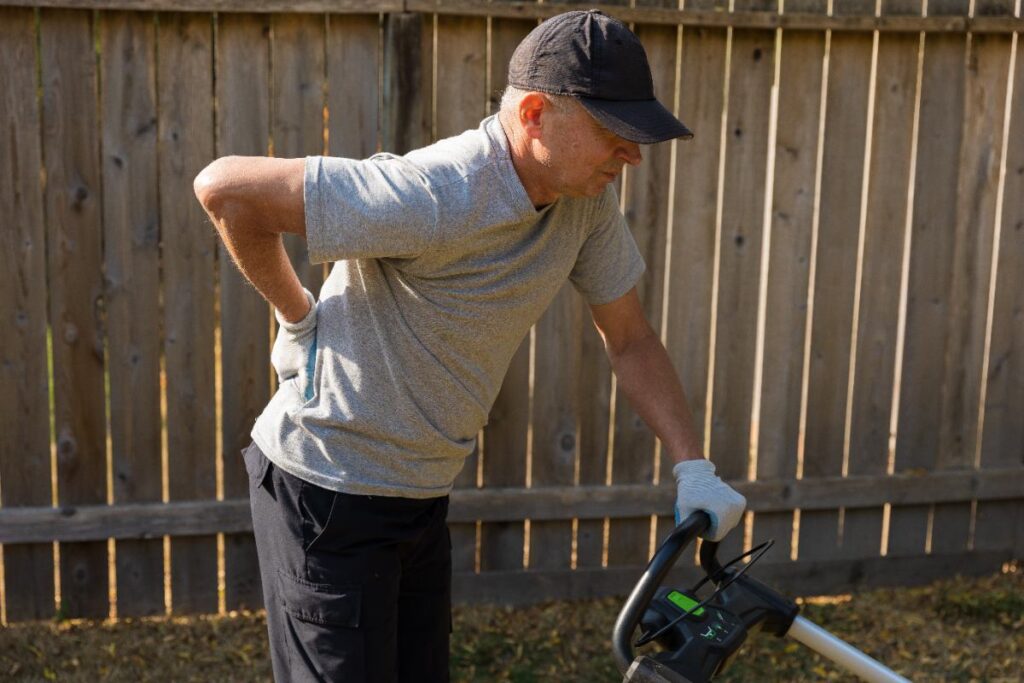
Every person is different, and age alone doesn’t decide when your parents should stop mowing. Health and fitness matter too.
Laura Cherry Akgerman, disability services coordinator for the Ohio AgrAbility Program at Ohio State University Extension, has seen farmers in their 80s who can safely operate equipment and younger individuals with health conditions that make some tasks unsafe.
“The key question,” she says, “isn’t, ‘How old are you?’ It’s, ‘Can you perform the task safely?’”
Watch for these signs that mowing isn’t as safe for your parents as it used to be:
- The grass is overgrown, and their mower hasn’t moved for weeks.
- They struggle to climb on or off the mower, or to turn and look behind them while backing up.
- They’ve had a fall, near-fall, or dizzy spell while doing yard work.
- A doctor has restricted heavy outdoor activity or heat exposure.
- They’re avoiding slopes, edges, or the back corners. This means they’ve assessed the risk themselves without mentioning it.
- They’re worn out long before the job’s done, or are on medication that causes drowsiness.
- The neighbors or HOA have said something.
- They’ve asked you to mow “just this once” more than once.
How to bring it up without a fight

While you may see it as a simple yard chore, for many older adults, mowing the lawn is “part of their identity, routine, and sense of purpose,” Akgerman says.
Don’t make the discussion about their age (“You’re too old to do this anymore”), and don’t decide for them. Akgerman says to focus the talk on safety and problem-solving and keep your parent in the decision.
“Start by discussing concerns and exploring options together,” she says. “Ask questions like, ‘What part of mowing is becoming difficult?’ or ‘Is there a way we can make this safer?’“
She also recommends a gradual transition. “Perhaps a family member takes over mowing the steep slopes while the older adult continues mowing the flat areas.”
Eventually, your parent may hand off mowing entirely and stay involved in other ways.
Akgerman notes that people can keep gardening long after they stop mowing with adaptations like raised beds, drip irrigation, and seated work, and through lower-strain tasks like pruning, tending flower beds, or mentoring a younger family member on garden care.
“The goal is not to stop people from doing what they love,” she says. A core principle of AgrAbility, the program she works with, is “adapting, not quitting.”
What to look for when hiring lawn care for aging parents
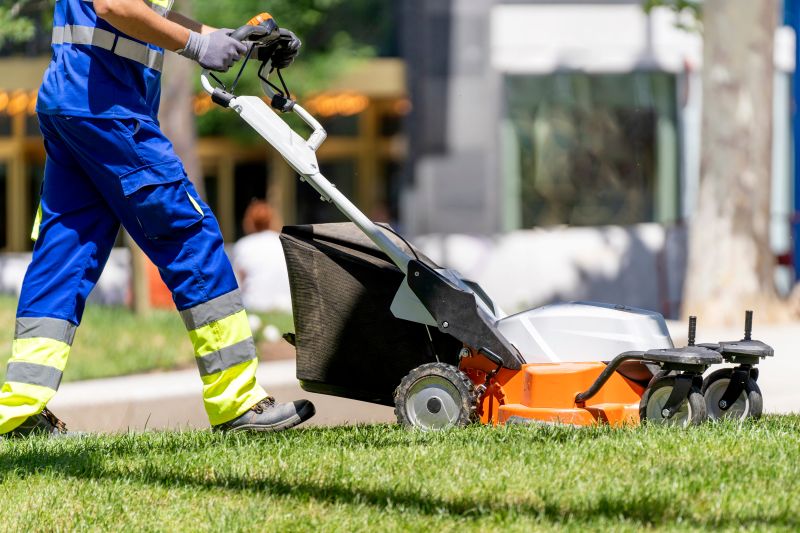
Hiring a provider for your parent’s lawn means handing someone recurring access to a property where your parent may be alone, often when you can’t be there to check. Most worries come down to 4 questions.
1. Can I trust who shows up?
Look for vetted, background-checked crews, real insurance, customer support, and third-party accreditation, like the Better Business Bureau (BBB). The BBB verifies a company’s license, checks for government actions against it, and weighs its track record at solving customer complaints.
Platforms don’t all screen providers the same way:
| Platform | How Pros Are Screened |
| Lawn Love | Background checks, plus customer ratings |
| LawnStarter | Background checks and ongoing monitoring |
| Lawn Guru | Background checks |
| GreenPal | Customer references and equipment checks |
| Local independent pro | Up to you |
| Angi/Thumbtack | Background checks on the business owner |
Lawn Love is BBB accredited with an A+ rating — the only one of the 3 major lawn care marketplaces that holds the accreditation.
For further peace of mind, every local provider on Lawn Love is background-checked and rated by other customers in the area. All Lawn Love providers also carry our damage coverage in case of accidental property damage.
2. How much will it cost, and will there be surprises?
Most Lawn Love customers pay about $60 per mowing visit, with typical mowing prices ranging from $45 to $75. Costs vary by platform:
| Option | Typical Cost per Visit |
| Lawn Love | $45 to $75 |
| LawnStarter | $44 to $71 |
| Lawn Guru | $29 to $75 |
| GreenPal | $30 to $85 |
| Local independent pro | $30 to $80 |
| Angi/Thumbtack | $40 to $150 |
Yard size, location, and how often you book drive the price. Regular mowing usually costs less over time because overgrown grass takes more labor. Slopes and obstacles add to the cost too.
To avoid surprises, ask about overgrown-grass fees, contract terms, and when your card is charged.
With Lawn Love, you see the exact price before booking. There’s no annual contract, though there is a 3-cut minimum. You’re charged 3 days after service, and you have 5 days to report a problem.
3. Can I manage lawn care from miles away?
A truly hands-off arrangement needs centralized customer support, a service guarantee, one account for multiple properties, and the option to pause service.
Other features worth looking for:
- Notification when the job is done
- Instant quotes (available for some services)
- A way to message the provider directly, so instructions like “use the side gate” go straight to the person doing the work
- Additional services like leaf removal, weeding, or yard cleanup, so you don’t have to find a second provider as seasons change
Not every option on the market offers these. For example:
- GreenPal connects you with pros, but it doesn’t treat you as its customer. If a job falls short while you’re miles away, GreenPal won’t step in to fix it. You have to sort it out with the provider yourself.
- Angi has no dedicated multi-property feature, and support varies by provider.
- Local independent pros may offer a personal relationship, but you’ll handle scheduling and problem-solving yourself. Most communicate by text, so there are no instant quotes or quick online booking. If something comes up, you wait for them to reply instead of reaching support anytime.
With Lawn Love, no one needs to be home. You’re notified when the job is done and you can message your provider or customer support in the app.
You can add your parent’s address to your own account, pause service in the off-season, and book any of more than 20 outdoor services when needed. Some services, like mowing, you can price with an instant quote in about 2 minutes. Your parent doesn’t need a smartphone or an account.
One tip for peace of mind: Ask someone to keep an eye on the yard. A neighbor, a sibling, or your parent sending a photo is enough. Many services have a short window for reporting problems, so the sooner, the better.
4. What if your parent moves?
44% of adults 50 years and older expect to relocate at some point, usually for financial reasons, according to AARP’s 2024 Home and Community Preferences Survey.
Before you commit to a service, ask:
- Can you move service to a new address without a new contract or cancellation fee?
- What happens to any prepaid or minimum visits if the parent moves before using them?
With Lawn Love, you add the new address to the same account, use any remaining cuts there, and close out the old property. Coverage varies by market, so confirm the new area first.
Hire a local lawn care pro
Your parent’s yard shouldn’t be one more thing to worry about. With Lawn Love, you set up the recurring service once: Enter their address, see the price instantly, and choose a schedule.
A background-checked local mowing pro handles every visit, and the app lets you know when the job is done. Get a free quote and take lawn care off your list.
Source:
Laura Akgerman, MA, CRC, ATP, Disability Services Coordinator, Ohio AgrAbility Program, OSU Extension, Columbus, OH. Personal interview.
Main Image: Adult daughter helping her aging father with lawn care and yard work. Photo Credit: Budimir Jevtic / Adobe Stock
Related Posts: