| Key takeaways |
|---|
| • The most effective yard flea killers are pyrethroid sprays (bifenthrin, permethrin) applied to shady, moist breeding areas. • Follow up every 7 to 10 days for 3 to 4 weeks: flea pupae survive the first application and hatch later. • Insect growth regulators (IGRs) prevent new generations from hatching. They combine with a spray to hit all life stages. • Treat your pet and your yard at the same time, or you'll keep reinfecting both. |

Getting rid of fleas in your yard takes two steps: fix the conditions that let them thrive (mow properly, reduce moisture, clear debris), then treat with a chemical spray, IGR, or natural option. Plan for 3 to 4 weeks.
Fleas breed fast: a single female lays around 27 eggs per day, and their pupae can lie dormant in the yard for up to 5 months, according to Texas A&M AgriLife Extension. Treating the yard alone won’t work. You need to treat your pet at the same time, or you’ll keep reinfecting both.
If yard maintenance is piling up alongside the flea problem, Lawn Love can connect you with local lawn care professionals who can help keep your lawn in the kind of shape that gives fleas fewer places to hide.
How to know if you have a flea infestation
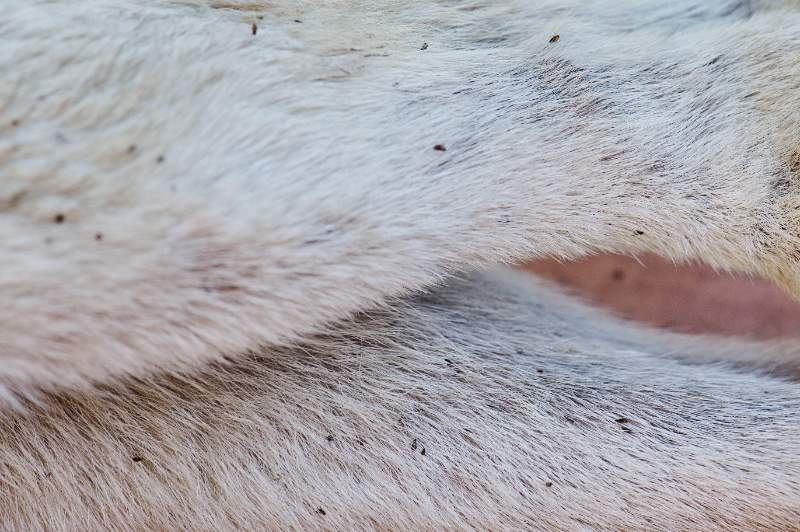
To confirm you have a flea problem before treating:
- Check your pet’s coat for fleas, hair loss, or red patches.
- Look for pale gums in pets, a sign of anemia from heavy flea feeding.
- Put on tall white socks and walk through your yard. Fleas will collect on the fabric.
- Look for flea dirt (small reddish-black specks near pet resting areas), and spray with water. If it turns reddish-brown, it’s flea waste.
Also, remember that 95% of a flea population lives in just 5% of your yard, concentrated in warm, shady, moist spots, according to Oklahoma State University Extension.
Mike Rust, professor emeritus of entomology at the University of California Riverside, says fleas are rarely found in open areas of your yard. Instead, fleas concentrate in what he calls “protected microhabitats” near crawl spaces, under decks, and around structures where feral or stray animals rest, and humidity stays higher.
Fleas live in the soil and leaf litter beneath the grass, not on the grass blades themselves, which is why surface sprays need to penetrate down to the soil to work.
How to prep your yard
Fix the environment before you spray. Treatment won’t work if the underlying conditions stay the same. The CDC recommends debris removal, moisture control, and wildlife prevention as the foundation of flea prevention. These are the same conditions you control with proper yard prep.
Mow to the right height
Mow too low, and you eliminate the beneficial predators (ground beetles, ants) that prey on flea larvae. Mow too high, and you create the shady, humid environment fleas love. The best height to cut your grass depends on your grass type, but for most grasses, 2.5 inches is the ideal height.
Always follow the one-third rule: never cut more than one-third of the blade at once. During active growth, stay on the lower end. During dormancy, mow slightly higher.
Control moisture
Overwatering creates the moist conditions flea larvae need to survive. According to the University of Florida’s Institute of Food and Agricultural Sciences (UF/IFAS), larvae die when humidity drops below 50% and soil temperatures exceed 95 degrees. Lawns generally need about 1 inch of water per week, less during dormancy or after rain.
Signs you’re overwatering:
- Pooling water or runoff on driveways
- Squishy grass hours after watering
- Excess weeds, mushrooms, or fungal growth
Here’s how much water each grass type needs per week on average, both during active growth and dormancy.

Warm-season grasses
| Grass type | Actively growing | Dormant |
| Bermudagrass | 0.5 inch/week | 0.2 inch/week |
| Zoysiagrass | 0.5 inch/week | 0.2 inch/week |
| St. Augustinegrass | 1 inch/week | 0.5 inch/week |
| Centipedegrass | 1 inch/week | 0.5 inch/week |
| Bahiagrass | 0.5 to 0.75 inch as needed | * Rarely needed |
| Buffalograss | 0.3 inch/week | 0.2 inch/week |
*According to UF/IFAS, bahiagrass goes dormant in drought and rarely needs irrigation when dormant.
Cool-season grasses
| Grass type | Actively growing | Dormant |
| Kentucky bluegrass | 1.2 inches/week | 0.7 inch/week |
| Perennial ryegrass | 1.5 inches/week | 1 inch/week |
| Tall fescue | 1 to 1.25 inches/week | 0.5 inch/week |
| Fine fescue | 0.6 inch/week | 0.25 inch/week |
If you’re in a transition zone, you may have a blend of both warm- and cool-season grasses.
Early morning, between 4 a.m. and 10 a.m., is the best time to water your grass to cut evaporation and reduce surface moisture. How long you should water depends on the grass type and the climate.
Clear debris
Debris is the perfect hiding spot for fleas. Rake your yard and bag what you collect in a tightly tied garbage bag. Remove fallen branches or twigs. Prune overgrown shrubs to let sunlight reach the ground. Pick up toys and outdoor furniture and sanitize before storing.
Get rid of wildlife
Raccoons and rodents are the main carriers of fleas into your yard. To discourage them:
- Bring pet food bowls inside immediately after feeding.
- Move trash cans away from the house.
- Seal entry points with steel wool and caulk: around doors, windows, vents, and foundation gaps.
- Set traps to catch any wildlife already on the property.
Read more:
Flea treatment options
Focus your treatment on the prime breeding zones: under decks and porches, in garden beds, around dog houses, and beneath lawn furniture or wherever shade and moisture collect.
“Flea larvae feed on dried fecal blood droplets produced by adult fleas feeding on a host,” Rust says. “Naturally, these dried droplets are going to areas where feral animals nest or harbor.” That’s why targeting those zones matters more than blanket-spraying the whole yard.
| Treatment | Best for | How fast |
| Bifenthrin/permethrin | Active infestations | Fast, adults die on contact |
| Pyrethrins | Mild infestations | Fast but short residual |
| Insect growth regulators | Preventing new generations | Slow (4 to 6 weeks) |
| Nematodes | Mild infestations | Slow (2 to 4 weeks) |
| Diatomaceous earth (DE) | Spot treatment | On contact (adults only) |
| Essential oils/home remedies | Not recommended | Not effective |
Chemical pesticides: the fastest option
Pyrethroid-based sprays are the most effective treatment for active outdoor flea infestations.
- Key limitation: Pupae survive the first application. Two or more treatments are always required.
- Pet-safe: Safe for dogs and cats once the treated area is completely dry, typically 30 to 60 minutes. Always read the product label.
Look for these active ingredients:
Bifenthrin or permethrin: Longer residual than alternatives, typically several weeks. Both are the most commonly recommended active ingredients for outdoor flea control by university extension programs, including Texas A&M.
However, Rust says that cat fleas have developed widespread resistance to most pyrethroid insecticides commonly sprayed around homes, which means results may vary depending on local flea populations. If a first application isn’t producing results, resistance may be a factor.
Pyrethrins (botanical): Kill fleas fast but break down within hours. Require 2 to 3 follow-up applications spaced 5 to 10 days apart. For best results outdoors, use in liquid spray form.
Liquid sprays are more effective than granules for outdoor use. If you use granules, water them in right after to activate the product. Focus coverage on shady, moist areas. Dry, sunny lawns rarely support significant flea populations.
A note on Sevin dust: If you’re like me, you grew up reaching for carbaryl (Sevin dust) the moment fleas or ticks showed up in the yard. It works, but I wouldn’t use it now. It’s toxic to beneficial insects and poses real risks for cats.
Insect growth regulators (IGRs)
- Key limitation: IGRs don’t kill adult fleas. Always combine with a pyrethroid spray for active infestations.
- Pet-safe: Yes, low toxicity to mammals.
IGRs like pyriproxyfen mimic insect hormones to prevent flea eggs and larvae from developing into adults. They don’t kill adults quickly. IGRs require 4 to 6 weeks for full results, but they break the reproductive cycle. Combining an IGR with a pyrethroid spray hits both adult fleas and prevents the next generation from hatching.
For outdoor microhabitats specifically, Rust recommends pyriproxyfen.
“It will prevent larvae from developing into adults and has good residual activity outdoors,” he says. It won’t eliminate existing adults, which is why pairing it with a contact spray remains the standard approach.
IGRs have low toxicity to mammals and can be applied preventively in late spring or early summer. Pyriproxyfen is the better outdoor option. Methoprene breaks down in sunlight and is better suited for indoor use.
Nematodes

- Key limitation: Variable results; need moist soil to survive
- Pet-safe: Yes
Microscopic worms that target flea larvae in the soil. Apply in the early morning in moist conditions, as they require moisture to survive. Expect gradual results over 2 to 4 weeks, not overnight. They work best in sandy, well-drained soil.
Diatomaceous earth (DE)
- Key limitation: Ineffective in humid or wet conditions
- Pet-safe: Yes, but use food-grade DE if you have pets
A fine powder that physically damages flea exoskeletons. Apply only to completely dry outdoor areas, as it’s ineffective when wet.
Essential oils and home remedies
- Key limitation: Not proven to eliminate infestations. Home remedies have no scientific evidence of effectiveness.
- Pet-safe: No, as some essential oils are toxic to pets. Always check with your vet before use.
Essential oils (lavender, cedarwood, peppermint, eucalyptus) may provide minor repellent effects but aren’t proven to eliminate infestations. Always dilute properly and check with your vet. Some essential oils are toxic to cats.
Home remedies, including brewer’s yeast, B vitamins, cedar chips, and sulfur products, have no scientific evidence of effectiveness against fleas. Gasoline is dangerous and ineffective.
Treat your pets
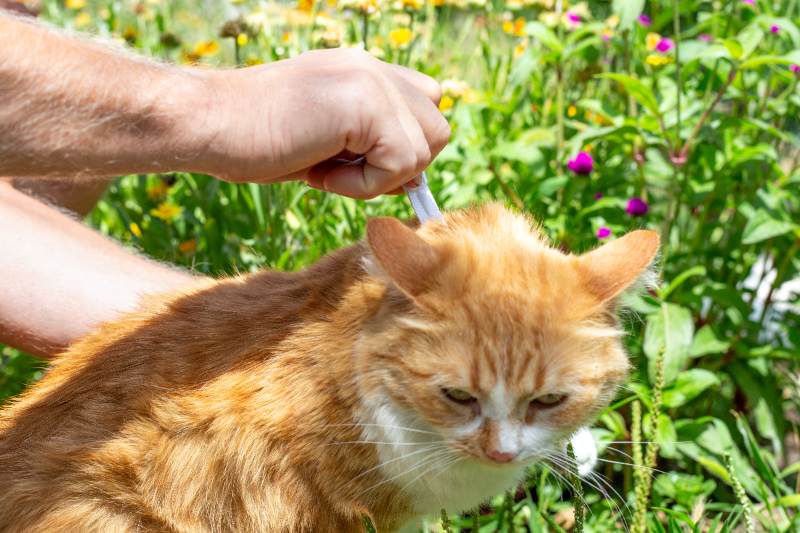
Daniel Banting, vice president at Native Pest Management in West Palm Beach, Florida, says you have to treat your pets as well as your yard.
“If pets are not professionally treated, the problem will not resolve,” Banting says. It’s one of the biggest mistakes in DIY flea control: treating the yard thoroughly but not your pets, and it becomes a vicious cycle.
- Bathe your pet with flea shampoo and let it sit 1 to 2 minutes before rinsing.
- Comb through with a flea comb dipped in soapy water to remove live fleas.
- Wash all pet bedding weekly during treatment.
- Ask your vet about topical or oral treatments. Products containing imidacloprid (Advantage) or fipronil (Frontline) are commonly recommended for monthly flea control.
How to prevent fleas from coming back
Complete flea control depends on treating every part of the environment at the same time. “Fleas are an ecosystem problem, not a single treatment problem,” Banting says. Getting rid of them requires several things working together:
- Treat and maintain your lawn. “The yard needs properly timed liquid treatments, especially in shaded zones, not random spraying,” Banting says. Long-term, consistent mowing, proper watering, and debris removal are the most effective deterrents because they eliminate the conditions fleas need to breed.
- Check your sprinklers twice a year. Look for broken or clogged heads, puddles, and wilted or yellowing grass.
- Treat the home. “The home must be treated thoroughly, including carpets, furniture, and baseboards,” Banting says. Vacuum before and after applying an indoor flea treatment to draw fleas out of hiding.
- Treat your pets professionally. Otherwise, fleas will continuously re-enter the environment.
- Manage time and expectations. Even with proper treatment, activity can take 72 hours to begin dropping off, Banting says. Full control requires breaking the lifecycle, not just killing adults.
- Watch for ticks, too. Fleas and ticks share the same shaded, humid zones. The pyrethroid sprays used for fleas (bifenthrin, permethrin) also kill ticks, so treating those breeding areas covers both pests.
Once the infestation is under control, the same prep steps that broke the cycle keep fleas from coming back.
Read more: Best Organic Pest Control Options for Your Lawn
FAQs
Yes, but they are for short-term use. Standard flea collars aren’t designed for long-term wear. Ultrasonic flea collars are ineffective and can cause hearing damage in pets. For ongoing protection, talk to your vet about topical or oral treatments instead.
Plan for 3 to 4 weeks. You should see flea activity drop noticeably within 72 hours of the first pyrethroid spray application. Reapply every 7 to 10 days through the full treatment window to catch new generations as they emerge from the soil and leaf litter.
No treatment is truly instant. Pyrethroid sprays with bifenthrin or permethrin kill adult fleas on contact, but the pupal stage is sealed inside a protective cocoon that insecticides can’t penetrate, and pupae can stay dormant for up to 5 months.
Get professional help with fleas
Getting rid of fleas takes the right products, the right timing, and treating your yard and your pet at the same time. If keeping up with the yard work feels like too much alongside an active infestation, Lawn Love can connect you with local lawn care professionals who can handle the maintenance while you focus on the treatment.
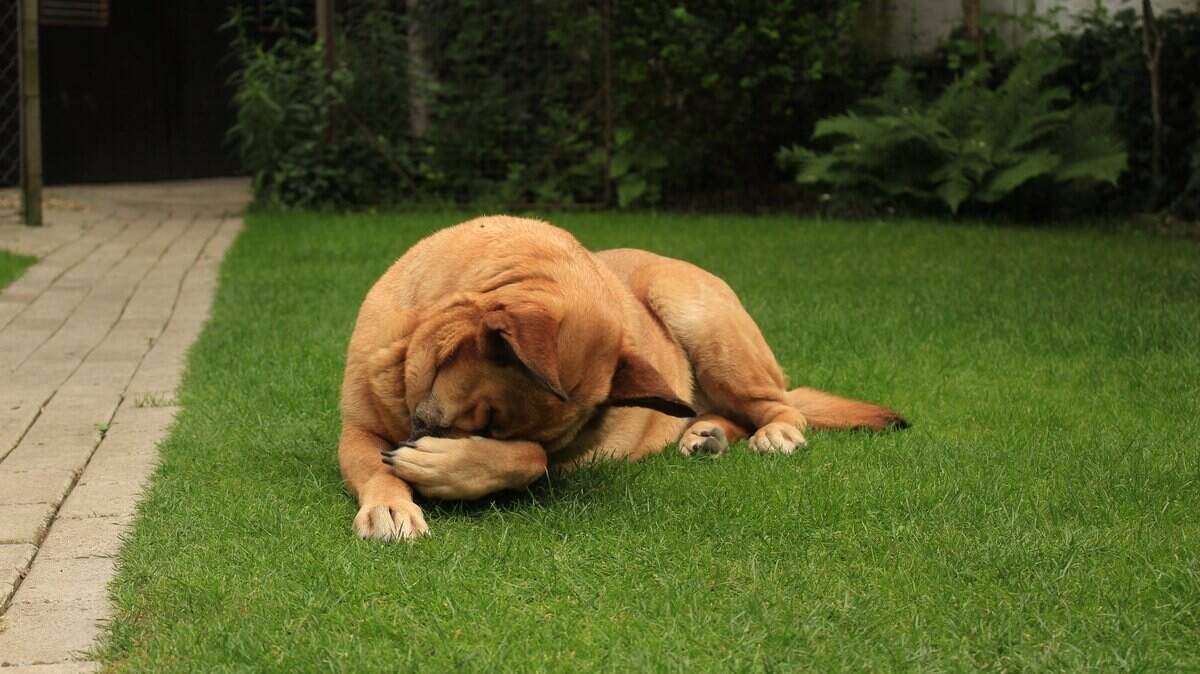
Main Image: A dog scratches itself on a green lawn. Photo Credit: Donnie Ray Jones / Flickr / CC BY 2.0
Related Posts: