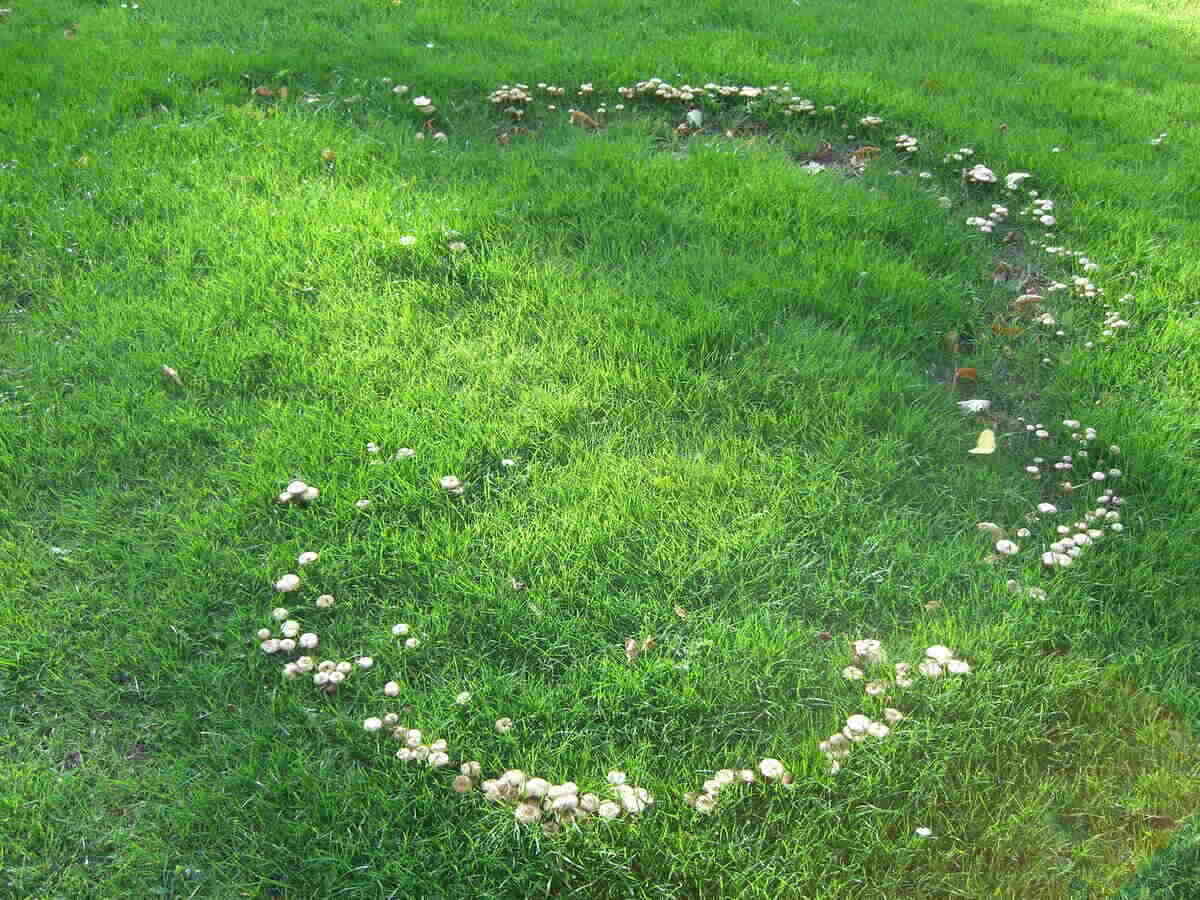
Mushrooms in lawns are caused by fungi breaking down organic matter like decomposing tree roots, buried wood, or thatch in the soil, and they thrive in moist, shady areas that don’t drain well.
“Fungi are everywhere and can take up to 70% of the mass of soil in some areas,” explains Karla Griesbaum, extension specialist at the University of Illinois Extension. “If you take a soil sample from anywhere on earth, fungi will be present, and they’re essential for a healthy ecosystem.”
However, the sudden appearance of mushrooms can also be a sign that something’s off in your yard. Poor drainage, overwatering, or persistently damp conditions may be encouraging their growth. In these cases, it’s worth looking below the surface to identify and fix the root causes before they lead to long-term lawn problems.
Excess moisture
Mushrooms pop up seemingly overnight in wet conditions. How do they grow so fast? Horticulture professor Megan Kennelly says they are packed into a small, egg-like structure that “can expand quickly, like one of those sponge-animals that expands when you put it in a bucket”.
You can’t thwart heavy rains that encourage mushroom growth, but you can be mindful of how much you’re irrigating your lawn with your sprinkler system.
Use some basic logic: Don’t run your sprinkler during rainy periods. And when you do water, do so in the morning and allow the sun to dry out the grass in the middle of the day. Finally, remember that grass in shade often needs less water than grass under full sun.
Read more:
Shade
Shade goes hand-in-hand with extra moisture. Because they don’t get sunlight, shaded areas are often cooler – and by extension, damper.
Trees are excellent at providing shade, which makes them prime real estate for ‘shrooms. It may be time to trim and prune some of the branches to let more sunlight filter down to your yard.
Read more:
Poor drainage
If mushrooms keep appearing after rain, they’re often a symptom of poor drainage, not the cause of lawn damage. Griesbaum explains that when lawns struggle and mushrooms are abundant, “it’s usually a parallel problem, such as poor drainage, excess moisture, or buried debris. Fungi love those conditions, but it’s not the fungus itself that’s hurting your lawn.”
When water sits too long, it suffocates roots and weakens grass. The solution is to fix the drainage, not fight the mushrooms. Installing a French drain, yard drain, or rain barrel can help redirect excess water. If your soil is compacted and forming puddles, aerating the lawn will improve air and water flow, helping your yard dry out.
Read more:
- 14 Ways To Manage Stormwater Runoff
- Lawn Drainage Solutions
- How to Get Rid of Standing Water in Your Yard
Excess thatch

Excess thatch is a two-for-one special for mushrooms, trapping moisture and feeding them. The thatch layer consists of living and decaying organic matter sandwiched between grass and the soil. Mushrooms decompose this organic matter and then feast on the nutrients.
The problem arises when the thatch layer becomes thicker than ½-inch because it contributes to soil compaction and holds onto water.
Read more:
Rich, organic material
Fungi feed on organic matter such as fallen leaves, twigs, logs, stumps, rotting roots, or even animal waste.
Robert Olen, horticulturist at the University of Minnesota Extension, notes that fungi are “obligate parasites,” meaning they rely on decaying organic material as their food. He adds, “They do not contain any chlorophyll, so they cannot produce any of their own food.”
Mushrooms are a natural part of the cleanup crew, breaking down organic debris and enriching the soil. If you’d like to reduce their appearance, simply remove what they feed on: rake up leaves, clear away old stumps, and keep your yard clean.
Read more: How to Clean Your Yard
Underground fungal networks
Beneath your lawn lies a hidden world of fungi— the real reason mushrooms appear on the surface. Oslen explains that mushrooms are simply “the fruiting body (as they contain reproductive spores) for fungi that reside in the soil.”
These underground fungi form vast, thread-like structures called hyphae that weave throughout the soil. Griesbaum explains that when these hyphae connect with plant roots, they form mycorrhizae, a mutually beneficial relationship. In this partnership, “many fungi are actually helping plants access more water and nutrient resources for photosynthesis in return for carbon, which the fungi use for energy,” she adds.
When mushrooms might indicate a bigger problem

While most mushrooms are harmless and even beneficial, a few can signal trouble in your yard. Two common culprits are fairy rings and honey fungus. The former attacks grass, while the latter signals disease in trees.
Fairy rings manifest most visibly as expanding rings of white or tan mushrooms. These mushrooms can either cause the grass beneath them to grow greener or die. The first happens because the fungi decompose organic matter, and fertilizing your lawn can help even out the color and growth.
The second occurs because the hydrophobic fungi have colonized the soil, preventing water from penetrating the soil. To cure this, aerate your lawn and use a wetting agent to help water seep into the soil. Overseed your lawn to fix bare spots.
See related: What is Fairy Ring and How to Get Rid of It
Honey fungus pops up at the base of trees or stumps. Appearing in fall, these light brown mushrooms signal a common disease called Armillaria root rot, which targets the cambium, the part of a tree responsible for growing bark and wood. “Any injury to these tissues disrupts their functions and affects growth,” says extension specialist Travis Cleveland.
Unfortunately, the appearance of these honey-colored mushrooms often heralds the end of a tree or shrub. “The mushrooms usually don’t appear until the host tree is dead or in advanced stages of decline,” say experts from the University of California. Even removing the dead tree won’t help because the fungi responsible persist in the soil for decades.
FAQ
Pluck or cut them out, stick them in a paper bag, and throw them away. If you’re concerned about getting poisoned, mushroom expert Marc Cubeta recommends using latex gloves. However, he notes that – apart from the rare allergic reaction – touching mushrooms will not result in poisoning.
Most mushrooms are not bad for your lawn. They do spread spores that produce more fungi, but they’re more of a signal of the ones existing in the soil. They can be a sign of other problems in your lawn, like excessive thatch and overwatering.
Fairy ring mushrooms include the fairy ring mushroom, meadow mushroom, and false parasol; the first two are edible, but it’s wise not to gamble if you aren’t a mushroom expert.
You might also see toadstools, inky caps, honey mushrooms, stinkhorns, and puffballs.
Yes, nitrogen fertilizer can help eliminate mushrooms because it speeds up decomposition. When a mushroom’s food source is depleted, it goes away.
Experts from the University of California suggest the following fertilizers per 1,000 square feet of lawn:
● 5 pounds of ammonium sulfate (21-0-0)
● 6 pounds of 16-6-8
● 4 pounds of 27-3-4
The mushrooms disappear after their preferred growing conditions stop being met. However, they will continue to spring up when these conditions happen again. “The mushrooms will disappear permanently when the organic matter they are decomposing has been exhausted,” says extension specialist Aaron Steil.
Hire a pro for a clean, beautiful lawn
Keeping your lawn mushroom-free often involves good lawn management. If you’re too busy to properly care for your lawn, hire a Lawn Love pro to handle the mowing, fertilizing, aeration, and yard cleanup for you instead.
Sources:
Karla Griesbaum. Environmental and Energy Stewardship Educator. University of Illinois Extension. Personal Interview.
Robert Olen. Horticulturist. University of Minnesota Extension. St. Louis County. Personal Interview.
Travis Cleveland, extension specialist at the University of Illinois Urbana-Champaign Extension, Urbana, IL. Personal interview.
“Fungi thriving in wet conditions.” By Megan Kennelly, professor and department head. Kansas State University.
“Mushrooms Growing in Turf.” By Travis Cleveland, extension specialist. University of Illinois Urbana-Champaign Extension.
“Armillaria Root Rot.” By A.J. Downer, I.L. Lacan, K. Windbiel-Rojas, A.M. Sutherland, B. Messenger-Sikes. University of California Agriculture and Natural Resources.
“How do I get rid of mushrooms in my yard or garden bed?.” By Aaron Steil, extension specialist. Iowa State University Extension and Outreach.
Main Image Credit: Mushrooms grow in a shady area at the base of a tree in a lawn. Photo Credit: LUGOSTOCK / Adobe Stock
Related Posts: