| Key takeaways |
|---|
| • A French drain uses a perforated pipe buried in gravel to redirect groundwater away from your yard or foundation. • Most French drains last 30–40 years when they’re installed correctly. • Installation costs $10 to $75 per linear foot ($2,800 to $6,500 on average). • DIY works for shallow surface drains; deeper installs near foundations need a contractor. |

A French drain is a gravel-filled trench with a perforated pipe that collects and redirects groundwater away from a specific area. Water flows toward the gravel, enters the pipe through small holes, and drains out at a lower exit point by gravity.
If you have a chronically wet yard, water pooling around your foundation, or erosion after every rain, a French drain system is often the most effective fix.
If you’re not sure whether a French drain is the right fix, Lawn Love can connect you with a local drainage pro who can inspect your yard and recommend the best solution.
What is a French drain?
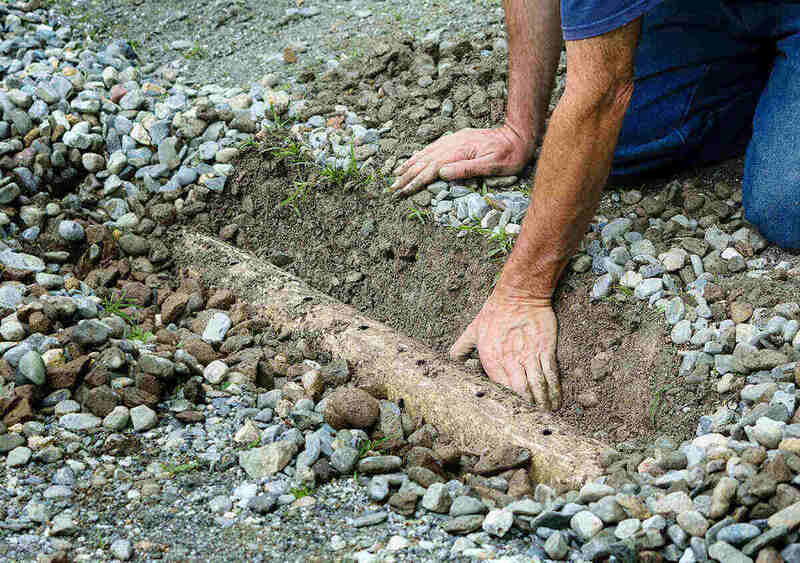
A French drain (also called a weeping tile or blind drain) is an underground system that collects excess surface and groundwater and redirects it to a safe exit point.
Fun fact: It wasn’t imported from France; it was invented by Massachusetts farmer Henry French in the 1800s.
How it works
The system relies on gravity and the natural tendency of water to seek the path of least resistance.
- The Design: A trench is lined with filter fabric, filled with loose gravel, and fitted with a perforated pipe at the bottom.
- The Process: Because water naturally seeks the path of least resistance, it flows easily into the loose gravel, enters the pipe, and travels downhill to an exit point.
The importance of slope
A French drain needs a 1% slope, roughly a 1-inch drop every 8-10 feet, to prevent stagnation and failure. Achieving this on level ground requires strategic planning.
For surface grading, Kevin Thompson, owner of Sylvan Scapes, in Staunton, VA, says, “In perfectly flat yards, I design a networked ‘herringbone’ pattern of laterals feeding a main trunk line, pitched just 1% toward a low point we’ve confirmed with laser levels.”
However, underground conditions determine what is actually possible.
Drainage specialist Victor Coppola, owner of GreenWorks Environmental in New Jersey, says, “On flat lots, I design around the water table first, not the surface grade.”
If the site’s water table is high, he warns against forcing gravity discharge, recommending a sump-based solution instead.
French drain components
A French drain isn’t just a single pipe—it’s a complete system. You’ll need to purchase each component separately to customize the setup for your yard’s specific drainage needs.
1. Perforated pipe
This is the core of the system that collects and channels the water. Install it with holes facing down (or at 4- and 8 o’clock) so water seeps in from the trench bottom. Choose durable, rigid PVC or flexible corrugated pipe for tight curves.
Note: Sandy or silty soil may require a “modified” drain using a fabric-wrapped pipe (pipe sock) and larger gravel to filter heavy sediment.
2. Drainage gravel

Washed stone surrounds the pipe to create empty space, allowing water to flow rapidly through the trench. Be sure to skip sand or rounded pea gravel, as they tend to shift over time.
For the most durable setup, Thompson recommends 1 to 1.5-inch angular crushed stone. Because of its jagged edges, he notes that these stones lock firmly in place, allowing water to drain while keeping clog-causing dirt out.
Pro tip: Coppola suggests an engineered alternative: “For aggregate, I now spec NDS EZ-Flow with Poly-Rock over traditional gravel wherever site conditions allow.” He notes that this synthetic rock delivers 30% greater water flow and boasts a 100-year lifespan.
3. Filter fabric (geotextile):
A permeable cloth liner acts as a barrier between the soil and your clean gravel.
Mike Nichols, owner of Heroes Lawn Care in Omaha, NE, warns against relying solely on a pipe sock.
“What works better is lining the whole trench with a strong, non-woven geotextile fabric. If you don’t, soil will slowly mix into the gravel and block the system.”
4. French drain exit point
This is the final destination for the water your system collects. The right choice depends on your property’s layout, slope, and local regulations. Common options include:
- Pop-up emitter: Opens under water pressure, then closes when dry to block pests.
- Daylight discharge: Empties above ground onto a naturally sloped, lower area.
- Storm drain connection: Connects to municipal curbside drainage (check local codes first).
Pro tip: “Pop-up emitters suit mowed commercial lots like our hospital clients to avoid mower damage, while daylight discharges fit wooded residential edges for natural dispersion without erosion,” Thompson says.
When do you need a French drain?
A French drain is an excellent solution to redirect water if your yard experiences:
- Standing water that’s still there a day or two after rain instead of soaking in within 12 to 36 hours
- Water pooling against your foundation or seeping into a basement
- A soggy, muddy yard through wet seasons
- Erosion channels form in the same spots after every storm
- Runoff from an uphill neighbor is draining toward your property
Warning: Stagnant water is a primary mosquito breeding site that helps spread diseases like West Nile virus, Zika, and dengue fever, according to the EPA and CDC.
Pro tip: Standard French drains will fail if your yard hides dense clay or a high water table. Coppola says, “If your seasonal high water table sits at 18 inches, engineering a gravity-fed system without accounting for that is just moving the problem.”
When site conditions won’t support gravity drainage, he advises installing a sump pump instead.
Is drainage or grading the right fix? Our lawn drainage solutions guide covers all options. If slope erosion is the main issue, see our erosion control guide. For capturing water rather than redirecting it, a rain garden may work well alongside a French drain.
French drain costs
French drain installation costs about $5,000, with most projects falling between $2,800 and $6,500, or roughly $10 to $75 per linear foot, depending on depth, soil conditions, and materials.
Shallow curtain-style drains (around 9 to 18 inches deep) are the least expensive and most practical for DIY, while deeper perimeter drains buried 2 to 3+ feet near foundations usually require professional excavation.
How to install a French drain

You can hire a professional or tackle the installation yourself. The basic steps are:
- Dig a trench 1 to 2 feet deep.
- Line the ditch with landscape fabric to prevent root clogs and keep gravel in place.
- Add a gravel base, lay the perforated pipe (holes facing down), and cover with more gravel.
- Fold the fabric over and backfill with soil to match the surrounding yard.
DIY installation warning: “If you hit a utility line, that’s an immediate red flag,” Nichols says. He adds that water filling the trench while you’re still digging, going deeper than 2 feet, or lacking a clear drainage endpoint are all strong signs to pause your project.
Pro tip: A French drain lasts 30 to 40 years with regular maintenance, like annual flushing and clearing debris screens. If placed near downspouts, add a leaf guard to keep sediment and tree roots from clogging the line.
For a complete step-by-step walkthrough with tools, pipe sizes, and gravel specs, see our How to Install a French Drain guide.
Hire a local lawn care pro
Getting drainage right takes more than digging a trench; slope, soil type, exit point, and proximity to your foundation all affect whether a French drain actually solves the problem.
If you’re not interested in breaking out your shovel, and also for all your other lawn maintenance needs, including mowing and seasonal cleanup, call in a Lawn Love local pro.
Main Image: French drain in a lawn. Image Credit: Shutterstock
Related Posts:


