| Key Takeaways |
|---|
| • It's all in the leaves: Broadleaf weeds have wide leaves with netted veins, while grassy weeds have narrow blades with parallel veins like your turfgrass. • Identification drives treatment: Knowing whether a weed is broadleaf, grassy, or a sedge determines which herbicide will actually work without harming your lawn. • Healthy turf is your best defense: A thick, well-maintained lawn crowds out weeds of every type before they take hold. |

Telling broadleaf weeds vs grassy weeds apart comes down to their leaves: Broadleaf weeds have wide leaves with branching veins, while grassy weeds have narrow blades with parallel veins, just like your turf. Knowing which is which helps you pick the right control method.
Once you’ve figured out whether the weed in your yard is grassy or broadleaf, you can narrow it down even further to identify the specific type of weed it is. Once you know that, you can choose the best weed control method for that type of plant.
If you’d rather skip the guesswork, LawnLove’s weed control service connects you with local lawn care providers who can identify and treat the weeds in your yard for you.
What counts as a weed?

A weed is any plant that is unwanted, out of place, or unintentionally grown. That means even turfgrasses and wildflowers one homeowner plants on purpose can be weeds to a neighbor who doesn’t want them.
Lawn weeds fall into 3 categories, and each needs a different control method, so identify yours before you pull or spray. Broadleaf weeds are the most common type homeowners battle, but grassy weeds and sedges each demand their own approach. The 3 weed categories:
- Broadleaf weeds: Wide-leaved plants like dandelions and clover
- Grassy weeds: Grass-like invaders such as crabgrass and foxtails
- Sedges: Grass-like weeds like nutsedge that need their own specialty products
Read more: 32 Common Types of Weeds
What is a broadleaf weed?

Broadleaf weeds are weeds that don’t look like grasses, as they have broader leaves (hence the name). They’re the easiest type to spot and, in most cases, the easiest to treat, since selective herbicides can kill them without harming your grass. Common examples include:
- Dandelions
- Common chickweed
- Clovers (like white clover)
- Ground ivy
- Knotweeds
- Milkweeds
- Thistles
- Plantains
- Henbit
Beyond their wide leaves, broadleaf weeds have netted veins that branch out, plus showy flowers and a deep taproot.
Read more: Is Clover a Weed?
What is a grassy weed?

Grassy weeds are weeds that look like turfgrass, and they are true grasses, belonging to the same plant group as your lawn. Because they’re so closely related to your turf, they’re the hardest type to tell apart from the grass you want and the trickiest to treat without harming it.
Common grassy weeds include:
- Crabgrass
- Goosegrass
- Annual bluegrass
- Sandburs
- Foxtails
- Bermudagrass
- Zoysiagrass
- Bentgrass
Some turfgrasses spread so easily that they creep into areas where they aren’t wanted and become weeds. Bermudagrass invading a cool-season lawn is a classic example. They spread through rhizomes and stolons, the underground and above-ground runners that let one plant colonize a wide area.
Telling a grassy weed from a broadleaf weed is pretty easy, but telling grassy weeds from your lawn grass itself can be a bit tricky.
“The easiest way to identify a grassy weed is to look for patches that stand out from the surrounding lawn in color, texture, blade width, or growth pattern,” says Kathleen Hallal, vice president of Landcare and Municipalities at FireHawk Bioherbicide in Pasadena, California.
“For example, quackgrass has broader, coarser blades than fine-textured lawn grasses and may form irregular patches. For a more accurate identification, examine the shape of the leaf tips and where the blades meet the stems.”
Read more: What is Crabgrass?
Broadleaf weeds and grassy weeds compared

Broadleaf and grassy weeds come from different plant families, so the differences are easy to spot once you know what to look for. The table below breaks down every ID cue side by side.
| Characteristic | Broadleaf weeds | Grassy weeds |
| Leaf width | Wide leaves, broader than grassy weeds and turfgrasses | Long, narrow leaves similar to blades of turfgrass |
| Leaf shape | More varied than grassy weeds and turfgrasses | Very little variation |
| Leaf margins (edges) | More varied than grassy weeds and turfgrasses | Very little variation |
| Leaf arrangement (phyllotaxy) | More varied than grassy weeds and turfgrasses | Usually alternate (in which only one leaf grows, as opposed to two leaves next to each other on both sides of the stem) |
| Leaf veins | Netted veins (meaning they branch out like a tree); can be pinnate or palmate | Parallel veins (meaning they run in parallel lines along the length of the leaf) |
| Flowers | ● Usually showier than grassy weeds and turfgrasses ● Have petals in multiples of 4 or 5 | ● Flowers are unremarkable ● Have petals in multiples of 3 |
| Stems | ● Usually solid ● Nodes usually have 1 or 2 leaves | ● Usually hollow and rounded ● Nodes are usually hard and closed |
| Root system | Broadleaves have taproots, which is a thick root with smaller branches that digs deep into the ground. | Grassy weeds have fibrous roots, which are a collection of smaller, thinner roots that spread out horizontally instead of digging straight down. |
| Seedlings | Sprout with 2 “leaves” | Sprout with 1 “leaf” |
While broadleaf and grassy weeds do differ a lot, they also have similarities. Weeds spread very fast, no matter the type of weed.
They also thrive when your lawn is in poor shape, so always keep your turf in top form with good lawn care practices to prevent weeds of all shapes and sizes.
How to control broadleaf and grassy weeds
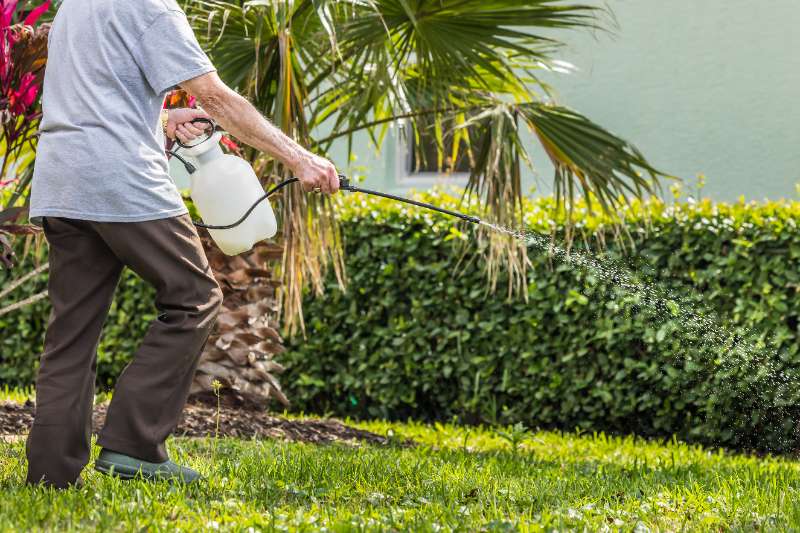
Once you know what type of weed you’re dealing with, you can pick a control method that actually works. The wrong product can waste your money or even harm your lawn, so matching the treatment to the weed is key.
“Identifying the type of weed you’re treating is important because many post-emergent herbicides are selective, meaning they’re designed to control certain plants while leaving others relatively unaffected,” Hallal says. “For example, some products target broadleaf weeds without harming established turfgrass, while others specifically kill grassy weeds.”
“Non-selective herbicides like FireHawk Bioherbicide work differently, acting directly on green plant tissue to cause rapid desiccation. Because they are non-selective, they can also damage desirable turfgrass and other plants if sprayed directly.”
Here’s how your approach changes by weed type:
- Broadleaf weeds: Selective herbicides target these weeds without hurting your turfgrass, unlike non-selective products (like glyphosate) that kill everything they touch. If you prefer hand-pulling, remove the entire taproot, since any piece left behind can regrow.
- Grassy weeds: These are trickier because they’re closely related to your lawn. A pre-emergent herbicide applied before they sprout is often your best bet, since many post-emergent products can damage your turf too.
- Sedges: Sedges need their own specialty herbicides, as products made for broadleaf or grassy weeds usually won’t touch them.
No matter the weed, a thick, healthy lawn is your best long-term defense. Proper lawn mowing service, watering, and fertilizing crowd out weeds before they get a foothold.
Read more:
- How to Control Broadleaf Weeds
- How to Identify and Control Grassy Weeds
- How to Identify and Get Rid of Nutsedge in Your Lawn
FAQs
How long does it take to get rid of established weeds?
It depends on the weed and the method. A post-emergent herbicide can knock back many broadleaf weeds within a week or two, but perennials with deep roots often need repeat applications over a full season. Staying on top of mowing your lawn speeds up long-term results by keeping new weeds from taking over.
Can the same herbicide kill both broadleaf and grassy weeds?
Usually not. Selective herbicides are formulated for one type and may leave the other untouched, which is why matching the product to the weed matters. Annual weeds are easier to control than perennial weeds, and correct identification tells you which weed killer to use and when.
What category is nutsedge?
Nutsedge (also called nutgrass) is a sedge, not a grassy weed, even though it looks grass-like. One quick tell: Sedge stems are triangular and roll between your fingers, while true grass stems are round. That distinction matters for control, because many weed killers made for grassy weeds won’t touch sedges.
Are there broadleaf weeds that look like grasses?
There are some broadleaf weeds that do look like grass, such as doveweed. However, that doesn’t make them grassy weeds. Their method of control can be quite different, so always check your weeds carefully using the identification tips in this article.
Make weed control easy with LawnLove
If you’re unsure about your weed ID skills or short on time, let a pro handle it. LawnLove’s local lawn treatment service providers have the expertise to clear the weeds plaguing your lawn so you don’t have to.
Get a free estimate today and let a LawnLove pro take care of your lawn care and landscaping needs, including weed control.
Read more:
Main Photo Credit: Justin Smith | Canva Pro
Related Posts: