| Key Takeaways |
|---|
| • The Supreme Court ruled 7–2 that federal law (FIFRA) blocks state "failure-to-warn" lawsuits when the EPA approved a pesticide's label without a cancer warning. • It did NOT ban Roundup or rule it safe. Roundup is still legal and sold nationwide, and the cancer debate is unresolved. • Most Roundup sold for home lawns and gardens has been reformulated away from glyphosate since 2023, but some consumer products still contain it. |
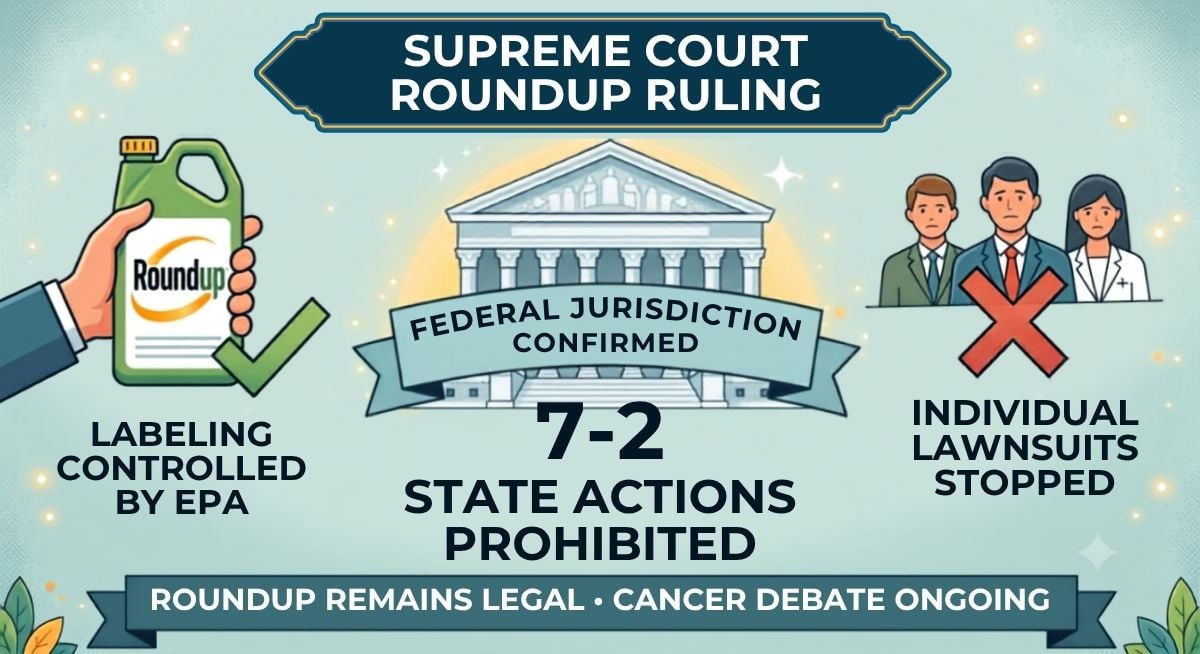
A recent ruling by the U.S. Supreme Court handed Monsanto (owned by Bayer) a massive victory in the endless legal war over Roundup, the most widely used weed killer in the U.S. In a 7–2 decision, the Supreme Court shut down a wave of lawsuits claiming Roundup needed a cancer warning.
The Supreme Court did not ban Roundup, nor did it declare the chemical safe. This was a strict ruling about lawsuits and labeling laws, not a new scientific finding.
What the Supreme Court actually ruled
The case, Monsanto v. Durnell, centered on John Durnell, who blamed his non-Hodgkin lymphoma on years of Roundup use and won a $1.25 million Missouri jury verdict in 2023.
The core legal question: Can someone sue Roundup’s maker under state law for failing to warn about a cancer risk, when the EPA (the federal agency that regulates pesticides) approved the label without that warning?
In a ruling on June 25, 2026, the Supreme Court ruling said no.
Writing for the 7–2 majority, Justice Brett Kavanaugh reasoned that the Federal Insecticide, Fungicide, and Rodenticide Act (FIFRA) overrides those state failure-to-warn claims once the EPA made its safety determination. Justices Ketanji Brown Jackson and Neil Gorsuch dissented.
Chad D. Cummings, founding attorney and CEO at Cummings & Cummings Law in Bonita Springs, Florida, says this decision completely disarms consumers.
“The Durnell ruling eliminated the most common legal theory consumers had against pesticide manufacturers,” Cummings says. “I advise my clients that failure-to-warn claims under state law are now dead on arrival for any EPA-registered pesticide, not just Roundup. Consumers (and attorneys) who relied on that cause of action have lost their primary weapon.”
Beyond individual lawsuits, Cummings says this ruling gives chemical giants a massive shield against future local laws.
“Bayer and the agricultural lobby will cite Durnell to kill state pesticide-liability bills, arguing that Congress intended federal uniformity,” Cummings says. “State legislators will find it politically difficult to pass labeling laws that courts will preempt on day one. EPA approval now functions as a liability shield, which removes the financial incentive for manufacturers to update warnings voluntarily.”
What the ruling does NOT mean
This is where headlines mislead people. The ruling:
Did NOT ban Roundup or glyphosate.
Did NOT declare Roundup “safe.” The Court didn’t rule on the actual science.
Did NOT resolve whether glyphosate causes cancer. That debate continues. The EPA says glyphosate is “not likely” carcinogenic when used as directed, while the World Health Organization’s IARC classified it as “probably carcinogenic to humans” back in 2015.
Read more: Is Roundup Dangerous After It Dries?
What happens to the 61,000 Roundup lawsuits?
This ruling reshapes a massive body of litigation. To date, Bayer has settled around 100,000 Roundup lawsuits and paid out about $11 billion through large-scale block settlements and pre-trial resolutions.
Those payouts account for two-thirds of the more than 170,000 cases filed since litigation began, and roughly 61,000 Roundup lawsuits remain active, with several thousand consolidated in a federal court in California.
Because most of those cases rest on failure-to-warn claims the Supreme Court just shot down, judges will likely dismiss many of the current suits and block similar future ones.
To clear the rest of the docket, Bayer is pushing a nationwide class settlement reported at around $7.25 billion to cover most of the remaining plaintiffs, which has received preliminary approval from a Missouri court.
Cummings says that the timing of this Supreme Court decision traps thousands of victims who already agreed to settle.
“The settlement and the ruling should not be conflated (they are distinct),” Cummings says. “The opt-out deadline passed before the Court issued its opinion, which means thousands of claimants made irreversible decisions without knowing Durnell would gut their trial prospects.”
If you get sick down the road, your legal options are bleak.
“Future claimants whose injuries manifest years from now face a brutal calculus,” Cummings says. “The settlement caps individual payouts as low as $6,000 after fees, yet independent litigation now requires surviving a preemption motion before even reaching discovery.”
To even get a foot in the door of a courtroom now, lawyers have to turn to much harder, vastly more expensive arguments.
“Plaintiffs must now pivot to design defect, negligent testing, fraudulent concealment, and statutory consumer protection claims,” Cummings explains. “Each of these theories carries a higher evidentiary burden than failure-to-warn but are still workable in many jurisdictions.”
“I see design defects as the strongest surviving theory, but plaintiffs must prove a reasonable alternative formulation existed, which requires expensive expert testimony that most claimants cannot afford.”
Is Roundup still legal and on store shelves?
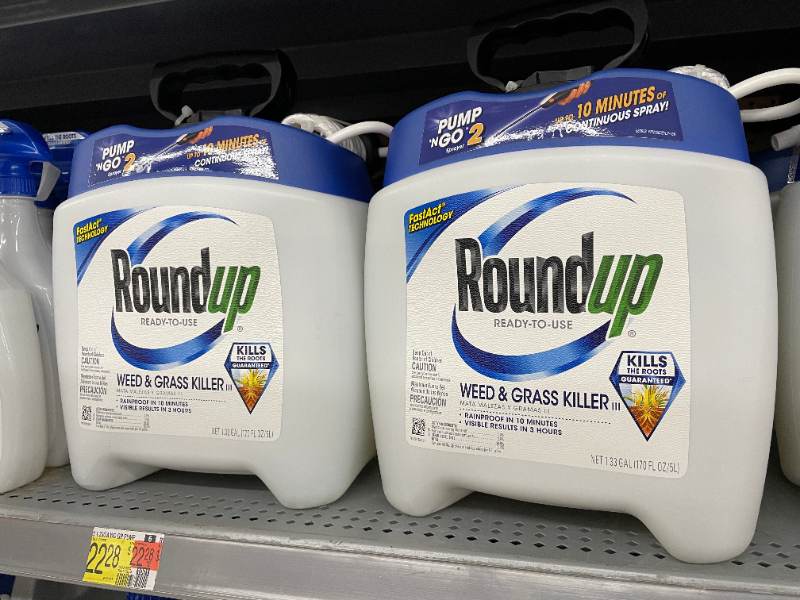
Yes. Glyphosate remains federally registered. Roundup products are still sitting on store shelves nationwide and remain legal to use according to label directions.
The EPA is completing its FIFRA‑mandated 15-year registration review of glyphosate, with a final decision expected by late 2026, which could bring new label warnings or usage guidance.
Local governments are not waiting for the EPA. Numerous U.S. cities and counties, like New York City, Portland, Miami, Baltimore, and Los Angeles County, have already restricted or outright banned glyphosate and other broad lawn pesticides.
Read more: All-Natural and Organic Weed Killers
Is the Roundup in your garage affected?
The Roundup you buy for your lawn or garden may not even contain glyphosate. Starting in late 2022, Bayer reformulated its U.S. residential Roundup lawn‑and‑garden line to use different active ingredients (fluazifop‑p‑butyl, triclopyr TEA salt, diquat dibromide, and imazapic ammonium) in a move the company says was driven by litigation risk, and not safety concerns about glyphosate.
Taylor Olberding, franchise owner at Heroes Lawn Care in Omaha, Nebraska, says the change was strictly about dodging lawsuits, not protecting homeowners.
“If you’re expecting the same results from the bottles sitting on the home improvement store shelves right now compared to what we all got used to buying years ago, you might be in for a huge surprise,” Olberding says.
“When they swapped out glyphosate for this new chemical cocktail, they didn’t really do it to give a safer or more effective product to clean up your driveway cracks,” he explains. “They did it to escape a massive never-ending mountain of courtroom lawsuits.”
So this ruling doesn’t just concern older glyphosate formulas or big farm sprayers, but it also reaches any EPA‑registered pesticide, whether it’s glyphosate‑based or one of the newer Roundup mixes.
If you bought Roundup recently, the active ingredient is different. But different does not mean better.
“I’ve noticed that while the brand-new formula hits the weeds incredibly fast, making everything look withered and totally dead within just a couple of hours because of the intense burn-down chemicals they threw into the mix, it actually struggles to completely destroy the deep stubborn root system of older perennial weeds,” Olberding says.
That means you have to spray the exact same spots over and over. And the new chemicals behave differently in your soil.
“To make matters worse, you really have to watch your step because one of the new ingredients, triclopyr, travels through the dirt in a way old Roundup never did,” Olberding warns.
“If you just casually spray a bunch of weeds growing right over the root zones of your favorite oak tree or your prized rose bushes without thinking about it, you are probably going to accidentally poison and kill your expensive landscaping plants.
“Just because a corporate giant changes its formula doesn’t mean it’s suddenly gentle or foolproof for a regular DIY homeowner to handle without some serious caution,” Olberding adds.
What it means for you
- If you use Roundup: If you still plan to use the bottle sitting in your garage, nothing changes on the safety front. Wait until it’s fully dry, wear protective gear, and keep kids, pets, and pollinators away from wet spray.
- If you’re worried about glyphosate: If it makes you nervous, check the back of your bottle first. You can swap it out for homemade remedies, transition to natural weed killers, or hand the entire mess off to a professional weed control service.
- If you think you were harmed: If you believe this chemical harmed you, consult a qualified attorney about how the ruling affects your situation.
Read more:
FAQs
Diquat dibromide is banned in 35 countries, including in the European Union, the United Kingdom, and Switzerland. Global regulators pulled the chemical due to severe toxicity risks and dangers to agricultural workers.
Despite those international restrictions, the ingredient remains completely legal and common in the U.S., which is exactly why it ended up in Bayer’s reformulated residential products.
Days after the ruling, Reps. Chellie Pingree and Thomas Massie introduced the bipartisan People Over Poison Act, which would amend FIFRA to state that federal law doesn’t block state-law claims over pesticide labeling, directly undoing the Durnell precedent.
The bill is still in the early stages of the legislative process, and its path forward remains uncertain.
The Durnell ruling only preempts state lawsuits over label warnings, and it doesn’t touch states’ and cities’ separate authority to restrict where and how pesticides can be sprayed. Local bans remain intact and enforceable.
A federal judge handling the paraquat lawsuits (a Parkinson’s disease lawsuit involving a different weedkiller) paused a key motion to wait for the Durnell ruling. The exact same federal logic that protected Bayer could destroy the failure-to-warn claims in the paraquat fight.
Hire a local weed control pro
Whatever you make of the Roundup debate, the goal is usually the same: a weed-free lawn without the guesswork. Lawn Love connects you with a local weed control pro who can assess your yard and treat the weeds safely and effectively.
Disclaimer: This article is for general information only and is not legal or medical advice.
Main Image: Infographic summarizing the Supreme Court’s 7–2 decision upholding federal preemption in the Roundup herbicide case, blocking state-level cancer lawsuits. Photo Credit: created using Gemini AI
Related Posts: