| Key takeaways |
|---|
| • Clover attracts bees only when in flower — mowing during bloom drops bee activity within 24–48 hours. • Microclover has fewer flowers than white clover, so fewer bees. • Talk to a doctor before planting if anyone in your home has a bee sting allergy. |
Clover lawn and bees go together — but mostly when the clover is in bloom. Mow off the flower heads and bee activity drops in a day or two. Microclover and clover-grass blends draw fewer bees from the start.
For most households, the bees are worth putting up with. They’re useful pollinators and rarely sting unless stepped on. It’s a different story if someone in your home has a bee sting allergy or if you’ve got young kids running around barefoot.
If you’d rather hand the mowing off to a pro, Lawn Love can match you with local lawn care professionals who can keep your clover lawn on a steady schedule through bloom season.
Do clover lawns attract bees?

Yes. White clover is one of the most bee-friendly plants in a residential yard. Its dense, nectar-rich flower heads pull in honey bees, bumble bees, and native bees, and it’s one of the top nectar sources for honey bees across North America.
One thing to know: Bees go for clover flowers, not the leaves. A clover lawn that isn’t blooming (just mowed, in the off-season, or between bloom rounds) draws about as many bees as a regular grass lawn.
It’s also worth knowing that bees aren’t aggressive by default. “Most bees are content to leave people alone,” says Andrea DeLong-Amaya, horticulture educator at the Lady Bird Johnson Wildflower Center and author of The Texas Native Plant Primer.
When are clover lawns most attractive to bees?
Bee activity in a clover lawn depends on two things: bloom season and time of day.
Clover types vs. bee activity
| Clover type | Bloom & flower density | Relative bee activity |
| White clover | May to September, lots of flowers | High |
| Microclover | May to September, fewer and smaller flowers | Low to moderate |
| Clover-grass blend | May to September, flowers spread thin | Low |
White clover bloom season. May through September across most of the U.S. In warmer Southern zones (USDA hardiness Zones 8 and 9), bloom can start as early as March.
Each flower head is a tight ball of up to 100 tiny flowers, according to NCSU Extension. Every one makes nectar — which is what brings the bees.
Microclover bloom season. Microclover blooms across the same May-to-September window as white clover, but it puts out fewer and smaller flowers, according to UMD Extension. That means less nectar per square foot and a lot fewer bees feeding at any one time.
Time of day. Honey bees are busiest from late morning through mid afternoon, roughly 10 a.m. to 4 p.m., according to WSU Extension. Early mornings and late afternoons are the best times for barefoot outdoor play.
How to reduce bee activity in a clover lawn

If you want to enjoy a clover lawn without all the “buzz,” there are ways to reduce the number of bees.
Mow during bloom season
Mowing takes off the flower heads, which cuts off the bees’ food source. Within 24 to 48 hours of mowing a blooming clover lawn, bee activity drops fast.
Pro tip: Mow every 2 to 3 weeks during peak bloom (June through August) instead of letting your lawn flower fully between cuts. That keeps flower count low and bee activity down.
Choose microclover instead of white clover
Microclover is a small version of white clover, bred to produce fewer, smaller flowers and grow closer to the ground.
It blooms across the same summer season as white clover, but the flowers are sparser and harder to spot. Less nectar means fewer bees at any one time.
Use a clover-grass blend
A lawn that’s mostly grass with a little clover mixed in will have far fewer flowers at any one time than a pure clover lawn. Most extension and seed industry sources recommend keeping microclover at about 5% of a grass seed mix by weight.
The grass spreads out the flowers, which cuts down on both nectar and bee traffic. You still get the soil and weed benefits of clover without the bee activity of a pure clover lawn.
Plan outdoor activities around mowing
If you’re hosting a backyard get-together or want to let kids play barefoot, mow a day or two before. The flower heads will be gone, and bee activity will stay low for the next 10 days while new flowers come in.
Mow a path through your lawn
If only part of your lawn is in bloom at a given time, you can mow just the spots where kids or bare feet are most likely to be. You don’t have to mow the whole lawn. Bees go where flowers are, so a freshly mowed patch is basically bee-free.
- Reasons Why a Clover Lawn is Better Than a Grass Lawn
- Common Types of Clover for Your Yard
- Benefits of Planting Clover in Your Yard
Clover lawn and bee sting allergies

About 3% of the U.S. population has insect sting allergies, according to Asthma and Allergy Foundation of America. The CDC reports an average of 72 deaths a year in the U.S. from hornet, wasp, and bee stings.
“Most stings occur when someone accidentally steps on a bee,” DeLong-Amaya says.
Mild bee sting reactions (pain at the sting spot, swelling, redness) are normal and common, and not allergies. They’re just how your body responds to a sting.
Swelling can spread past the sting spot and still be normal. The USDA ARS Carl Hayden Bee Research Center notes that a sting on the finger can cause swelling all the way to the elbow. That looks alarming, but it usually isn’t dangerous.
Bee sting allergy (anaphylaxis) is a serious reaction that can be life-threatening. Symptoms include hives, trouble breathing, dizziness, or passing out. According to the USDA ARS, they usually start within minutes of the sting.
Warning signs to act on
USDA ARS gives a clear sign you need emergency care: if you’re stung on one hand and swelling shows up on the other hand or your neck, that’s a full-body reaction, not local swelling
Other warning signs of a full-body reaction:
- Hives
- Nausea
- Lightheadedness
- Stomach cramps
- Vomiting
- Diarrhea
- Low blood pressure
Over-the-counter allergy meds can help with mild symptoms. Bad reactions need emergency care.
Note: If you or someone in your family has had a full-body reaction to a bee sting, talk to an allergist before making any lawn choice based on bees. The American College of Allergy, Asthma & Immunology (ACAAI) notes that venom immunotherapy is highly effective at preventing future systemic reactions and is worth asking about.
For families with a known severe bee sting allergy, the best move is to not risk it and avoid planting clover altogether. But, if you do choose to add clover:
- Choose microclover over white clover to cut down on flowers and bees.
- Use a clover-grass blend instead of a pure clover lawn.
- Mow often during bloom to keep the flower heads short.
- Keep an EpiPen on hand outdoors, no matter what kind of lawn you have.
A quick note on stinger first aid
Honey bees lose their stinger and venom sac when they sting. That’s why a honey bee dies after stinging once. The stinger left behind can keep pumping venom for up to a minute after the bee is gone.
Scrape it out with a credit card, knife edge, or fingernail. Don’t pull it out with tweezers or your fingers, because that squeezes more venom into your body (USDA ARS).
Bumble bees and wasps don’t lose their stingers and can sting more than once, so the scrape-out trick is just for honey bees.
The case for keeping the bees
Bees are in trouble. Honey bees and native bees are facing serious pressure from habitat loss, pesticide use, and disease. Planting a clover lawn, especially a white clover lawn in full bloom, is one of the easiest things a homeowner can do to help local pollinators.
Clover fills the late-spring gap. It flowers during a window when many early flowers have faded, and late-summer plants haven’t started yet. That makes it a key food source for honey bees, keeping their colonies healthy, and for native bees stocking their nests.
The clover effect on bee health: USDA Agricultural Research Service research found that honey bee colonies feeding on clover-covered land graded A (the top health score) 78% of the time. Colonies kept near heavily farmed crop fields were graded A 20% of the time.
Read more: How to Create a Pollinator Lawn
FAQs
Not really. Wasps and yellow jackets hunt other bugs more than they go after flowers. The clover crowd is mostly honey bees, bumble bees, and native bees. Heavy wasp activity in your yard usually means there’s a hidden nest in a wall, eave, or ground hole.
Yes, but it takes work. Pull small patches by the roots. For bigger spreads, aerate, overseed with grass, and mow higher (3 to 4 inches) to crowd the clover out. Broadleaf herbicides also work, but will kill other broadleaf plants you’ve got. If you mainly want fewer bees, mowing during bloom is the easier fix.
Mow in the early morning or late evening, when bees are least active. Honey bees forage the most from late morning through early afternoon, so mowing outside that window is safest.
Hire a local lawn care pro
Starting a clover lawn and managing bee activity through the season takes a little planning and some know-how.
If you’d rather hand it to someone who does this every day, Lawn Love can match you with local lawn care professionals who can keep your lawn on a steady schedule through the season. Get a free instant quote, pick a time, and a vetted local pro takes it from there.
Read more: How to Get Rid of Clover on Your Lawn
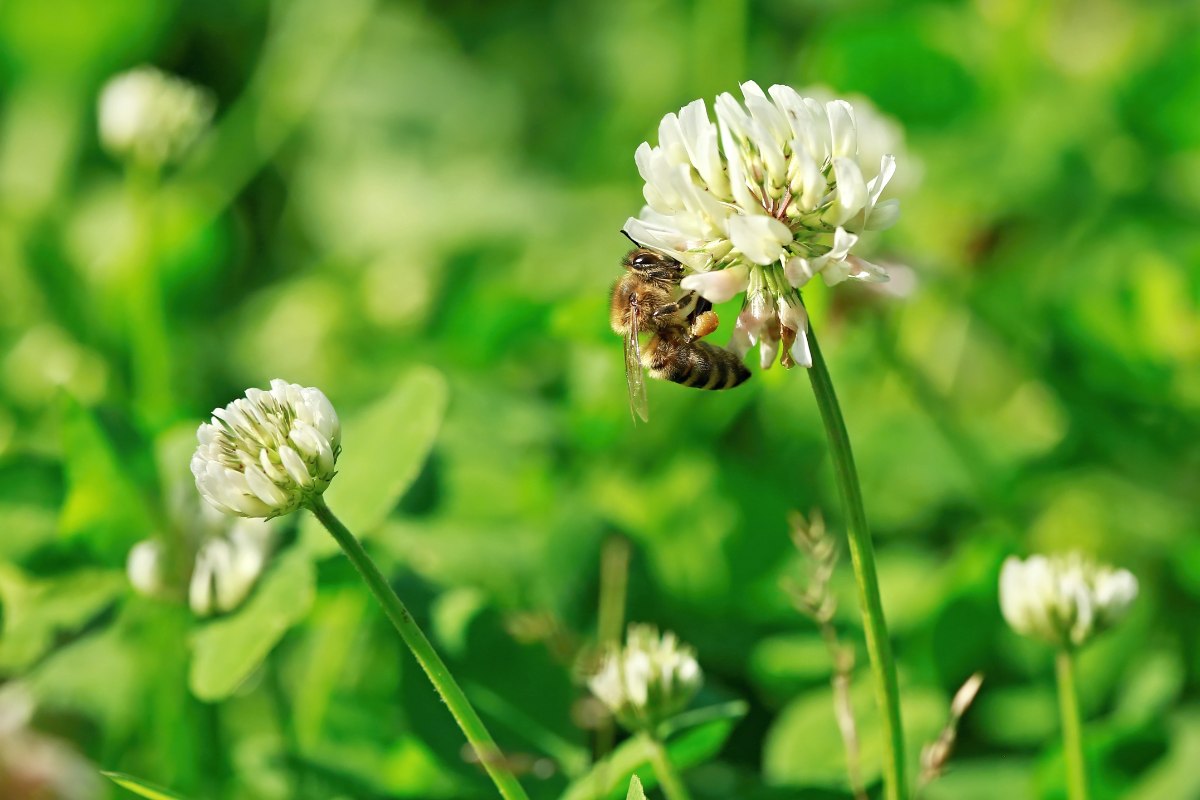
Main Image: A bee collecting pollen from a white clover flower on a sunny day. Photo Credit: Lioneska / Adobe Stock
Related Posts: