| Key Takeaways |
|---|
| ● Prevention is simple: Drink 1 cup of water every 15 to 20 minutes, rest in the shade, and stop at the first warning sign. ● Know the difference: Heat exhaustion is serious but treatable; heat stroke is a 911 medical emergency. Risk isn’t equal: Adults 65 and older, children, people on blood pressure medications or antidepressants, and anyone with a heart condition face higher risk. |
Mowing the lawn in extreme heat puts more strain on your body than most people expect. Heat exhaustion, and even heat stroke, can set in during a routine mow, not just after hours of hard labor.
The numbers back that up. A Lawn Love analysis of Consumer Product Safety Commission (CPSC) data shows an estimated 5,800 people landed in the ER with mowing-related heat illness from 2023 to 2025. 1 in 5 needed hospitalization, nearly double the rate for adult mowing injuries overall.
If you or someone in your household has to mow in this heat, learn the warning signs first. Or hire a Lawn Love pro and stay out of the sun altogether.
Why mowing in extreme heat is a health risk
According to Rebecca Stearns, chief operating officer of the Korey Stringer Institute, exertional heat stroke (EHS) has the highest risk when several factors combine: how hard you’re working (relative to your fitness), the heat around you, your hydration, and how used to the heat you are.
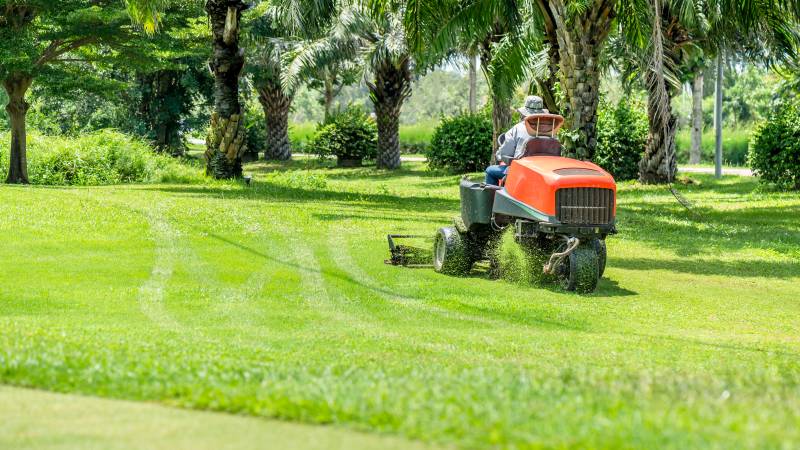
“Mowing has multiple risks at once,” she says. “It’s sustained physical exertion (pushing a mower), commonly done in the hottest part of the day (or at least during the day), and can occur without much acclimatization if it’s the first hot day of the season or the first mow after a break.”
A sudden jump in temperature can outpace what your body is ready for. Stearns says your body needs 5 to 7 days of progressively harder work in the heat to get used to it.
“A person who mowed fine in cooler spring weather and then does the same mow on the first 95-degree day of summer is essentially an ‘unacclimatized new worker’,” she says, “one of the highest-risk categories.”
That doesn’t mean every hot-day mow is a medical emergency. For someone using a push mower, Stearns says the risk of heat stroke is probably not that high, as long as they take simple precautions.
Most people aren’t motivated to push past their limits on a chore, and they can take breaks or move the mowing to a cooler time of day. The risk drops when people heed those signals and adjust their plans, she says.
Heat exhaustion vs. heat stroke: Know the difference
Heat exhaustion means your body is struggling to cool itself. Heat stroke means it can’t anymore. That’s the line between something you can handle in the shade and something you call 911 for.
Untreated heat exhaustion can turn into heat stroke, but heat stroke can also strike without warning.
| Heat exhaustion | Heat stroke | |
| What it is | The body’s response to losing too much water and salt through sweating | The body’s temperature control system has failed |
| Symptoms | Headache, nausea, dizziness, weakness, irritability, thirst, heavy sweating, fainting, elevated body temperature, decreased urine output | Confusion, altered mental status, slurred speech, hot, dry skin or profuse sweating, seizures, very high body temperature (104 degrees or higher), loss of consciousness |
| What to do | Move to a cool place, remove excess clothing, sip cool water, apply cold compresses, then have a medical evaluation | Call 911 immediately, move to shade, and start cooling; don’t wait for EMS. Best: cold-water immersion. Next best: soak them with a hose or cold shower and fan them. If neither is available: cold wet cloths or ice on the head, neck, and armpits. Stay with the person. |
Sources: NIOSH, Mayo Clinic, Rebecca Stearns (Korey Stringer Institute)
How hot is too hot to mow?
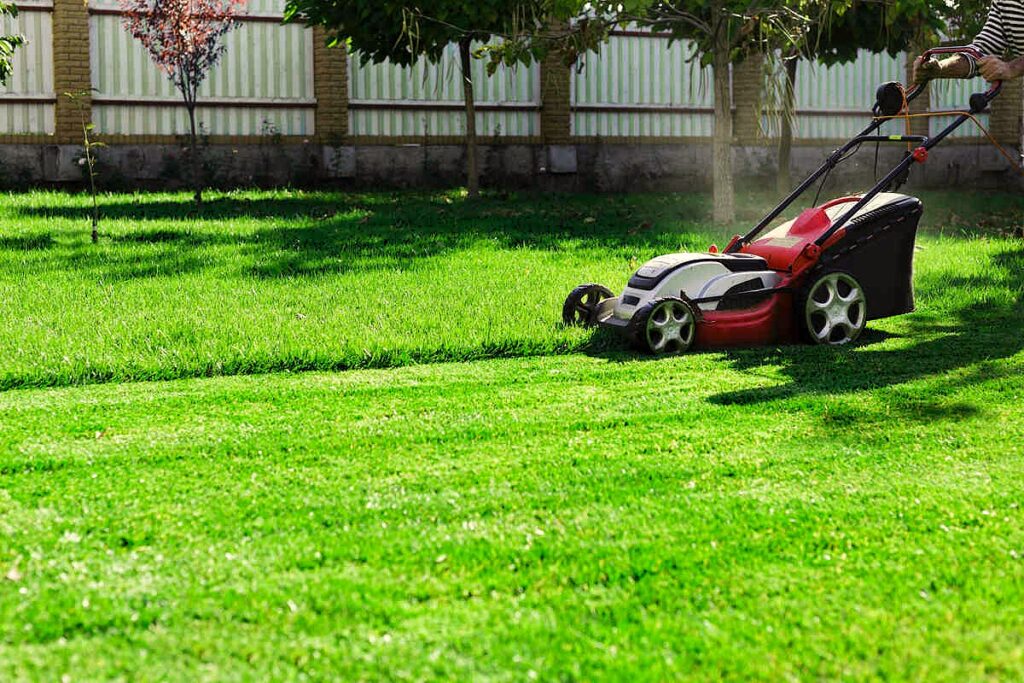
Once the heat index reaches 90 degrees, mowing in open sun gets risky, because direct sunlight can add up to 15 degrees to what the forecast says.
More relevant than temperature, the heat index folds in humidity because humid air keeps sweat from evaporating. The National Weather Service (NWS) sorts it into 4 groups:
| Heat index | NWS classification | What it means for someone mowing |
| 80 to 90 degrees | Caution | Fatigue possible with prolonged exposure or physical activity |
| 90 to 103 degrees | Extreme Caution | Heat cramps, heat exhaustion, or heat stroke possible with prolonged exposure and physical activity |
| 103 to 124 degrees | Danger | Heat cramps or heat exhaustion likely; heat stroke possible with prolonged exposure or physical activity |
| 125 degrees or higher | Extreme danger | Heat stroke very likely |
Source: NWS
The chart assumes shade. A forecast index of 90 (the low end of Extreme Caution) can effectively be 105 on an open lawn at noon, squarely inside the Danger zone.
For a local answer, enter your ZIP code on the CDC HeatRisk Dashboard. You’ll see the daily heat-risk level and the groups most at risk.
Read more: Lawn Care for Seniors: Signs It’s Time to Stop Mowing Your Own Lawn
Precautions to take if you mow anyway
If mowing can’t wait, these steps reduce your risk:
- Mow during the coolest window of the day. Early morning, before 10 a.m., is safest.
- Drink about 1 cup (8 oz.) of water every 15 to 20 minutes. Don’t wait until you’re thirsty.
- Take a break in the shade at the first sign of overheating.
- Wear light-colored, breathable clothing, a wide-brimmed hat, and sunscreen.
- Eat beforehand and skip alcohol, which the National Institute for Occupational Safety and Health (NIOSH) warns worsens dehydration. A normal (not heavy) meal replaces the salt and electrolytes you lose through sweat.
- Don’t mow alone during a heat wave. Use a buddy system with check-ins several times an hour. Somebody else will notice your confusion before you do.
Read more: How to Mow Grass in Extreme Heat Without Damaging Your Lawn
Warning signs you need to stop right now
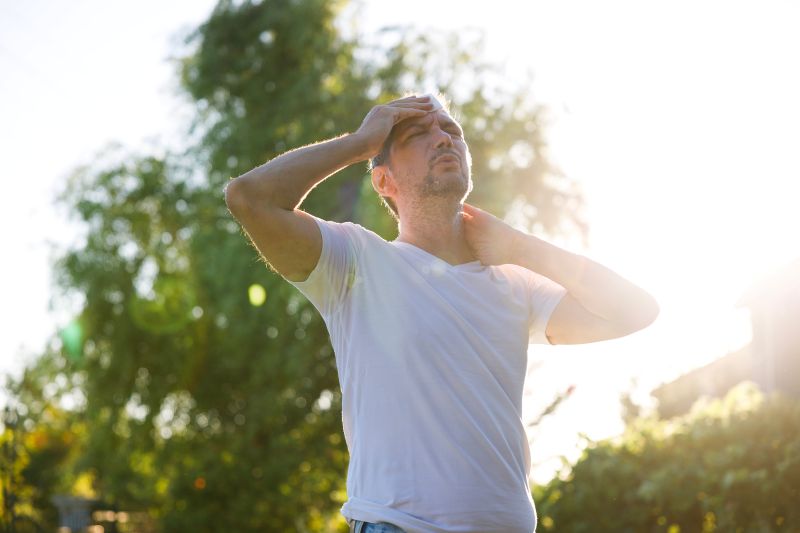
Watch for signs such as:
- Unusual fatigue
- Dizziness or lightheadedness
- Nausea, loss of coordination, or trouble concentrating
When you notice these symptoms, stop mowing immediately and get out of the heat, says Zachary Schlader, associate professor of kinesiology at Indiana University School of Public Health-Bloomington.
Stearns agrees. “Don’t try to finish the row,” she says. Then cool actively: Shade and rest barely lower core body temperature on their own, so pair them with air conditioning, a fan, and cool water on your skin. Air moving over wet skin significantly speeds up cooling, she says.
Sip cool water or an electrolyte drink while you cool. If symptoms get worse, last longer than an hour, or you start vomiting, get to urgent care or an ER.
One complication worth knowing
Rhabdomyolysis happens when muscle tissue breaks down and damages the kidneys. It’s rare with mowing, and the signs show up hours or days later, long after you finished the work.
Schlader says telling it apart from ordinary soreness is tough. Normal post-mow soreness is milder and fades in 2 to 3 days. With rhabdomyolysis, the pain is worse, the muscle can swell, and it lasts longer.
The clearest sign is your urine: “Rhabdo is also accompanied by very dark urine and may be difficult to urinate — which is probably the key differentiating factor,” he says. Either one means go to the ER.
When to call 911 and what to do
Heat stroke is a medical emergency. Call 911 if you notice these signs of cognitive dysfunction, which Stearns says can look “similar to a concussion or, as strange as it sounds, someone who is inebriated.”
Call 911 if you notice:
- Confusion, disorientation, slurred speech, or acting “not like themselves”
- Loss of consciousness or collapse
- Inability to respond normally or follow directions
“If you’re debating whether it’s ‘bad enough’ to call, that hesitation is itself the sign to call,” she says.
Then start cooling. Don’t wait for EMS. Cooling within the first 30 minutes of onset is what determines whether the person lives, dies, or ends up with long-term complications, she says.
- Move the person to shade or air conditioning and remove outer clothing
- Get them into cold water: a bathtub, a kiddie pool, or a hose soaking their clothes
- Keep air moving around them
- Keep cooling until EMS takes over
- If they’re not alert and can’t follow instructions, give nothing by mouth
Who’s most at risk
Factors such as low fitness, not being used to heat, and cardiac disease affect the body’s ability to dissipate heat and increase the risk, Stearns says. “And medications like beta-blockers or common antidepressants like SSRIs increase heat intolerance.”
One high-risk group is adults 65 and older. This category is nearly 4 times as likely as younger adults to visit the ER for a mowing-related heat illness, according to CPSC data. When they do, they’re admitted to the hospital about twice as often.
For an aging parent, the safest answer during a heat wave is usually to let the grass grow. A delayed mow costs you a slightly shaggy lawn; the alternative can cost far more.
Read more: How to Manage Your Aging Parents’ Lawn Care: Risks, Conversations, and Solutions
FAQ
Yes. Heat stroke can escalate fast: Once it sets in, body temperature can climb to 106 degrees or higher within 10 to 15 minutes, according to NIOSH. Stop at the first mild symptom. Don’t wait to see if it gets worse.
Early morning is generally better. Temperatures are typically lowest, and you’ll have daylight to spot hazards like holes or debris. If morning isn’t possible, evening after the sun drops is a reasonable second choice.
For a few days, yes. Grass tolerates a delayed mow far better than a person tolerates heat stroke. If it drags on, mow during the safest hours yourself, or hire a pro.
Hire a local lawn care pro
If midday is the only time you can mow, the health risk isn’t worth it. Get an instant quote, choose a time, and a background-checked lawn mowing pro will handle the rest.
Read more: Summer Lawn Care Tips: Mow, Water & Maintain
Sources:
- Rebecca Stearns, chief operating officer of the Korey Stringer Institute and Associate Professor in Residence, Department of Kinesiology, University of Connecticut, Storrs, CT. Personal interview.
- Zachary Schlader, associate professor of kinesiology at Indiana University School of Public Health-Bloomington, Bloomington, IN. Personal interview.
- Lawn Love analysis of U.S. Consumer Product Safety Commission (CPSC) National Electronic Injury Surveillance System (NEISS) data, 2023–2025, lawn mower product codes, adults 18+. Figures are weighted national estimates of emergency-room-treated injuries and are approximate. Population rates use U.S. Census Bureau Vintage 2025 national population estimates, averaged over 2023–2025.
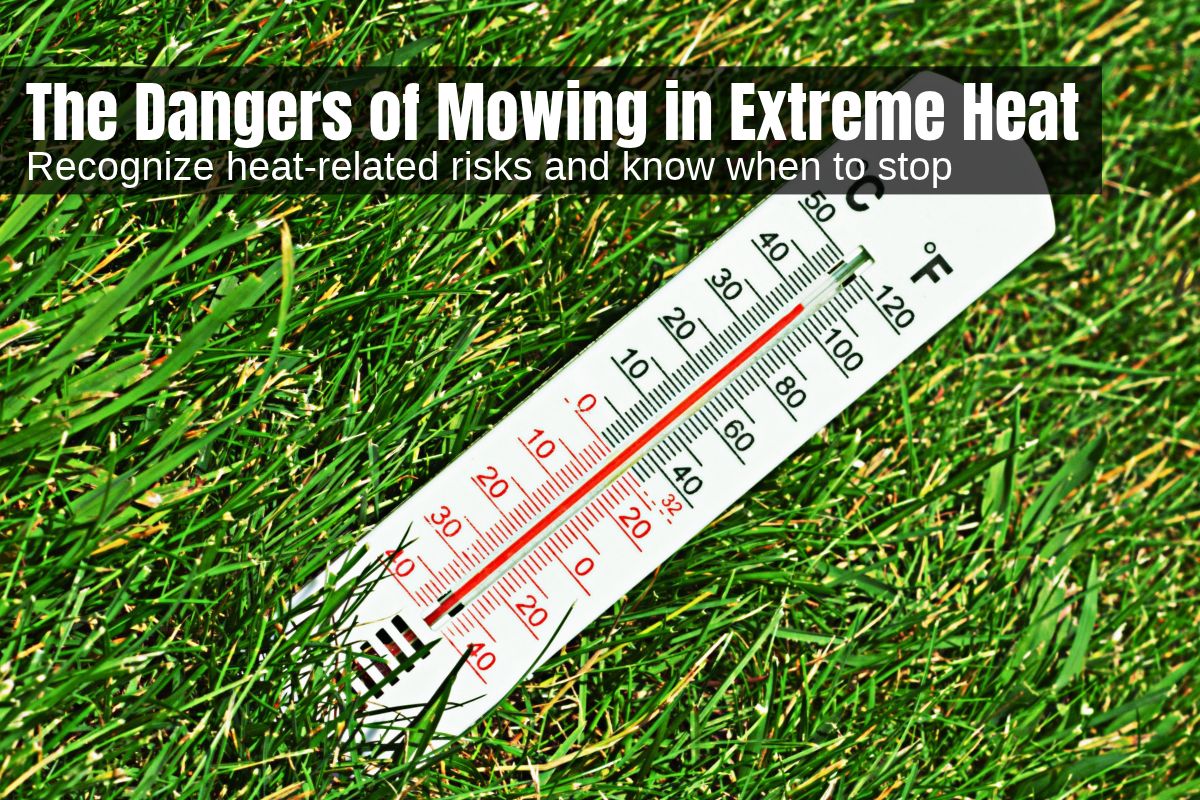
Main Image: A thermometer lying on a green lawn during summer heat. Photo Credit: Irina / Adobe Stock
Related Posts: