
Alternating your mowing direction might seem like a minor detail, but it makes a significant difference for your lawn’s health. This simple practice keeps your grass in excellent condition and helps ward off winter problems like snow mold and water accumulation.
Understanding why mowing pattern variation matters becomes especially important as you tackle that final seasonal cut.
While the principle is straightforward, it does require some additional attention. If you prefer to entrust this work to someone with a little more know-how, consider using a local mowing pro.
Reason 1: It prevents soil compaction and rutting
Keenan L. Amundsen, turfgrass genetics professor at the University of Nebraska–Lincoln warns that repeating the same pattern each time leads to wear and compaction, which can damage turf.
My friend, Tom, bought a riding mower, and midway through the first season noticed that the lawn was becoming rutted from the heavy tractor tires rolling over the same places week after week. The ruts began to fill in shortly after he started varying his mowing pattern, but it took a full year, and an aeration treatment to loosen the compacted soil, for them to recede completely.
Read more: Expert Tips for a Healthy Lawn
Reason 2: It keeps grass from leaning and matting
Grass tends to lean in the direction you mow. If you always mow the same way, the grass blades start growing at an angle rather than standing upright. This “grain” makes the lawn look striped or uneven and can result in an uneven cut.
Reason 3: It helps prevent snow mold
First and foremost, snow mold loves long grass, so it’s important to cut grass a little shorter on your last mow of the season. But matted grass, as mentioned above, is unhealthy grass, and unhealthy grass is susceptible to snow mold in Northern climates.
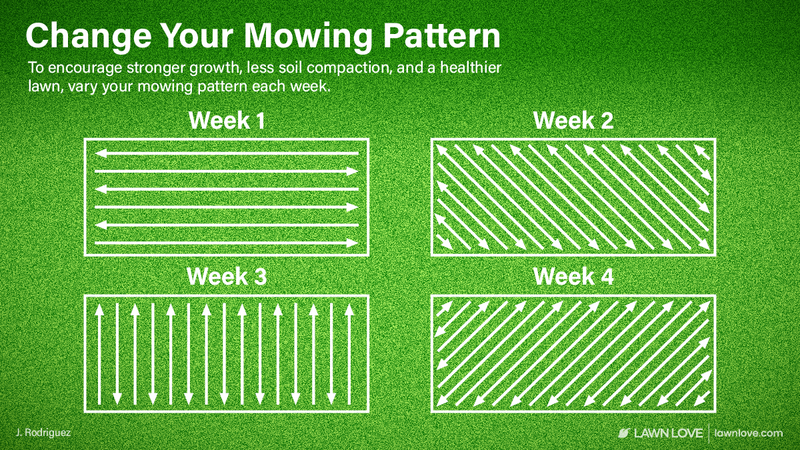
Alternate your mowing pattern 45 to 90 degrees before the winter to create strong, straight blades that are more resistant to diseases like snow mold, Amundsen says.
Read more:
- What is Gray Snow Mold and How to Get Rid of It?
- What is Pink Snow Mold and How to Get Rid of It?
- When to Apply Fall Fertilizer to Your Lawn
Reason 4: It helps keep water from pooling on your lawn
Smart mowing, alone, won’t prevent a water-logged lawn, but it helps. Pushing or driving a mower in the same pattern over and over compacts soil, as we said earlier, and compacted soil simply doesn’t soak up water like it should.
Additionally, water will often flow in the direction grass is leaning, especially if the turf is matted. Alternating mowing patterns keeps grass from leaning, so runoff isn’t forced to flow in one direction all the time.
Read more:
FAQ About Mowing Patterns
No, just make sure you alternate it every time you mow, just like on the rest of your lawn.
No, but you’ll have an easier time striping cool-season grasses like Kentucky bluegrass, because they’re bendy.
Don’t bother trying out different mowing patterns on steep grades. On a steep grade, the best mowing pattern is the one that keeps the mower from tipping or doesn’t cause you to slip and fall.
Throughout the season, and especially when doing your final cut, change the mowing pattern 45 to 90 degrees, if possible. Mowing in straight lines is most effective for this method.
Read more: The Last Mow of the Season: When to Stop Mowing
When to call a pro

Thinking about which direction you need to mow is at least kind of annoying, if not a nuisance. Get this load off your shoulders by calling one of LawnLove’s pros instead. We can help you with mowing, aeration, fertilization, leaf removal, and more.
Main Image: Striping lines. Photo Credit: World Travel Photos / Adobe Stock
Related Posts:


