| Key Takeaways |
|---|
| • Match the method to the infestation: Hand-pull small clover patches, spray a selective broadleaf herbicide on large ones, or smother areas you plan to reseed. • Late summer to early fall is the best time to spray: Clover sends nutrients down to its roots then, so a systemic herbicide travels down with them. • Fix the lawn, not just the weed: Clover is a sign of low nitrogen, compacted soil, or thin turf, so correcting those problems keeps it from coming back. |

To get rid of clover on your lawn, hand-pull small patches, spray larger areas with a selective broadleaf herbicide, or smother patches you plan to reseed. Then fix the lawn problems that let clover move in.
As a creeping perennial, clover can be stubborn, but you don’t have to destroy your lawn to win the war on clover. Below, we cover how to remove it, how to identify it, what causes it, and how to keep it from coming back.
Tall, regularly mowed grass is one of the best defenses against clover, and Lawn Love’s lawn mowing service can keep your grass at the right height all season.
How to get rid of clover
The best way to get rid of clover depends on how much you have. Hand-pull a few small patches, spray widespread clover with a selective broadleaf herbicide, or smother large patches you plan to reseed.
Pick the method that fits your lawn:
| Method | Best for | Keep in mind |
| Selective herbicide | Widespread clover across the lawn | Read the label to make sure it’s safe for your grass type |
| Hand-pulling | A few small patches | You must remove all of the roots |
| Smothering | Large patches you plan to reseed | Kills the grass under the cover, too |
Spraying herbicide on clover
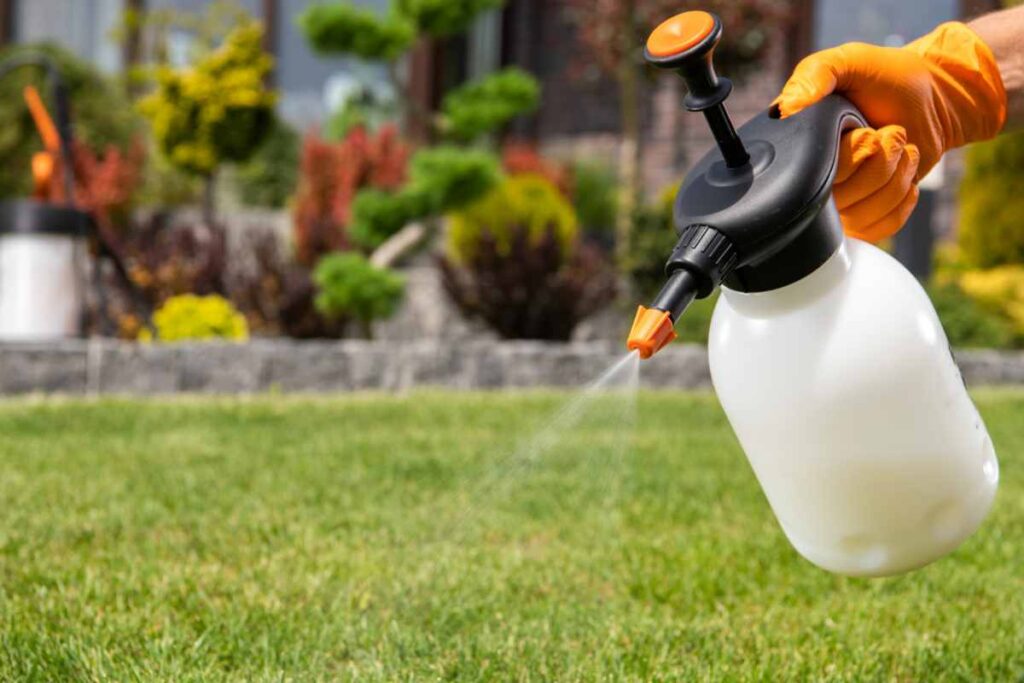
If the clover is already on your lawn, you’ll need a post-emergent weed killer. Use a systemic herbicide for broadleaf weeds such as triclopyr, dicamba, mecoprop (MCPP), 2,4-D, fluroxypyr, and quinclorac.
Note: Some of these herbicides might injure some types of grass. Always read the label before buying to make sure it’s safe for your turf.
Do organic herbicides work on clover?
In a UC Agriculture and Natural Resources article, Karey Windbiel-Rojas, an Integrated Pest Management (IPM) advisor for UC Cooperative Extension, explains that organic herbicides only work on contact. On larger or perennial weeds, they usually just damage the top growth, and the weeds grow back within a couple of weeks.
Herbicides with chelated iron (FeHEDTA) are a better organic-friendly option. They kill broadleaf weeds like clover through iron toxicity but leave grass unharmed, though you’ll likely need several applications per season.
You can also try A.D.I.O.S. (Advanced Development In Organic Solutions), which uses salts to draw water out of clover, drying it up and killing it.
Salt kills any plant it touches and can leave the soil inhospitable, so use it with caution.
When to spray clover with herbicide
If your goal is to eliminate clover, apply broadleaf herbicides in late summer to early fall, says Tim Abbey, commercial horticulture educator with Penn State Extension in York, Pennsylvania.
That’s when broadleaf weeds store nutrients in their roots for winter, so the weed killer travels down to the roots, too.
Organic herbicides can also be sprayed in spring while weeds are young. Summer spraying looks satisfying, but clover usually regrows within days.
Other things to note when spraying:
Rain: Don’t spray before rain or when your lawn is wet.
Wind: Don’t spray if it’s windy out.
Temperature: Don’t spray when air temperatures climb above 90 degrees.
Manually pulling clover
For a few small patches, pull clover by hand. It’s a natural way to kill clover without harming your grass, but it takes more effort than spraying larger areas.
Pull out all of the roots, since clover regrows from root fragments. White clover’s shallow roots make this fairly easy, but deep-rooted species like red clover are tougher.
How to hand-pull clover (you’ll need gloves, a spade, and water):
Moisten the soil before pulling the clover. Or wait until after it rains or you water your lawn or garden beds. Moist soil is easier to work with.
Use the spade to loosen the soil. Work the soil around the clover patch.
Pull up the clover plants carefully, making sure to get all of the roots of the clover patch.
Read more:
Smothering clover
Clover can’t survive without air and sunlight. For large patches, cover the clover with a garbage bag or opaque plastic sheet, and leave it long enough to use up the nutrients stored in its roots.
Secure the edges with bricks or large rocks. After a few weeks, remove the sheet and reseed. Clover with a taproot takes longer to die.
Skip smothering for small or irregular patches, since it also kills the grass around them. It’s best for areas you plan to clear completely.
How to identify clover
This perennial weed is native to Europe and Asia, but it now grows throughout the U.S. There are hundreds of clover species, but the most common clover found in yards is white clover (Trifolium repens).
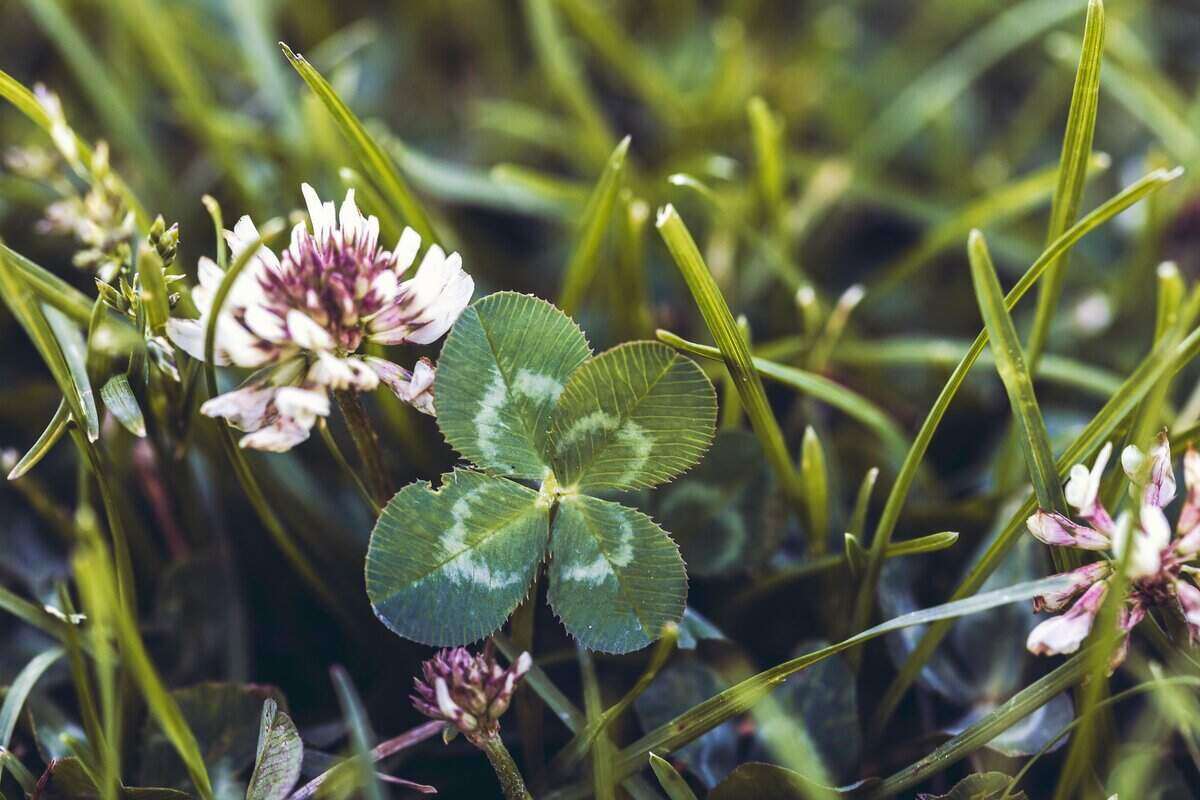
Clover, a legume in the pea family, is one of the most common lawn weeds. Its best-known feature is its 3 “leaves.”
Other features that can help you recognize clover:
Leaves: Made up of 3 leaflets (sometimes there are 4, but that is a mutation). Clover leaves can be green, purple, or red. They often have a white or greenish V-shaped pattern called a watermark or chevron.
Flowers: Most clover species have white or pink flowers arranged in small, round clusters called inflorescences. Each flower head is a cluster of dozens of tiny florets.
Growth habit: Clover is a creeping, low-lying plant (prostrate). In addition to seeds, it spreads through stolons.
What causes clover to grow in your lawn?
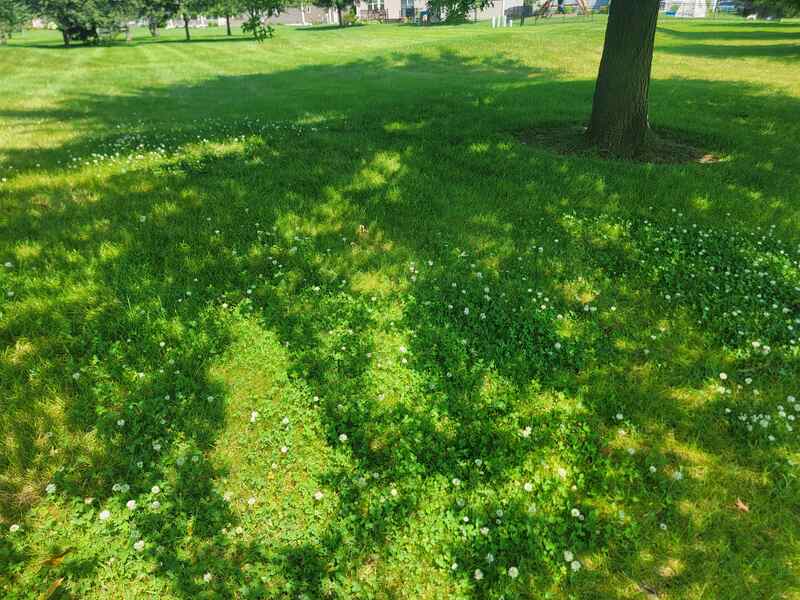
More often than not, clover is a symptom of poor lawn conditions. Clover takes over lawns with the following conditions:
Compacted soil: Clover thrives in the face of soil compaction thanks to its interconnected root system. Many turfgrasses have trouble growing in compacted soil. If your lawn has compacted soil, you need to aerate it, preferably with a core aerator.
A lack of nitrogen: Turf growth stalls if you fall behind on fertilizing your lawn, but clover keeps growing.
That’s because Rhizobium bacteria in clover’s roots let it make its own nitrogen.
Irrigation issues: Overwatering and underwatering both make your lawn more susceptible to a clover takeover. Overwatering washes out nitrogen from the soil, while underwatering can stunt growth or even kill turf. Water your lawn properly to prevent these issues.
Bare patches: Clover quickly fills bald spots, and all of the problems above can leave your lawn patchy. Overseed your lawn or install sod to take care of the patches.
Unbalanced soil pH: Most lawn grasses prefer slightly acidic to neutral soil, while clover tolerates acidic and alkaline soils alike. A soil test will tell you where you stand.
Sun exposure: White clover favors full sun, so it’s usually sparse in heavy shade. Most cool-season grasses struggle in heavy shade, too, so if clover grows in a shady spot, Abbey suggests leaving it or planting shade-tolerant perennials.
Roughstalk bluegrass, Chewings fescue, and creeping red fescue are the cool-season grasses that handle shade best, he says.
How to prevent clover in your lawn
Skip the pre-emergent herbicide
Pre-emergent herbicides won’t do much against established clover, Abbey says. He explains that white clover is a perennial that spreads mainly through stolons, so the spring pre-emergents used on crabgrass miss it.
Clover can spread by seed, Abbey notes, but in managed lawns, “the flowers are typically mowed off regularly so that seeds never develop.”
Mulch your landscape
Weed control is just one of the many benefits of mulch. Mulch can block sunlight from reaching clover seeds, which will prevent them from germinating properly. Mulch works only on landscape beds, though.
Mow your grass high
Mow at the high end of the recommended mowing height for your grass type. Proper mowing builds a dense lawn, and dense turf crowds out weeds.
Taller blades also shade out clover seeds. If your lawn is weed-free, leave the clippings (grasscycling) to return nitrogen to the soil.
Grow a healthy lawn
A lush, healthy lawn outcompetes most weeds, including clover.
Landscape designer David Barbera, president of Artificial Turf Supply in Carlsbad, California, sums it up by noting that “only a healthy lawn gives no place for weed growth.”
A healthy lawn requires good lawn care practices:
Lawn aeration to alleviate soil compaction
Dethatching your lawn to remove excess thatch
Proper fertilization to supply your lawn with nutrients
Following the One-Third Rule when mowing your lawn
Watering your lawn properly
Should you remove clover?
Removing clover is mostly a personal choice, as long as your homeowners association allows it. Is clover a weed? That depends on what you want from your lawn.
If you want a uniform lawn, remove it, since clover competes with your grass for nutrients, sunlight, space, and water.
Others love clover, and some homeowners have swapped turf for clover lawns.
Abbey has clover in his own yard. “Clover is an important pollinator plant,” he says, since bees and other insects use its flowers. If someone in your home is allergic to stinging insects, factor that in.
Reasons you might be better off keeping clover on your lawn:
Reduces erosion
Prevents other weeds
Provides nitrogen to other plants
Creates green manure
Can be eaten
Can be used as living mulch
Can be a low-maintenance alternative to turf
FAQs
No, vinegar is unlikely to kill clover without repeated applications. Horticultural vinegar is a contact herbicide, so it burns the leaves but doesn’t reach the roots. Clover can regrow from those roots, though injuring it many times may eventually use up its stored nutrients.
Beyond hand-pulling and smothering, these non-toxic weed control methods can help keep weeds in check without harsh chemicals, especially in garden beds and large open areas:
• Landscape fabric
• Mulching
• Solarization (trapping the sun’s heat under clear plastic)
• Flame weeders
• Goat rentals
A high-nitrogen fertilizer helps your grass outcompete clover. A quick-release product boosts nitrogen fast, but slow-release fertilizer is better in the long run. Avoid adding too much nitrogen, which also harms turf, and test your soil first so you apply only what your lawn needs.
Hire a pro to remove clover from your lawn
If you want it gone but don’t have the time, don’t surrender to this 3-leaved weed. Lawn Love can connect you with local lawn treatment pros who feed your grass so it can crowd out clover.
Main Image Credit: White clover growing in a lawn. New York State IPM Program at Cornell University | Flickr | CC BY 2.0
Related Posts: