| Key takeaways: |
|---|
| • Water early between 5 a.m. and 9 a.m. to beat evaporation and disease. • Give your lawn 1 to 1.5 inches a week, deep and infrequent. • Adjust for your soil type, grass type, and local watering rules. |
The best time to water your lawn in hot weather is early morning, between 5 a.m. and 9 a.m. At that hour, wind and evaporation are low and the sun is weak, so water reaches the roots instead of vanishing into the air.
Early-morning watering also lets the blades dry by midday, which lowers the risk of fungal disease. Skip midday and evening watering.
Want it off your plate entirely? Lawn Love’s local lawn care pros can dial in a summer watering and care plan for you.
The best time to water your lawn in hot weather
The best time to water your lawn in hot weather is between 5 a.m. and 9 a.m. when wind and evaporation are less likely, and the sun is at its weakest.
| Time of day | Evaporation risk | Disease risk | Our recommendation |
| Early morning (5–9 a.m.) | Lowest | Low | Finish watering by about 9–10 a.m. whenever possible. |
| Midday (10 a.m.–4 p.m.) | Highest | Low | Avoid. Only water at midday in emergencies. |
| Late afternoon/early evening (4–7 p.m.) | Moderate | Moderate | Use sparingly. |
| Night (after 8 p.m.) | Low | High | Drip irrigation is safer if you must water at night. |
Early morning irrigation allows the water to penetrate the soil and reach the roots. It also gives the water left on the foliage time to dry, which reduces the risk of fungal lawn diseases.
But life happens. So what should you do if you sleep through your alarm and completely miss that window?
Taylor Olberding, franchise owner at Heroes Lawn Care in Omaha, Nebraska, has strict advice.
“If you miss that early morning sun because life sometimes goes unplanned, don’t start watering your lawn during midday,” Olberding says. “Watering at noon is a waste of money since the heat just evaporates most of the water before it even reaches the roots. But don’t skip a day either; your plants will hate you for it. Instead, wait until the sun dips down to water your yard.”
While an occasional evening watering is okay, you cannot make it your regular routine. Without the sun to dry the water on your grass blades, your lawn becomes an easy target for disease.
“Just make sure not to turn it into a habit, as soaking your yard every evening allows for nasty fungi like brown patch or pythium blight to grow, which then leaves you with greasy dead spots,” Olberding says.
To mitigate the risks, use a drip irrigation system. It targets the grass roots directly without touching the foliage. Still, it’s best to water your lawn in the morning to give your grass the best chance at growing and staying healthy.
How often to water in hot weather
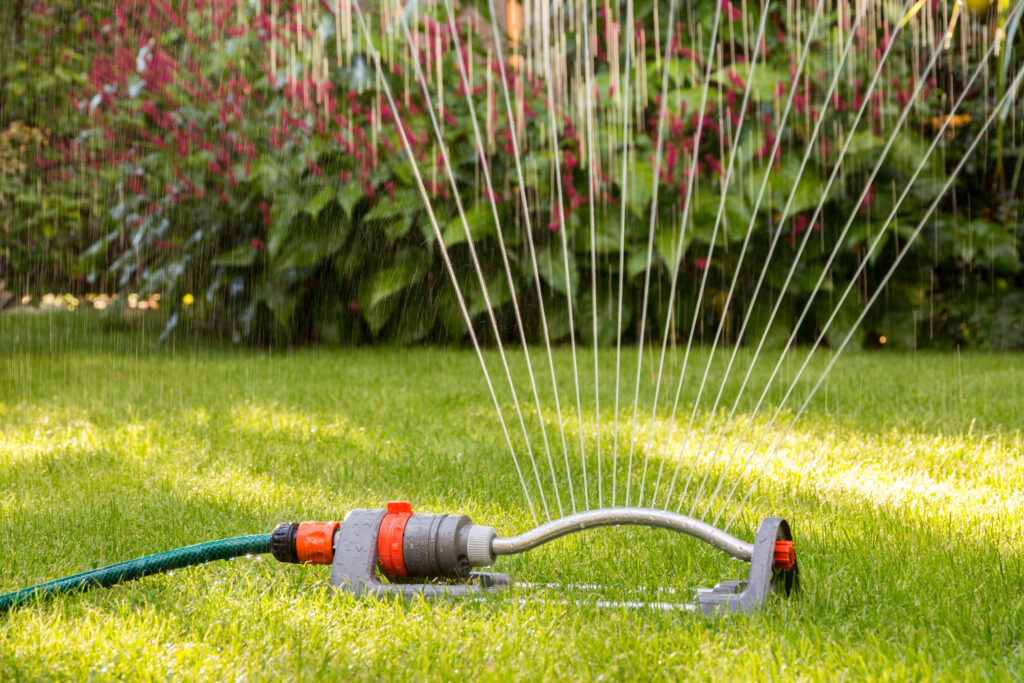
Most lawns need 1 to 1.5 inches of water per week (either from irrigation or precipitation) according to the University of Missouri Extension.
If there is no rain in the forecast, deeply water your grass 2 to 3 times a week, applying enough water each time to reach your weekly target of roughly 1 to 1.5 inches. In extremely hot weather, give your grass a solid 2 inches of water weekly, especially if you have sandy soil.
To know how much water your grass is getting, Olberding uses a very simple field test.
“When you do get to soaking your yard, take a long flathead screwdriver and push it into the dirt,” Olberding says. “It should slide through the soil like butter, but then it stops once it touches dry earth. Use this technique to tell how far down the moisture went, especially if you’re dealing with heavy clay soil.”
A good session soaks the soil until it’s damp 4 to 6 inches down. Let the surface dry before the next watering.
What changes your watering plan
If you’re experiencing scorching temperatures in your area, you may have to alter your watering routine based on your soil, your grass, your sprinklers, and local regulations.
Soil type
Soil type decides how fast water soaks in and how long it stays. Each retains and drains water differently, which can affect the condition of your lawn in hot weather. If you’re unsure of yours, test a soil sample through your local Extension office.
| Soil type | How it behaves | Watering approach |
| Clay | Holds water, drains slowly | 1–1.5 in per session; watch for runoff |
| Sand | Absorbs fast, drains fast | ⅓ in, 3× per week; water deep |
| Silt | Drains moderately; erodes easily | ½ in, 2× per week; don’t overwater |
| Loam | Balanced retention and drainage | ½ in, 2× per week |
If you have heavy clay soil, Olberding says it’s best to not let your sprinkler run continuously.
“Instead of soaking the soil all at once, try watering in increments,” Olberding says. “Give it 5 minutes, then an hour to let it sink in, and repeat. It takes longer, but it keeps the water from running straight down the driveway and into the drains.”
Grass type

When it comes to watering your lawn, the same amount of water doesn’t apply to every grass type. Warm-season grasses sip water and thrive in heat. Cool-season grasses drink more and may go dormant when it’s hot.
If your cool-season grass goes dormant, do not panic. Olberding says this is a natural survival mechanism, but it still requires some attention.
“If your cool-season grass looks brown and dead, it’s just sleeping to protect itself from the heat,” Olberding says. “Even so, it still needs a little love to survive the summer. Completely cutting off the water will actually kill the roots. You wouldn’t wanna overdo it either. Give it a light soak every two or three weeks to keep the crown alive until cold weather arrives.”
| Grass category | Examples | Water per week |
| Warm-season | Bermuda, Zoysia, St. Augustine, centipede, bahia | ½–1 in |
| Cool-season | Tall fescue, Kentucky bluegrass, fine fescue, perennial ryegrass | 1–1.5 in |
Per Illinois Extension, warm-season grasses use noticeably less water than cool-season types. Match your schedule to your grass.
Sprinkler system
A properly working sprinkler system will deliver just the right amount of water to your lawn. Since grasses are more vulnerable during the hot summer months, it’s especially important to check the condition of your sprinklers and make any necessary adjustments before the temperatures become unbearable.
Check the following off your to-do list:
- The nozzles and heads are in excellent condition and distribute water evenly.
- The water pressure is calibrated according to your lawn’s needs and soil type.
- Your sprinklers don’t have any leaks contributing to water waste.
If you are thinking about upgrading your system, Olberding highly recommends smart weather-based controllers to spare yourself the extra brainwork.
“It uses real-time local weather data to automatically skip watering when it rains, or scale it up during heatwaves,” he says.
Local watering regulations
In the heat of summer, local watering regulations can throw a wrench in your well-established lawn care routine. To conserve water, prevent water shortages, and keep things as eco-friendly as possible, municipal authorities may activate the following measures:
- Frequency restrictions
- Time of day restrictions
- Duration restrictions
- Complete bans for a set period of time in extreme cases
- Required compliance with smart irrigation systems
Common watering mistakes
The two big mistakes in summer are watering too little and watering too much. Both stress your lawn.
- Underwatering shows up as yellow, brown, or grey grass, footprints that linger, a dry crispy feel, and slow growth.
- Overwatering shows up as puddles, mushrooms, squishy ground, yellowing, weeds, and thatch buildup.
FAQs
Once air temperatures climb into the mid‑90s, overhead watering becomes a lot less efficient. On very hot, sunny afternoons (around 95 degrees F or higher), much of the water you spray can evaporate before it soaks down to the roots.
If you want to know how long your sprinkler system takes to accumulate a specific amount of water, take the “tuna can test.” Follow these steps:
Step 1: Randomly place 8 or 9 shallow, flat-bottomed containers, such as empty tuna cans, around your lawn. Try to space them out as evenly as possible.
Step 2: Turn on your sprinklers and set a timer for 30 minutes.
Step 3: At the end of the 30 minutes, measure the water in each can with a ruler. Add the amounts together and divide the total by the number of cans on the lawn to find out how much water your sprinkler supplies in 30 minutes.
Step 4: If you found the average amount of water in each can was about half an inch, you’re good to water your lawn for 30 minutes each session. If the average was less than half an inch, you’ll need to leave the sprinklers on longer. If it was more, you’ll need to turn them off sooner.
A soil moisture meter can make your life easier by telling you how moist (or dry) your soil is.
Insert the probe end as far into the soil as possible and check the display. Ideally, the reading should be situated in the blue “moist” zone. Outside of that, you may need to change how you water your grass to help it thrive long-term.
In a newly seeded lawn, keep the top 1-2 inches of soil moist (not soggy) for about 2 to 3 weeks, or until most of the seed has germinated.
“When you have to patch up those bare spots with fresh seed in the middle of July, you have to switch things up,” Olberding says. “Seeds need constant moisture to avoid being toasted under the sun, so you’ll have to give those re-seeded patches a light mist three or four times a day just to keep the top layer of dirt damp.”
Hand over the hose
You’re well aware of the importance of watering your lawn just right during the hot summer months. But not everyone’s cut out for DIY work, or even enjoys it. If you’re that person, we can set you up with a local pro instead.
They’ll care for your lawn just like you would if you weren’t unwinding by the pool and enjoying your free time with friends and family. From mowing, edging, and weeding to aerating and fertilizing it, the sky is the limit when a professional team is on the job.
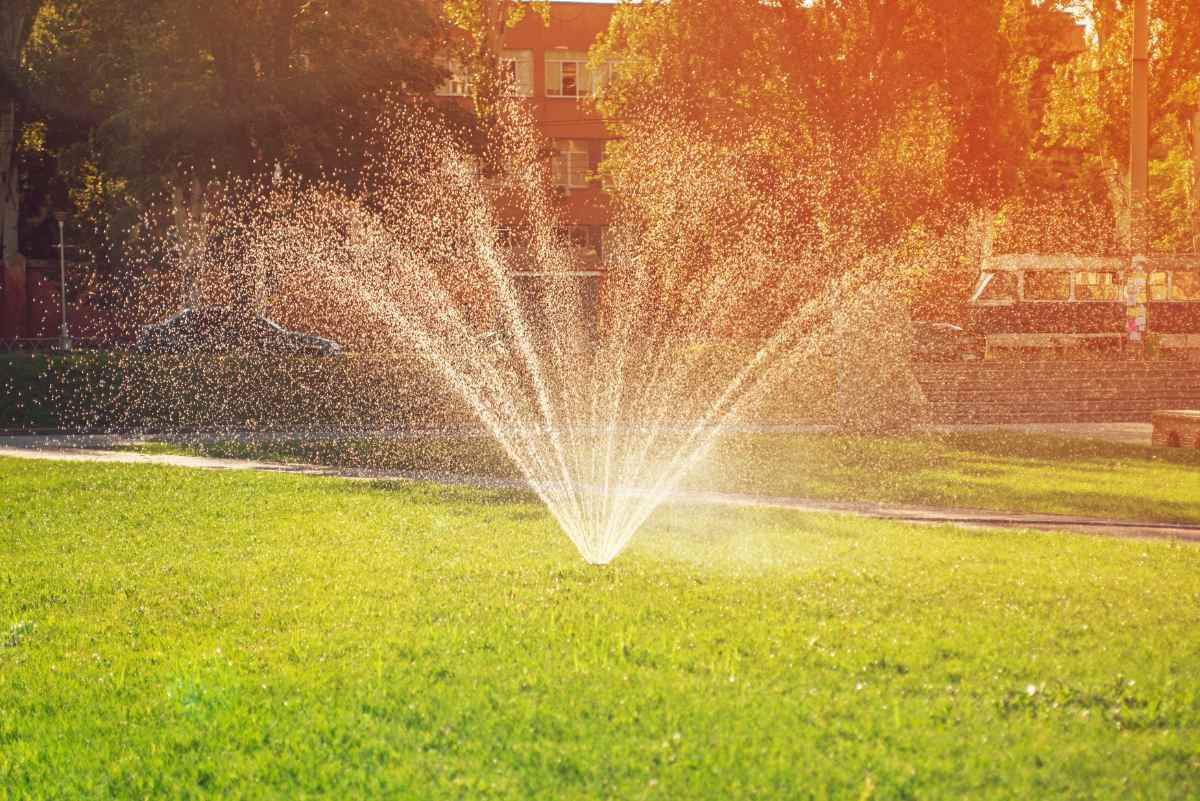
Main Image: A sprinkler waters a green lawn on a hot summer day. Photo Credit: spyrakot / Adobe Stock
Related Posts: