The 2026 lawn care season is starting off on a dry note: Over 60% of the contiguous U.S. is currently in drought.
So, where is lawn watering the biggest drain on homeowners’ budgets?
To mark Water Awareness Month in May, Lawn Love ranked the Most Expensive Cities for Watering Your Lawn in 2026.
Some lawn irrigation stats:
💧 An estimated 30% of average residential water use is spent outdoors, primarily on landscape irrigation.
💧 Across the 500 largest U.S. cities, households spend an average of 1.15% of their yearly income on water bills, but this ranges from $459 annually in Flint, Michigan (No. 426) to $2,160 in Newton, Massachusetts (No. 119).
💧 Water and sewer bills across the U.S. increased by 5.1% in 2025, outpacing inflation.
To rank the cities, we looked at climate metrics such as drought risk, precipitation rates, and growing season length. We also factored in yard size, how water-intensive the region’s most common grass types are, and whether rainwater harvesting systems are restricted or incentivized.
Explore our ranking of the 500 largest U.S. cities below. To learn how we ranked the cities, see our methodology.
In this article
- Rankings: Most expensive cities for watering your lawn
- 5 most expensive cities for lawn watering
- What the data shows: Regional water woes
- Expert take: Making every drop count
- How we ranked the Most Expensive Cities for Watering Your Lawn
- Water-wise landscaping: Lower your water bill
Rankings: Most expensive cities for watering your lawn
Where is it costly to maintain a green backyard oasis? Here are the Most Expensive Cities for Watering Your Lawn.
5 most expensive cities for lawn watering
In 2026, the 5 most expensive cities for lawn irrigation include: 1. Scottsdale, Arizona; 2. Henderson, Nevada; 3. Las Vegas; 4. Tucson, Arizona; and 5. Buckeye, Arizona.
While keeping a traditional green lawn is costly in these cities, homeowners in each of these cities have access to incentives like rebates for sustainable upgrades, such as turf replacement or adopting smart watering systems.
Check out the slideshow below for insights on each of our 5 most expensive cities for watering your lawn.
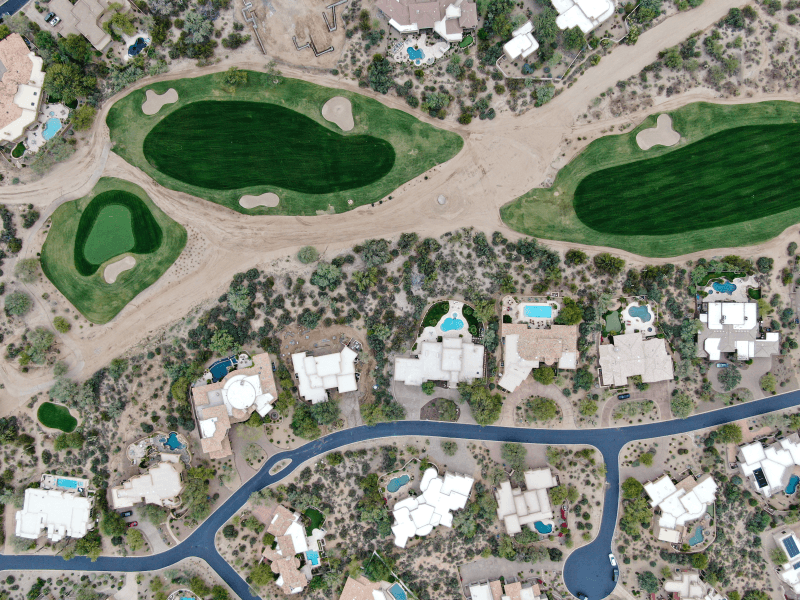
No. 1: Scottsdale, Arizona | Overall score: 60.14
• Scottsdale ties with the 5th lowest historical average monthly precipitation: 0.6 inches.
• Ties with the most average annual number of extremely hot days, with 170 days above 90 degrees.
• Ranks within the top 20 cities spending the largest portion of their income on water, and just outside of the top 100 cities with the largest yard space.
Policies
As an affluent resort destination with sparkling pools and a strong golfing community, water is in high demand in Scottsdale.
In an effort to conserve water, the city prohibits natural grass front lawns in new residential construction and asks all residents and local businesses to help reduce their own water use by 5%. Scottsdale advises homeowners against overseeding, which increases watering needs.
The city has a Native Plant Ordinance, protecting 20 indigenous plants — including junipers and saguaros — from being removed, relocated, or destroyed without a permit from the city.
Rebates
Scottsdale has a program offering rebates for removing grass and pools, and also for installing Smart Home Water Monitors.
Other local tips
Locals can get landscaping inspiration from the Scottsdale Xeriscape Garden at Chaparral Park.
Helpful links:
• Best Native Plants for Phoenix-Mesa-Scottsdale, AZ
• Month-by-Month Lawn Care Calendar for Arizona
• Best Grass Seed for Arizona
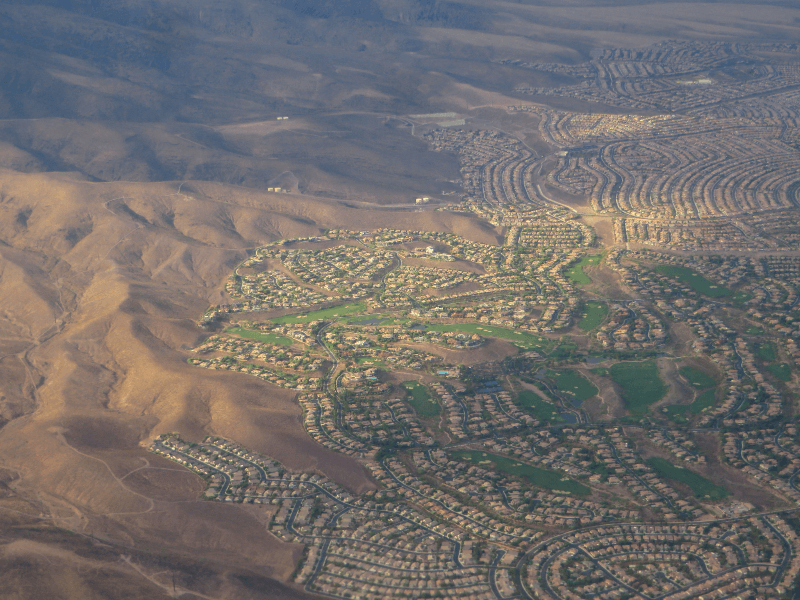
No. 2: Henderson, Nevada | Overall score: 58.55
• Henderson ties with the lowest average monthly precipitation, 0.35 inches.
• Nevada limits rainwater harvesting to rooftop runoff from single-family homes for nonpotable domestic use (no permit needed), with no rainwater harvesting incentives.
• Ties with the 15th-highest number of extremely hot days (136 days above 90 degrees) and among the 100 cities spending the most on water bills relative to income.
Policies
Henderson has banned the installation of new natural turf in residential front yards and restricts turf to 50% or less of the total square footage of landscaping on side and/or rear yards.
Henderson has a mandatory seasonal watering schedule, which assigns households to certain days of the week when they are permitted to water their lawns.
Rebates
The Water Smart Landscapes Rebate can help reimburse up to $5 per square foot of lawn replaced with desert landscaping through the Southern Nevada Water Authority (SNWA). The city offers an additional $575 rebate for qualifying households replacing turf. SNWA also offers a $100 rebate for each new tree installed, and Henderson’s rebate stacks an additional $50 per tree.
Other local tips
H2One: Henderson’s Call to Conserve initiative helped remove over 3.2 million square feet of grass across the city, conserving an estimated 182 million gallons of water. This initiative was awarded by the American Planning Association in 2026.
SNWA offers free water-saving classes online or at Springs Preserve in Las Vegas.
Helpful links:
• Native Plants for Southern Nevada Landscapes
• The Best Grass for Southern Nevada
• Nevada Planting Zones
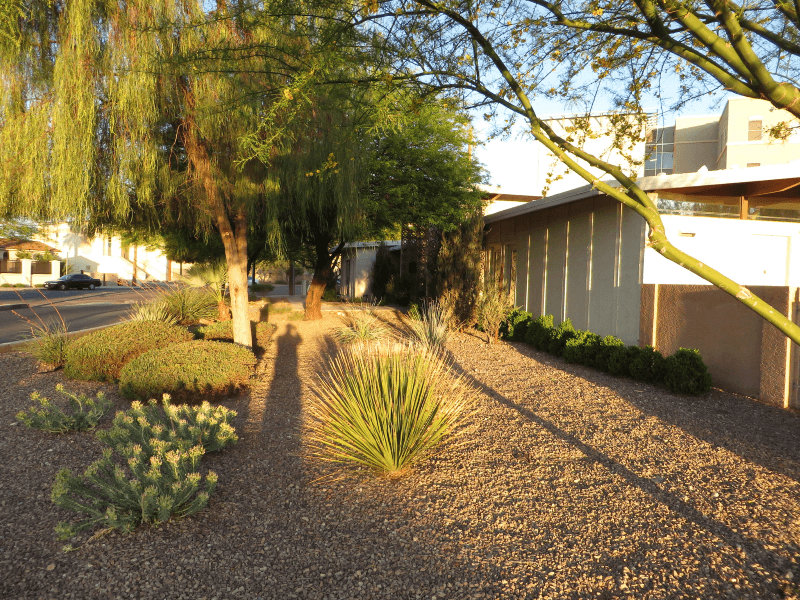
No. 3: Las Vegas | Overall score: 58.46
• Las Vegas ties with the lowest average monthly precipitation, 0.35 inches.
• Nevada limits rainwater harvesting to rooftop runoff from single-family homes for nonpotable domestic use (no permit needed), with no rainwater harvesting incentives.
• Ties with the 15th-highest number of extremely hot days (136 days above 90 degrees) and among the 100 cities spending the most on water bills relative to income.
Policies
Nevada’s Nonfunctional Turf Removal Ban (AB 356) goes into effect at the beginning of 2027, prohibiting nonfunctional grass — aka lawn space with the sole purpose to be looked at and mowed — throughout the Las Vegas Valley (single-family homes are exempt).
Rebates
The Water Smart Landscapes Rebate can help reimburse up to $5 per square foot of turf replaced with desert landscaping through the Southern Nevada Water Authority (SNWA).
Las Vegas Valley Water District (LVVWD) offers a $2 per square foot rebate for lawn replacement, bringing the total “Cash for Grass” rebate for locals up to $7 per square foot for qualifying residential areas.
Other local tips
SNWA offers free water-saving classes online or at Springs Preserve, a 180-acre desert museum and botanical garden where homeowners can also get native landscape design inspiration.
Helpful links:
• 8 Low-Maintenance Landscaping Ideas for Las Vegas
• 6 Drought-Resistant Landscaping Ideas for Las Vegas
• Las Vegas Lawn Watering Schedule
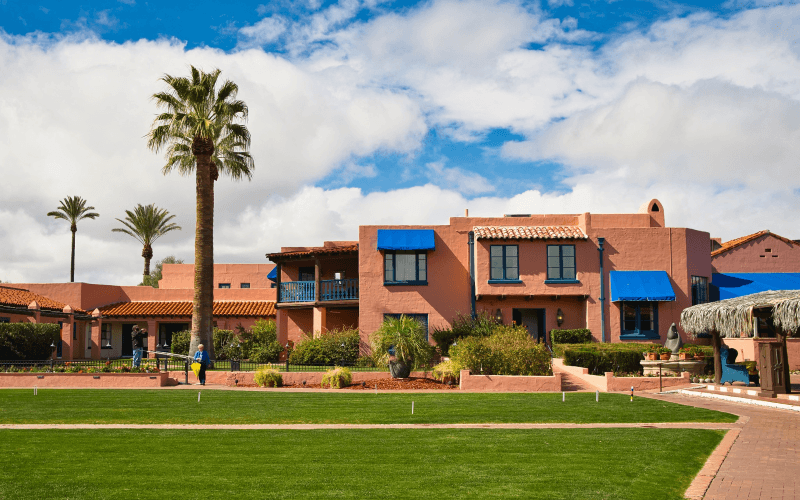
No. 4: Tucson, Arizona | Overall score: 57.92
• Tucson ranks among the 50 cities with the highest proneness to drought.
• Has the 14th-highest average number of extremely hot days, with 148 days above 90 degrees each year.
• Lands among the 100 cities with the largest yards, with an average yard size of 13,243 sq. ft. or 0.3 acres.
Policies
Tucson was the first city to pass a commercial rainwater harvesting ordinance in 2008, requiring commercial developments to use harvested rainwater for at least 50% of landscaping watering needs.
Rebates
Tucson Water offers rebates up to $2,000 for rainwater harvesting system installation and up to $1,000 for gray water irrigation systems. Additional rebates for lawn replacement are available for commercial and multifamily properties.
Other local tips
The Watershed Management Group offers free classes on rainwater harvesting, gray water, and sustainable desert living.
Homeowners can get inspired by native landscapes at Tohono Chul Park, a botanical garden full of plants native to or adapted to the Sonoran Desert, spanning 49 acres.
Helpful links:
• Month-by-Month Lawn Care Calendar for Arizona
• Seasonal Watering Schedule for Arizona Lawns
• Best Grass Seed for Arizona
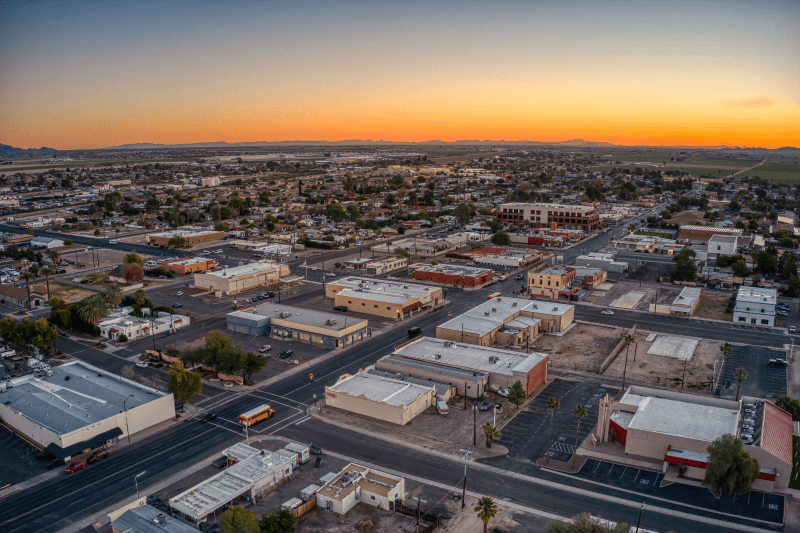
No. 5: Buckeye, Arizona | Overall score: 56.97
• Buckeye ties with the 5th lowest historical average monthly precipitation: 0.6 inches.
• Ranks with the 67th longest average growing season, with 331 days of lawn growth each year.
• Ties with the most average annual number of extremely hot days, 170 days above 90 degrees.
Policies
One of the fastest-growing cities in the U.S., Buckeye is spending to keep up with rapid development. The city allocated $80 million to secure water rights for its rapid growth.
The city has a Drought Management Plan to activate in instances of severe water shortages.
Rebates
Buckeye has funds to allocate up to a total of $10,000 in water conservation rebates to homeowners on a first-come, first-served basis.
The city’s turf removal rebate program will pay 50% of removal costs (up to $1.75 per sq. ft.) for replacing natural lawns with xeriscapes or artificial turf. The city also offers up to $100 in rebates for smart irrigation upgrades.
Other local tips
Buckeye — along with Goodyear (No. 11) and Avondale (No. 18) — offers a series of free workshops to help homeowners learn about water conservation strategies.
The city encourages conservation with a tiered water rate structure, penalizing high-volume water use. Residents can track their water use with the EyeOnWater app.
Helpful links:
• Month-by-Month Lawn Care Calendar for Arizona
• Seasonal Watering Schedule for Arizona Lawns
• Best Grass Seed for Arizona
What the data shows: Regional water woes
💧 47 of the 50 states are currently in drought at the time of writing, impacting over 153 million Americans.
💧 Average annual spending on water bills across the 500 largest U.S. cities in 2024 was $970.
💧 Estimates show up to 50% of water used for outdoor irrigation is wasted to runoff, evaporation, or wind.
Soaring Southwestern bills
40% of the 50 most expensive cities for watering your lawn are in the Southwest, with the majority located in Arizona and Nevada.
Much of this region has been incentivizing turf replacement or sustainable lawn upgrades.
My water utility offers rebates per square foot of grass turf converted to a low water-intensive landscape. The rebate goes towards my water bill, and I probably won’t have to pay a water bill for 5–6 years.
— Corbin (Albuquerque homeowner), via Reddit
- All cities throughout the Las Vegas (No. 3) and Phoenix (No. 8) metros score among the 25 most expensive cities for lawn watering. A desert climate with shrinking water resources means it’ll cost you to keep a green lawn.
- Residents of Gilbert, Arizona (No. 16) faced a 75% water increase between 2024 and 2025, with another 25% increase this year. Due to the spike in costs and issues related to the new utility billing portal, there’s an outstanding $3.4 million in unpaid utility fees across 4,500 accounts at the time of writing.
- Flagstaff, Arizona (No. 486), stands out due to its high elevation, with a milder climate and over 2X the average monthly precipitation of Phoenix.
Parched Pacific Coast
13 California cities score among the 50 most expensive cities for watering your lawn, led by Bakersfield (No. 12), Visalia (No. 20), and Fresno (No. 21). While conditions are less extreme in the PNW, snowpack levels reached a record low this year, leading Washington to declare a statewide drought emergency.
- Inland cities across the Golden State are more expensive for lawn watering, with a higher risk of drought, extreme heat, and large average yard sizes. Meanwhile, coastal cities like San Francisco (No. 341) and Irvine (No. 339) tend to rank lower due to smaller yards and lower spending on water bills relative to income.
- East of the Cascades, Yakima, Washington (No. 50), doesn’t get bountiful rain the way other PNW cities do. With just 0.67 inches of rain per month, Yakima has a high drought risk and scores just outside the 50 cities with the largest yards.
Gulf Coast: Heat, rain, and rising costs
Despite being along the rainy Gulf Coast, population growth, rising evapotranspiration rates, and sensitive aquifers cause vulnerable landscapes in Texas and Louisiana.
- Texas cities like Mission (No. 9), Edinburg (No. 19), and Brownsville (No. 22) score among the most expensive cities due to drought-prone climates and high spending on water relative to income.
- Texas HB 29 passed in 2025 to crack down on municipal water loss. Corpus Christi (No. 109) was predicted to be the first modern American city to run out of water as soon as next spring.
- Despite having among the highest precipitation rates, Louisiana cities Shreveport (No. 63) and Lake Charles (No. 80) land among the 100 most expensive cities for lawn watering with large backyards and high water bills relative to income. Prolonged drought caused the Mississippi River to run 10 feet below average near Baton Rouge (No. 172) earlier this year.
Historic Southeast drought
As of May 2026, the U.S. Drought Monitor reported 99% of the Southeastern U.S. is facing moderate to exceptional drought conditions.
Most people would not imagine we have problems with drought, but we do, during dry weather. I didn’t like the waste of constantly fertilizing, watering, and mowing a lawn, so I decided to xeriscape and, little by little, eliminate the lawn, even though my water bill is low. I’m also lazy and don’t want to have to think about watering.
— u/tillandsia (Miami homeowner), via Reddit
- It’s typically less expensive to keep your turf green in Jacksonville (No. 308), with high precipitation and low (but not zero) drought risk. Meanwhile, cities like Miami (No. 105) are more drought-prone, with the sensitive Biscayne Aquifer, a larger risk of saltwater intrusion, and higher population density.
- While only a handful of these states’ cities land among the most expensive in our ranking this year, Georgia, North Carolina, and South Carolina just faced their driest September to March period since 1895.
- As of May 2026, North Carolina cities Charlotte (No. 465) and Raleigh (No. 362) have enacted lawn watering restrictions.
Rainwater refuges
The Coastal PNW, Ohio, New Orleans (No. 380), Chesapeake Bay region, and Hawaii score as the rain refuges in our ranking — where natural precipitation does most of the watering work, bills are affordable relative to income, and drought is less of a risk factor.
The tradeoff? Homeowners are more likely to deal with fungus, moss, or drainage problems from the abundant rain.
Other notable insights
- In June 2025, lawn watering was banned across a large portion of Des Moines, Iowa (No. 139), due to near-record nitrate levels threatening the local water supply. They spent $9,000 a day on nitrate removal, totaling $1 million. Local reports say another ban might be coming for summer 2026.
- Limited water resources are slowing real estate growth across the country, including around Phoenix (No. 8), Cambria, California, Ogden Valley, Utah, and communities in Texas’ Rio Grande Valley, where planned housing developments have been constrained, delayed, or blocked.
Expert take: Making every drop count
As the data in our ranking makes clear, the pressure to water wisely isn’t just a Southwestern problem anymore.
With water bills rising and more lawn watering restrictions adopted across the country, we asked a series of experts — from irrigation engineers to turfgrass specialists — to weigh in on water costs and how homeowners can lower their bills. Explore their insights below.
- How have watering restrictions and bans on grass lawns impacted homeowners?
- What factors determine the local cost of water to consumers?
- What are your 5 best tips for minimizing the cost of lawn irrigation?
- Drip irrigation system vs. sprinkler system: Which is better and why?
- Climate change, inflation, and high energy costs are driving up Americans’ water bills. What measures can various levels of government take to lower water prices and keep them under control?
- How much water and expense do drought-tolerant grass types really save homeowners?


How have watering restrictions and bans on grass lawns impacted homeowners?
They haven’t been able to have the verdantly green and lush lawns that they want. These green lawns can create local cooling and make living environments cleaner and more inviting.
What factors determine the local cost of water to consumers?
It depends on where they get their water from. Municipal water pricing is usually on a per-gallon basis. Every municipality prices these slightly differently and the prices are usually based on their costs. This is usually water from garden hoses connected to their home water supplies and is potable water and thus is higher cost due to the higher quality standards.
Some irrigators have access to a separate supply of water from an irrigation district. This water does not come through the home and thus is not potable, and often doesn’t have incremental pricing (‘just don’t use more than a given amount,” for example) and is therefore less expensive.
What are your five best tips for minimizing the cost of lawn irrigation?
1. The water needs of grass changes drastically throughout the season. Thus, don’t use a set schedule for your lawn that doesn’t change throughout the season. Most home lawn and garden irrigators over-irrigate in the spring, they might under-irrigate during the middle part of the summer, and then over-irrigate again in the fall.
The times that they over-irrigate, they are spending more money for water than is necessary and they can leach nutrients (primarily the nitrate form of nitrogen) out of their soil profile and move it towards the groundwater. Estimates of grasswater use (evapotranspiration) are often available for free online depending on your state.
2. Keep your irrigation system repaired, adjusted, and in good working order. Non-uniform irrigation means that more water must be applied everywhere in order to adequately irrigate the spots that get less water.
3. Get a good irrigation system designed by someone who knows what they’re doing. You pay the penalty for poor irrigation system designs for the entire life of the irrigation system.
4. Don’t irrigate every day. Irrigating every day results in a lot of water lost to evaporation from a wet soil and grass surface. It also encourages grass diseases. Figure out how much water your soil can hold, apply that much water all in one irrigation event, and then don’t irrigate again until that water has been used up.
Most soils can hold about 1 inch of water in the shallower root zone of lawn grass. This can be much less for sandy soils. It takes anywhere from 4 days to 3 weeks to use 1 inch of water, depending on where you live, what time of year it is, and what the weather is like. When making irrigation timer modifications for the changing seasons and weather, change the interval between irrigations instead of the irrigation run times (how much water is applied each time).
5. Let your grass get slightly water-stressed during the middle of the summer. It will save a lot of water.
Drip irrigation system vs. sprinkler system: Which is better and why?
Drip irrigation is significantly more efficient, but it is expensive to set up and maintain. It makes much more sense in beds with perennial bushes with nothing in between and is more difficult in areas where everything needs to be irrigated (like lawns).
Buried drip irrigation can have issues with plugging, primarily due to unclean water, or root intrusion. Unclean water is most common in non-potable water supplies and root intrusion is most common when deficit irrigating — roots go looking for water and find it in the drip emitters.
Drip irrigation can reduce water requirements by 20% to 40% depending on the climate and type of sprinkler irrigation system they are replacing.
Climate change, inflation, and high energy costs are driving up Americans’ water bills. What measures can various levels of government take to lower water prices and keep them under control?
Most governments aren’t charging more than their costs for supplying the water at the flow and quality levels that their customers want. Therefore, the only way to significantly modify water costs is for irrigators to lower their water use. High water prices are the biggest motivation for conservation.
How much water and expense do drought-tolerant grass types really save homeowners?
Not much if they are irrigated the same as regular grass varieties. Drought-tolerant grass varieties specialize in being able to survive the water being turned off for long periods of time. They usually survive by going dormant. But this dormant phase makes lawns look brown and dead and homeowners don’t like it, so they keep irrigating them.
Research shows that water use can be cut by up to ½ by deficit irrigating lawn grasses and they will recover with drought-tolerant varieties recovering much better from these droughts. They look bad though and home-owners aren’t getting out of lawns what they want.
How have watering restrictions and bans on grass lawns impacted homeowners?
Watering restrictions have become a common occurrence across Texas. Historically, watering restrictions were typical primarily during drought periods, but we are seeing more cities and utilities implement permanent year-round watering restrictions — often limiting landscape irrigation to only 1 day a week or no more than 2 days a week.
Obviously, no one wants to have a dead lawn, so homeowners are becoming more receptive to incorporating water conservation technologies and practices into their landscapes.
What factors determine the local cost of water to consumers?
Traditionally water costs were based on recuperating the costs to pump, treat, and convey the water.
However, costs are increasing due to a growing population and an aging utility infrastructure. Developing newer water supplies and treatment facilities is expensive depending on the source. Additionally, older pipelines can begin to leak over time, requiring expensive infrastructure upgrade projects.
In the absence of state and federal funding, the bulk of these costs are passed down to the consumers.
What are your five best tips for minimizing the cost of lawn irrigation?
1. Irrigation system maintenance. Check the system regularly for leaks and damaged hardware that can waste water such as sprinklers irrigating streets and sidewalks.
2. Pressure regulation. Most residential irrigation systems do not require high pressures for operation. Operating sprinklers at pressures higher than recommended by the manufacturer can result in higher evaporation from misting sprinklers as well as wind drift losses. Operating at the correct pressure increases efficiency and reduces the amount of water needed to be applied to maintain a healthy landscape.
3. Seasonal irrigation scheduling. Water requirements vary throughout the year. Turn off the irrigation system in the winter when most plants are dormant. Spring rains can be more than sufficient to meet plant watering needs. In the summer, irrigate in the early morning so water can better infiltrate deeper into the soil and not evaporate at the surface.
4. Cycle soak and deeper watering. When irrigating, water deeply and less often. This helps encourage deeper root systems in plants which makes them more resilient during drought periods and able to maximize their storage of rainfall. When long daily irrigation runtimes are needed, divide the irrigation into 2 or 3 short cycles throughout the day that allow more time for water to infiltrate deeper into the soil with less chance of becoming runoff.
5. Incorporate newer technologies. Smart controllers and rain and soil moisture sensors can be great tools for preventing unnecessary watering.
Drip irrigation system vs. sprinkler system: Which is better and why?
Each type of system has its place in the landscape. Overall, drip irrigation has an advantage over sprinklers when it comes to application efficiency. When installed below the surface (subsurface) the water applied goes straight into the soil and the plants’ root zone. There are no losses due to wind or surface evaporation. However, drip systems can be very costly in larger turfgrass landscapes.
Sprinkler systems are often more cost-effective for larger spaces. High efficiencies can be achieved through proper design principles including proper spacing, pressure regulation, and incorporating multi-stream, multi-trajectory type sprinkler nozzles.
Climate change, inflation, and high energy costs are driving up Americans’ water bills. What measures can various levels of government take to lower water prices and keep them under control?
Conservation is always cheaper than having to develop new water supplies. Watering restrictions and improving infrastructure help, but also maximizing their reuse capabilities can reduce strains on the water system.
Using “reclaimed water” that has been treated for reuse can allow the higher quality treated water to be used for primary potable water needs such in the home for drinking, cooking, and cleaning.
How much water and expense do drought-tolerant grass types really save homeowners?
A healthy lawn can be maintained with less water than most people think.
A common overused saying is that turfgrass requires an inch of water a week. This can be true of turfs with “peak” water use which can occur around the end of July to early August over a 2-4 week period, but isn’t necessary the majority of the year.
Research and demonstrations have shown that many turfgrasses can be maintained with as little as half an inch a week much of the year.
It comes down to homeowner satisfaction. As turfgrasses stress in the summer and during drought periods they are naturally going to discolor and lose their green lushness. This doesn’t mean the grass has died but it is simply adapting to its current level of drought stress.
If homeowners are willing to accept this temporary decrease in plant quality during drought periods they can save significant amounts of water. These drought-tolerant grasses are also generally very quick to recover once it does rain.
How have watering restrictions and bans on grass lawns impacted homeowners?
It negatively affects the appearance of our lawns and may reduce home value, among other impacts.
What factors determine the local cost of water to consumers?
The local cost of water to consumers is determined by factors such as the amount of water available and the costs of irrigation.
What are your best tips for minimizing the cost of lawn irrigation?
Developing and using drought-tolerant lawn grass varieties is one of the best tips for minimizing the cost of lawn irrigation.
Drip irrigation system vs. sprinkler system: Which is better and why?
A drip irrigation system may be considered too expensive and not suitable for lawns, while a sprinkler system might be a better option.
Climate change, inflation, and high energy costs are driving up Americans’ water bills. What measures can various levels of government take to lower water prices and keep them under control?
Various levels of government can promote the use of climate-friendly lawn grasses and sustainable practices to mitigate the impacts of climate change, inflation, and high energy costs on water bills.
How much water and expense do drought-tolerant grass types really save homeowners?
Drought-tolerant grass types can save homeowners a significant amount of water and expense, with potential reductions in water use ranging from 50 to 90%.
How have watering restrictions and bans on grass lawns impacted homeowners?
Watering restrictions and bans have driven homeowners to seek a drought-tolerant turfgrass genus and/or species. In northern climates, this includes tall fescue and fine fescue, while in southern climates, this includes bermudagrass and centipedegrass.
What factors determine the local cost of water to consumers?
Water availability typically drives water costs. The cost to irrigate turfgrass in Western Oregon, where rain is plentiful, is relatively cheap — $277 per acre per month in the summer — while the cost to irrigate turfgrass in New Mexico, where precipitation is minimal, is considerably more ($3,671 per acre per month).
What are your five best tips for minimizing the cost of lawn irrigation?
To reduce the cost of watering your lawn I would use the following practices:
1. Plant drought-tolerant turfgrass (tall fescue in northern climates and bermudagrass in southern climates).
2. If you don’t want to water in the summer, your turf will not die but will enter a period of seasonal dormancy, returning to green when seasonal rains return.
3. If you want to keep turfgrass green in the summer 1.0 to 1.5 inches of irrigation per week will be required. This is best applied in 3 applications per week like ⅓ to ½ inch per application.
4. If you want to apply more water, don’t exceed ½ inch per application. Rather, add days to your irrigation cycle. Meaning irrigate 4 or 5 times per week at a maximum rate of ½ inch per application.
5. For cool-season turfgrass (tall fescue, fine fescue, Kentucky bluegrass, ryegrass and bentgrass), don’t apply fertilizer during periods of drought stress. Fertilizer should be applied to in the spring and fall when temperatures are between 60 and 75 degrees. Summer application of fertilizer will only increase drought stress.
Drip irrigation system vs. sprinkler system: Which is better and why?
Drip irrigation is great for your landscape beds and garden areas, but bad for turfgrass because the coverage is not adequate to make the grass uniformly green. If you are installing an inground irrigation system, multi-stream rotating nozzle-matched precipitation (MP Rotators) provide the most efficient use of water in a lawn environment.
Climate change, inflation, and high energy costs are driving up Americans’ water bills. What measures can various levels of government take to lower water prices and keep them under control?
More humans on the earth mean more water use. To minimize lawn water use, governing bodies have started requiring lawns to use effluent water irrigation and implementing seasonal water use restrictions, which include lawn watering, and providing tax rebates for removing lawn areas.
However, all these options come with consequences. Untreated effluent water from your home is an environmental contamination concern. Watering your lawn reduces the temperatures adjacent to your home and workplace, which will reduce the cost to air condition your home or work.
Research has shown that turfgrass is a substantial carbon sink reducing greenhouse gas emissions, so removing your lawn would release this sequestered carbon into the atmosphere.
How much water and expense do drought-tolerant grass types really save homeowners?
Use of drought-tolerant turfgrass provides the biggest benefit when you don’t water the turf. This is not possible in all areas of the USA like the southern USA and upper mountain west, but in regions where annual precipitation is significant (more than 30 inches), like the coastal PNW, midwestern, eastern, and southeastern US this is quite possible.
The biggest change that will be required in these areas is the acceptance of some seasonal summer drought symptoms. Drought-tolerant turfgrass in these areas will return to green color when summer temperatures decrease, and seasonal precipitation returns.
If you plan to irrigate your drought-tolerant turfgrass, be sure to base your water use on local evapotranspiration rates or soil moisture content in your lawn. Drought-tolerant grass will remain green during periods of peak heat stress when receiving around 50% evapotranspiration replacement or irrigated when soil moisture reaches less than 20% soil volumetric water content.
How have watering restrictions and bans on grass lawns impacted homeowners?
Impact of Watering Restrictions and Lawn Bans on Homeowners:
Water restrictions and lawn bans could impact homeowners in several ways, including creating sub-optimal quality or less attractive lawns.
It could also force homeowners to replace their grass with drought-tolerant or native plants that may not necessarily be their primary choices and wishes to have in their yards. In addition, restrictions could limit outdoor activities and the use of green areas for sports and enjoyment.
Depending on the extent of the watering restrictions and severity, it could lead to reduced property values due to less attractive lawns.
What factors determine the local cost of water to consumers?
Local water costs are affected by several factors, including:
- Demand for water.
- Source of water.
- Availability of water.
- Frequency and duration of droughts and extreme weather events.
- Water distribution mechanisms.
- Infrastructure-related costs.
- Any laws and regulations, including fees from cities and municipalities related to water and sewerage systems.
What are your five best tips for minimizing the cost of lawn irrigation?
1. Lowering irrigation water costs could involve several factors, including improving irrigation water use efficiency by adopting smart irrigation systems that allow the application of water that plants need.
2. Irrigation should always aim to meet plant water requirements not met by rainfall. Soil moisture sensors, rain sensors, and weather stations could help monitor plant water requirements. The irrigation schedule needs to be seasonally adjusted to account for evapotranspiration demands.
3. When available, alternative water sources, including water from rainwater harvesting and wastewater treatment plants, should be considered.
4. It is also important to regularly inspect and maintain irrigation systems for leaks, clogs, or inefficiencies, and fix defects with parts with the same specifications.
5. Additionally, lawn irrigation costs could be reduced by planting drought-tolerant and native plants, and lawn grass could be completely avoided by replacing it with artificial grass or other pavements, sand, etc.
Drip irrigation system vs. sprinkler system: Which is better and why?
Drip irrigation allows localized water application near plants to maximize water use efficiency through reduced evaporation losses.
On the other hand, a sprinkler irrigation system applies water using sprinkler heads with different radii and applies water to the entire area. The area’s coverage could be small or big and could usually lead to land irrigation between plants.
Overall, a drip irrigation system is considered the most efficient due to reduced losses from irrigation and the absence of other losses, including wind drift.
In contrast, overhead sprinkler systems, while with better efficiency than other irrigation systems, such as flood and seepage, remain less efficient than drip.
However, it should also be noted that drip irrigation systems may not be a good fit for places where water quality, such as sediments, is an issue. Proper filtration systems and regular maintenance will be needed to avoid emitter clogging. This leads to clogging and continuous support.
Climate change, inflation, and high energy costs are driving up Americans’ water bills. What measures can various levels of government take to lower water prices and keep them under control?
Several measures could be taken to lower water prices and control costs, including:
- Investing in infrastructure to improve efficiency with reduced water loss through leaking and other mechanisms.
- Balancing water supply and demand is also critical.
- Planting the right crops in the right places is important.
- Promoting agriculture and other irrigation practices where water is available and optimal climate is critical.
- Promoting water rebate programs to incentivize homeowners and concerned citizens to adopt water-efficient irrigation and household utilities, including shower heads, faucets, toilets, etc., contributes to the efficient use of water resources and reduces costs.
- Protecting available water resources from pollution is also important.
- Promoting rainwater harvesting and groundwater recharge programs is another consideration.
How much water and expense do drought-tolerant grass types really save homeowners?
Drought-tolerant grass types and native plants could significantly reduce water usage and expenses for homeowners compared to traditional grass species. Water savings could be even higher, especially in regions with severe water scarcity or drought issues.
The exact savings from drought-tolerant grass is expected to vary from place to place depending on several factors, including water availability, competing needs for water, cost of water, and climate.
However, planting drought-tolerant and native plants typically requires less frequent irrigation. This, in turn, will save homeowners money from water bills and lawn care and maintenance costs.
How we ranked the Most Expensive Cities for Watering Your Lawn
To rank the Most Expensive Cities for Watering Your Lawn in 2026, we compared the 500 largest U.S. cities across 9 metrics.
Our metrics covered 4 main themes:
- Climate Vulnerability Rank (48%): Historic average monthly precipitation (in inches), proneness to drought, historical average number of days in growing season, and the historical average annual number of extremely hot and extremely cold days.
- Cost Rank (20%): We factored in annual spending on water, adjusted to average household income.
- Watering Needs Rank (28%): We looked at the water requirement for the most common grass type(s) and the average yard size.
- Rainwater Harvesting Restrictions Rank (4%): We considered the accessibility of rainwater harvesting by state, giving the states a score of 1-6. States restricting rainwater harvesting received a score of 1, and states offering a comprehensive framework and incentives received a score of 6.
For each of the 500 largest U.S. cities, we then gathered data on each factor from the sources listed below the table. We eliminated 2 cities lacking sufficient data in a single category, Athens, Georgia, and South Fulton, Georgia, resulting in a final sample size of 498 cities.
Finally, we calculated scores (out of 100 points) for each city to determine its rank in each factor, each category, and overall. A city’s Overall Score is the average of its scores across all factors and categories. The highest Overall Score ranked “Most Expensive” (No. 1) and the lowest “Most Affordable” (No. 498).
Notes:
- Water Requirement for Most Common Grass Type(s): Scores were awarded based on the level of watering required to maintain the health of the most common type(s) of grass in each city, as follows:
- Light = 1 point
- Medium = 2 points
- High = 3 points
- Legality of Rainwater Harvesting in State: Scores were awarded based on legal leniency as follows:
- Actively Restricted by Law = 1 point
- No Regulations (Unregulated) = 2 points
- Permitted — No Specific Framework = 3 points
- Regulated with Restrictions = 4 points
- Regulated — Permitted with Codes = 5 points
- Fully Legal — Comprehensive Framework + Incentives = 6 points
- Drought Susceptibility: Calculated by FEMA, this index considers annualized frequency of and exposure to drought, as well as social vulnerability and community resilience factors.
- Data collection for this story occurred between February 25, 2026, and April 27, 2026, using the most recent data available.
- The “Most Affordable” among individual factors may not be No. 498 due to ties.
Sources
Almanac, Federal Emergency Management Agency, Federal Housing Finance Agency, National Oceanic and Atmospheric Administration, Nature’s Seed, U.S. Census Bureau, U.S. Department of Energy, U.S. Environmental Protection Agency, and World Water Reserve
Water-wise landscaping: Lower your water bill
When Elliott Gordon moved into his home in Albuquerque, New Mexico (No. 242), he inherited a yard with dying grass and invasive trees. He spent $11,000 to professionally overhaul the backyard and DIY-converted the front yard into a native xeriscape, utilizing local “tree-bates” (tree rebates) and sprinkler rebates to offset the transition.
“Neighbors called code enforcement on me twice in the first few years, but I never got a fine or citation,” Gordon says. “I think they finally accepted what I was doing.”
His suburban lot is now certified through the New Mexico Backyard Refuge Program, hosting 160 documented species of native plants with sightings of over 1,900 species of wild animals.
My average water usage last summer was 7,500 gallons per month ($90), and winter is about 3,000 gallons per month ($60). It’s tough being in a statewide drought, because I need to water the trees regularly year-round.
— Elliott Gordon (Albuquerque homeowner)
Xeriscaping with native plants — even in just a section of the yard — can help homeowners who are looking to decrease their water bills, increase backyard biodiversity, or just lower landscaping maintenance needs.
Explore other tips and water-efficient landscaping upgrades in our guides below.
- Read how to keep your lawn green while using 50% less water.
- Learn the best strategies for watering your lawn during a drought and avoid common lawn watering mistakes.
- Conserve water use with a drip irrigation system.
- Lower your turf’s watering needs with a drought-tolerant grass type.
- Replace your turf with a drought-tolerant ground cover or other grass alternatives.
- Plant drought-tolerant shrubs, fruits, and trees.
- Know how to prepare, maintain, and help your lawn recover from drought.
- Keep an eye out for drought stress in trees and learn how to take care of trees during drought.
- Xeriscaping can also include adding mulch, rocks, or hardscaping elements.
- Drought can lead to wildfires — look into fire-resistant landscaping.
Hire a local Lawn Love crew to help design and install water-wise lawn and landscape upgrades to help save on your future water bills.
Media resources
Main photo credit: Images 1 and 2 by Karolina Grabowska via Pexels (cropped and overlaid)
Related Posts: