| Key Takeaways |
|---|
| • Honey mesquite can turn invasive: This drought-tolerant Texas native makes a good low-maintenance shade tree, but it can become invasive if left unchecked. • Yaupon holly needs both sexes to fruit: Only female Yaupon holly plants produce red berries from November through January, so pairing male and female plants ensures berry production. • Horseherb doubles as a ground cover: Also called straggler daisy, this semi-evergreen Texas native is considered a nuisance by some but works well as ground cover in shaded areas. |

San Antonio native plants are a smart fix for a high-maintenance yard because they’re built for local conditions. They are adapted to local heat, soil, and rainfall, so they cut watering, mowing, and upkeep while helping the local ecosystem.
This guide covers why to plant natives in San Antonio, then our picks for large trees, small trees, shrubs, flowering plants, grasses and sedges, ground cover, and vines.
A native plant is a plant that still lives in the place where it developed. Native plants carry a host of benefits for homeowners and the local ecosystem. LawnLove’s local lawn care providers can handle the lawn mowing service so you don’t have to.
Why plant natives in San Antonio
Native plants save you money and effort because they’re already built for local conditions. Landscape irrigation accounts for nearly one-third of all residential water use nationwide, and in dry climates like ours it can climb to nearly 60%, so swapping thirsty non-natives for natives can noticeably lower your water bill.
- Lower water bills: Once established, natives need little water beyond normal rainfall.
- Less maintenance: They’re adapted to San Antonio’s heat and clay soil, so they need less fuss than non-natives.
- Won’t harm local ecosystems: They won’t turn invasive like some imported plants.
- Feed wildlife: Many feed wildlife, adding color and activity to your yard.
Keeping a native yard tidy still takes some work.
Large trees
1. Honey mesquite (Prosopis glandulosa)
Honey mesquite is a top native shade tree for San Antonio, prized for its toughness and drought tolerance, and it shines in a low-maintenance yard. One caution: It can become invasive on open fields or pastures, so keep it contained in a home landscape.
Its wood is also prized for furniture, fences, and barbecue fuel.
- Plant type: Tree
- Sun: Full sun, no exceptions
- Water needs: Low
- Soil: Clay or sand
- Duration: Perennial
- Mature height: 25-40 ft. tall; 30-35 ft. wide
Read more: 10 Best Drought-Tolerant Trees for Your Landscape
Small trees
2. Mexican plum (Prunus mexicana)
Want more color in a small space? The Mexican plum is a deciduous, fruit-bearing tree that puts out lovely white flowers with pink centers from February to April. Its fruit ripens in late fall, changing from yellow to purple.
- Plant type: Tree
- Sun: Full sun or partial shade
- Water needs: Low to medium
- Soil: Clay or sand
- Duration: Perennial
- Mature height: 15-20 ft. tall and 15-20 ft. wide (estimates vary).
Read more: 20 of the Best Flowering Trees for Your Landscape
Shrubs
3. Yaupon holly (Ilex vomitoria)
Yaupon holly is often called the best evergreen holly for San Antonio, and it earns its spot with seasonal color:
- Red berries: Female plants produce them from November through January.
- White flowers: Both male and female plants bloom from April to May.
You can shear it into a hedge or topiary, and crafters prize its branches and berries. Position male and female plants together to ensure berry production.
- Plant type: Small tree or large shrub
- Sun: Full sun, full shade, or part sun, part shade
- Water needs: Low
- Soil: Sandy or clay; must be well-drained
- Duration: Perennial
- Mature height: 10-25 ft. tall; 3-6 ft. wide
4. American beautyberry (Callicarpa americana)
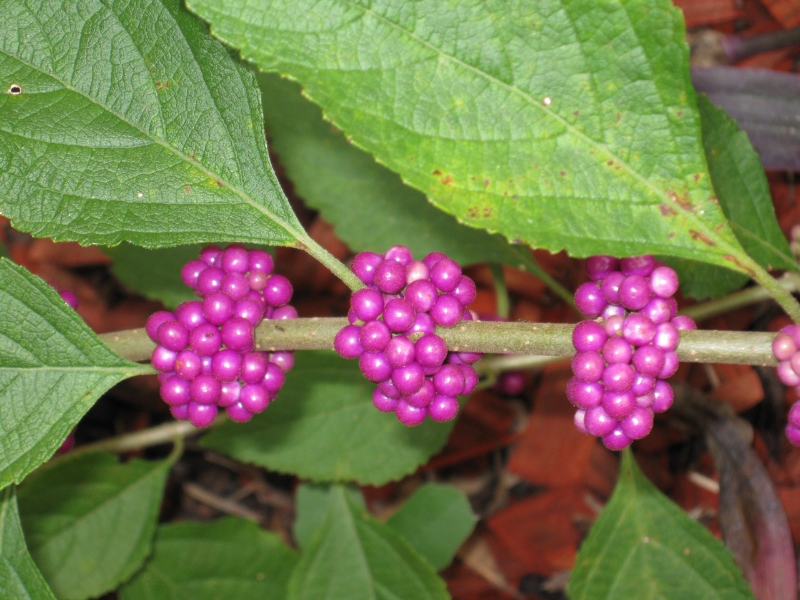
Also called the French mulberry, the American beautyberry is a favorite for plant enthusiasts who love its fall show of purple berries. If you love color, the American beautyberry puts out pink and white flowers from May to July.
This shrub is often found in forests shaded by larger plants such as Turk’s cap and yaupon holly.
- Plant type: Shrub
- Sun: Partial shade or full shade
- Water needs: Low, but may lose leaves and berries during an extended drought
- Soil: Sandy or clay
- Duration: Perennial
- Mature height: 3-5 ft. tall; 3-5 ft. wide
5. Aromatic sumac (Rhus aromatica)
If you want lots of bang for your landscaping effort, aromatic sumac is a low-maintenance or no-maintenance shrub with year-round color. In spring, aromatic sumac puts out yellow flowers, and in the fall the female plants have red berries and the foliage turns different shades of red, yellow, and orange.
Aromatic sumac works well in full sun or part shade and is deer-resistant.
There’s an ecological payoff, too: as Lisa Kuder of the University of Maryland Extension in College Park, Maryland, notes, “Native shrubs can provide pollinators with food, nesting sites, and a place of refuge from predators and mowing equipment.”
- Plant type: Shrub
- Sun: Full sun, full shade, partial shade
- Water needs: Low
- Soil: Thin, sand, or clay
- Duration: Perennial
- Mature height: 2-3 ft. tall; 3-4 ft. wide
Read more: What Shrubs and Bushes Are Best for Shaping?
Flowering plants
6. Texas lantana (Lantana urticoides)
If you or your local butterfly population are hungry for orange flowers during the warm season, consider Texas lantana. This deciduous shrub puts out stunning orange flowers during the warmer months that butterflies and other pollinators love to feast on.
Texas lantana requires no additional watering once established. If you want to prune, you can do light shaping in late winter.
- Plant type: Shrub
- Sun: Full sun or partial shade
- Water needs: Low
- Soil: Sand, clay, or thin
- Duration: Perennial
- Mature height: 1.5-6 ft. tall; 2-4 ft. wide
7. Turk’s cap (Malvaviscus arboreus var. drummondii)

If you have shade on your lawn and struggle to find beautiful plants that will thrive, Turk’s cap may be the plant for you. Turk’s cap loves partial shade and produces stunning red flowers in late summer that look like a Turkish hat or turban.
If you already have red in your lawn, some cultivars produce white flowers. Hummingbirds love this plant.
- Plant type: Shrub
- Sun: Prefers partial shade
- Water needs: Low to moderate
- Soil: Clay, loam, sand, or limestone; moist and well-drained
- Duration: Perennial
- Mature height: Usually 2-3 ft. tall and 2-3 ft. wide; can grow up to 9 ft.
Read more:
Grasses and sedges
8. Indiangrass (Sorghastrum nutans)

Also called yellow indiangrass, this native prairie grass still grows along roadsides in the San Antonio area. Indiangrass produces striking yellow seed heads in the fall and makes a great accent plant or rain garden plant for home landscapes.
- Plant type: Grass
- Sun: Full sun or partial shade
- Water needs: Moderate
- Soil: Sand, clay, thin; must be well-drained
- Duration: Perennial
- Mature height: 2-4 ft. tall; 2-4 ft. wide. Seed heads grow as tall as 6 ft.
Ground cover
9. Horseherb (Calyptocarpus vialis)
Horseherb, also called straggler daisy or rosemary grass, is a tough native ground cover for shaded areas. Some Texans treat it as a stubborn weed, while others love it for filling shade.
It produces small yellow flowers from March through November, or year-round in frost-free climates.
Horseherb is considered semi-evergreen. This means it is evergreen in milder climates but will lose its leaves (deciduous) in colder climates. And yes, you can mow it.
- Plant type: Ground cover
- Sun: Full sun or partial shade
- Water needs: Low
- Soil: Sandy or clay
- Duration: Perennial
- Mature height: 6-10 inches tall
Vines
10. Alamo vine (Merremia dissecta)
This flowering vine thrives in full sun or partial shade and produces white flowers from May through October. Alamo vine grows quickly during the warm season but dies back (deciduous) during the winter. It can be pruned in winter or summer, if needed.
- Plant type: Vine
- Sun: Full sun or partial shade
- Water needs: Low
- Soil: Sandy or clay
- Duration: Perennial
- Mature height: 8-14 ft.
11. Coral honeysuckle (Lonicera sempervirens)
Are you trying to attract more hummingbirds or butterflies to your yard? Both hummingbirds and butterflies love coral honeysuckle’s trumpet-like red blooms that appear from April through October. This vine is not aggressive like other non-native vines such as Japanese honeysuckle and looks beautiful growing across a trellis or fence.
- Plant type: Vine
- Sun: Full sun or partial shade
- Water needs: Low
- Soil: Sandy or clay
- Duration: Perennial
- Mature height: 8-15 ft.
FAQs
Your best bets are local specialty nurseries, botanical garden plant sales, and seasonal events hosted by native plant groups. Shopping local gets you plants already suited to your soil and climate, plus staff who can answer questions.
Fall, roughly October through early winter, is best because roots can settle before summer heat arrives. Spring is a solid second choice, but avoid planting during the hottest, driest stretch of summer.
Most established San Antonio natives get by on normal rainfall alone, needing supplemental water only during prolonged drought. A deep soak every week or two during extended dry spells is usually plenty, far less than the frequent watering non-natives demand.
Several native trees thrive in San Antonio. Honey mesquite is a tough, drought-tolerant shade tree reaching 25 to 40 feet tall. The Mexican plum is a small deciduous, fruit-bearing tree with white, pink-centered flowers from February to April. Yaupon holly can also grow as a small evergreen tree with red berries and white spring flowers.
Read more:
The Best 26 Texas Native Plants
9 Low-Maintenance Landscaping Ideas for San Antonio
Let LawnLove handle your native landscaping
Native plants cut down on watering and fuss, but they still need the occasional trim, weeding, and cleanup to look their best. LawnLove’s local lawn care providers can mow, handle bush trimming, and take care of flower bed weeding so your native landscape stays sharp year-round. Get a free estimate today and take yard work off your to-do list.
Main Photo Credit: Native plant in a San Antonio garden. satanoid | Flickr | CC BY 2.0
Related Posts:


