| Key Takeaways |
|---|
| • Compost suits every soil type: Unlike sand, which should only go on already-sandy soil, mature, screened compost works well no matter what kind of soil a lawn has. • Sand on clay creates a disaster: Adding sand over heavy clay without first amending the clay traps water at the interface, causing roots to rot. • Timing after aeration matters most: Topdressing immediately after core aeration lets material drop directly into the root zone, while waiting too long means the lawn gets minimal benefit below the thatch layer. |

Wondering how to topdress a lawn without tearing up your yard? Topdressing spreads a thin, ¼-inch layer of sand, topsoil, or compost over your grass to improve the soil underneath without any digging.
It’s one of the simplest ways to revive a struggling lawn without ripping everything out, and it works best paired with aeration.
Prefer to skip the labor? Lawn Love’s local aeration and topdressing pros can handle the whole process for you.
What is topdressing?

Topdressing is the process of spreading a thin layer (¼-inch thick) of organic material over your lawn to amend the soil. You can topdress your entire yard or focus on bare spots, combining it with overseeding to fill them in.
Topdressing is the best way to rejuvenate your lawn without pulling up all your grass (which is a pain) and starting over. As your grass grows through the layer of topdressing, the organic material is incorporated into the soil beneath it, adding nutrients and improving soil quality.
What materials can you use for topdressing?
There are 3 options for topdressing materials:
- Sand is commonly used on golf courses because it improves bounce and resiliency. For home lawns, sand should only go on soil that’s already sandy.
- Topsoil helps smooth out the ground but doesn’t contain much organic matter. It’s an inexpensive way to make your topdressing material go farther.
- Compost is recommended for all soil types. Use a compost that’s mature and screened with a fine particle size and a pH between 6.0 and 7.2. Look for these qualities on the label.
Most people use a mixture of the three to save money. Reed Santee, vice president at Central Home Supply in Scotts Valley, California, has been supplying landscape materials since 1974. He’s a big fan of adding compost to your lawn for long-term health.
“Topsoil is essentially inert,” Santee says. “It adds volume but little biology. Quality compost actually feeds the soil food web already living in your lawn. That’s the difference between a lawn that looks better short-term and one that actually builds healthier roots over time.”
Choosing the best topdressing material for your soil type
You’ll want to use a topdressing material that’s comparable to your current soil. If you make a drastic change, you will ruin your yard. Santee warns that putting sand over a heavy clay lawn is a guaranteed disaster.
“Clay already struggles to let water move through it,” Santee says. “Adding sand without deeply amending the clay itself creates a perched water table right at the interface. Roots sit in that saturated zone and rot. The fix isn’t more sand, it’s amending the clay profile first with organic compost before any topdressing happens.”
To determine what kind of soil you have, grab a handful of damp soil from your yard and rub it around in your hands.
| How the soil feels | Soil type | Topdressing material |
| Sticky | High clay content | Compost |
| Gritty | High sand content | Sand and compost |
| Fine, soft, slightly damp | Loam | Topsoil and compost |
If your primary goal is fixing a bumpy, uneven lawn, pure compost will not hold up.
“For leveling a bumpy lawn versus just feeding it, your mix needs to shift toward something with more structural consistency,” Santee says. “I’d lean toward a sandy loam blend. The sandy loam component settles predictably and holds grade. Pure compost compresses differently in different spots and can leave you with new bumps within a season.”
How much material do you need for topdressing?
To amend a home lawn, a ¼-inch layer of topdressing is recommended. That means you need 0.77 cubic yards of material to topdress 1,000 square feet. Don’t exceed ½ inch of material in a single application because you risk smothering the grass.
To find the amount of material needed for your yard, multiply the square footage of your yard by 0.77, then divide by 1,000.
Example: If your yard is 800 square feet, the calculations would be as follows:
- 800 x 0.77 = 616
- 616 ÷ 1,000 = 0.62 cubic yards of topdressing material needed
Supplies you’ll need for DIY topdressing
- Power rake or aerator
- Lawn mower
- Regular rake, shovel, or garden fork
- Wheelbarrow
- Grass seed (if overseeding)
- Topdressing material
- A soil test kit
8 steps for topdressing your lawn
1. Remove thatch

Thatch is the interwoven layer of living and dead materials between the grass blades and the soil. It can block topdressing materials (along with water and other nutrients) from ever reaching the soil.
If thatch is thicker than ½ inch, dethatch it first. Use a power rake or core aerator to break up the thatch layer so the topdressing material can penetrate the surface.
2. Mow your lawn
Mow the grass to about one-third of your usual height, staying within the lower end of the recommended height range for your grass type. Avoid scalping the lawn down to bare soil, since a stressed lawn recovers from topdressing more slowly.
3. Core aerate and overseed the lawn
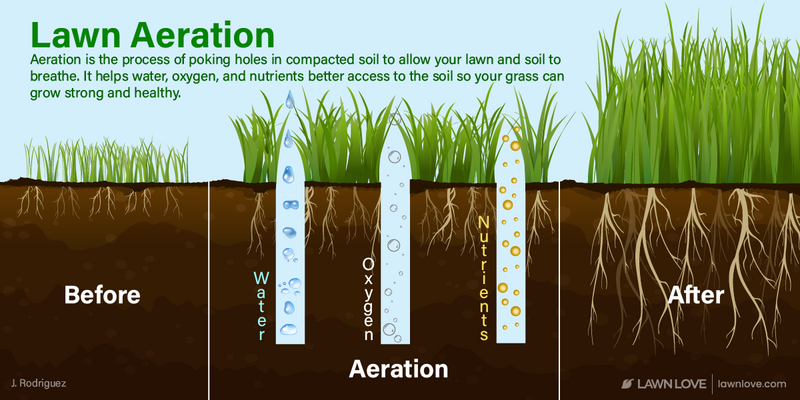
This is your best opportunity to overseed your grass. Throwing down grass seed now guarantees the topdressing will speed up seed germination.
Santee says combining aeration with topdressing is the ultimate cheat code for a healthy lawn.
“The timing is everything,” Santee says. “Aeration pulls cores that leave open channels, and if you topdress immediately after, that material drops directly into the root zone rather than bridging over the surface. Miss that window and you’re essentially just mulching the top of your lawn. The grass sees minimal benefit below the thatch layer.”
4. Clear away debris
Remove grass clippings, loosened thatch, or plugs of soil (from lawn aeration) from the area you’re going to topdress.
5. Spread the topdressing
Shovel a small amount of your topdressing material over a few square feet at a time. Fling them with a motion like hitting a hockey puck to spread the material in a ¼-inch layer.
You want an even, quarter-inch layer. Santee says that thin layers break down much faster than heavy piles.
“Thin, even applications work into the soil noticeably faster than thick uneven ones,” Santee says. “Screened compost breaks down faster because the particle size is uniform. Chunky, unscreened material creates air pockets and stalls the process.”
You also need to verify the quality of your compost to avoid planting a yard full of weeds.
“Cheap material often hasn’t reached the internal temperatures needed to kill weed seeds,” Santee says. “I’d specifically look for OMRI-certified compost. That certification tells you the product went through a legitimate process, not just a pile sitting in someone’s yard.”
6. Rake and water the topdressing into the lawn
Gently rake in the organic material after spreading, then water your lawn thoroughly to help it settle into the soil.
7. Leave your lawn alone
Avoid heavy foot traffic on your lawn for the next week and wait 7-10 days before mowing again.
8. Wait for your topdressing results
Watch and wait. It may take a few seasons to see the full benefits of topdressing, but you should see improvements in drainage and water retention within a few weeks.
Benefits of topdressing
Topdressing helps with many aspects of lawn care. When done properly, it reduces your lawn’s fertilizer and maintenance needs.
Improves soil aeration: Soil organisms break down compost and create small air pockets, so grass roots get more oxygen and water can penetrate the soil.
Improves soil quality: Topdressing adds significant nutrients to the soil, including nitrogen, phosphorus, and potassium. It also improves the soil’s cation exchange capacity, its ability to hold nutrients and water. This gives you greener grass.
Adds beneficial soil microbes: Compost contains microbes that break down organic matter, fix nitrogen, control diseases, and regulate nutrient levels.
Helps seed germination: All of the benefits of topdressing make it a valuable player for seed germination, which is why it goes hand in hand with lawn overseeding.
Levels the lawn: Poor lawn grading can cause drainage issues that may lead to fungal disease and yard erosion. Topdressing smooths out uneven areas in the lawn. Just don’t go overboard, or you could raise the grade too much, causing more drainage and erosion issues.
Breaks down thatch: Microbes in compost break down thatch, allowing water and nutrients to flow freely to the roots.
FAQs
Basal dressing is fertilizer or organic matter worked into the soil before you plant or seed a new lawn, giving young roots immediate access to nutrients. Topdressing is applied to an already-established, growing lawn to improve the soil without disturbing the turf.
Typically, topsoil costs $10 to $50 per cubic yard. Sand costs between $15 and $40 per cubic yard. Compost varies widely, but it’s always less expensive to buy in bulk. You can purchase 1 cubic yard of screened compost for $30 to $80, and garden centers often deliver.
What tools are needed for topdressing? You may already have some in your garden shed, but here’s how much they cost if you need them:
• Wheelbarrow – $50
• Garden trowel – $10
• Rake – $25
• Shovel – $18
• Garden gloves – $12
• Power rake or aerator rental – $29-$150
• Lawn mower – $475
• Bobcat – $300/daily rental
• Grass seed (if overseeding) – $3-$10
You can rent equipment from local hardware stores.
If your yard is due for fertilization, apply it a few weeks before topdressing. The fertilizer ensures your grass is healthy and will grow quickly with the topdressing. The best way to know if your lawn needs fertilizer is to get a soil test.
Warm-season lawns do best with late-spring topdressing; cool-season lawns do best in early fall, ideally right after aeration. See our full guide on when to topdress your lawn for grass-specific timing.
Don’t know where to start?
Topdressing isn’t necessarily complex, but it is labor and time-intensive. If you don’t have the time or tools to topdress yourself, call a local lawn care pro. A landscaping company in your area can topdress your lawn and maintain it once it starts growing strong and healthy.
Main Image: Topdressing a lawn. Photo Credit: Shutterstock
Related Posts: