| Key takeaways |
|---|
| • Transition slowly: A hybrid approach to phase out synthetics prevents shock to the grass. • Feed the soil: Organic care relies on compost and microbes, not just chemical nitrogen. • Withdrawal phase: Growth may slow for 4 to 8 weeks while the soil recalibrates. • Timing: Organic pre-emergents must be applied before the soil hits 55°F. • Savings: Initial costs balance out after 2 to 3 seasons of organic care. |

More homeowners than ever are rethinking what goes on their lawns. According to a 2021 survey, 60% of Americans say environmental sustainability is at least somewhat important in their lawn care choices.
Between new fertilizer regulations, concerns about kids and pets, and rising water costs, 2026 is the right time to transition your yard from synthetic chemicals to healthier, organic options.
If you are ready to make the switch but don’t want to handle everything yourself, Lawn Love’s local lawn care professionals can manage everything from organic fertilizer applications to core aeration.
- Quick overview: Organic lawn care pros and cons
- Why homeowners are making the switch
- Understanding what “organic lawn care” really means
- Your spring transition timeline
- Organic alternatives to common lawn products
- The Economics: Cost comparison
- What to expect during the transition
- Spring maintenance schedule for organic lawns
- Common mistakes to avoid
- FAQs
Quick overview: Organic lawn care pros and cons
| Organic lawn care pros | Organic lawn care cons |
| ✓ Safe for children and pets ✓ Protects local water quality ✓ Lower long-term maintenance costs ✓ Boosts soil health naturally ✓ Highly drought-tolerant turf | ✗ Higher upfront investment ✗ Takes longer to see initial results ✗ Requires strict application timing ✗ More manual weed control initially ✗ Temporary adjustment period |
Why homeowners are making the switch
- Safety concerns: Synthetic fertilizers and pesticides can stick to the grass for days. They can hitch a ride on your dog’s paws or your kid’s shoes and end up in your home.
- Water quality: Fast-dissolving fertilizers wash away during rains, fueling toxic algae. For instance, in New Hampshire, suburban runoff, including fertilizer, causes over 50% of coastal nitrogen pollution.
- Health benefits: Organic lawns actually work for the environment. Healthy, natural soil traps carbon and releases more oxygen than a chemically dependent lawn.
- Environmental responsibility: One teaspoon of healthy soil holds billions of microbes, which naturally recycle nutrients and help your lawn thrive without chemicals.
Note: States like New Hampshire, Maryland, and New Jersey now strictly limit lawn chemicals. Check your local government website for seasonal blackout dates before you fertilize this year.
Understanding what “organic lawn care” really means

Synthetic lawn care feeds the grass while organic lawn care feeds the soil.
There are a few common misconceptions about going organic, and the biggest one is that organic lawn care simply means doing nothing and letting weeds and pests take over your yard. In reality, it requires active management, especially in the beginning.
When you use organic products, you are adding organic matter to your lawn that feeds earthworms, beneficial soil microbes, and fungi. These organisms break down organic matter and naturally release nitrogen, phosphorus, and potassium to the grass roots.
When you make the switch, you should set realistic expectations because it takes time. An organic lawn relies on a thriving underground ecosystem. When the soil is healthy, the grass is naturally thicker and crowds out weeds and fends off pests without the need for chemicals.
Your spring transition timeline
Phase 1: Assessment (early spring/March)
Before applying anything, take a soil test to tell you your soil’s pH and exact nutrient deficiencies. You also should check your lawn for weeds and any heavily compacted areas where water tends to pool.
Phase 2: Final synthetic applications (if needed)
If your lawn is overrun with crabgrass or has been heavily chemically dependent, going cold turkey might be tough.
Steve Rice, owner of Lawn Kings, in Valencia, CA, advises against suddenly stopping if your lawn depends on chemicals.
“For lawns heavily reliant on synthetic products, an abrupt stop isn’t always ideal. A hybrid approach, gradually reducing synthetics while introducing organic inputs, tends to protect turf health while the soil system adjusts. This phased transition usually leads to better results and fewer setbacks,” he says.
Taylor Olberding, franchise owner at Heroes Lawn Care, in Omaha, NE, says your lawn needs time to adjust.
“You can start cutting back synthetics while introducing organic amendments so the grass doesn’t get shocked. That way, soil biology ramps up without leaving your lawn super vulnerable to weeds or nutrient stress,” Olberding says.
If you have severe weed issues, you should use a targeted synthetic pre-emergent one last time while you begin applying organic fertilizers to wake up the soil microbes.
Phase 3: Building soil health (mid-spring)
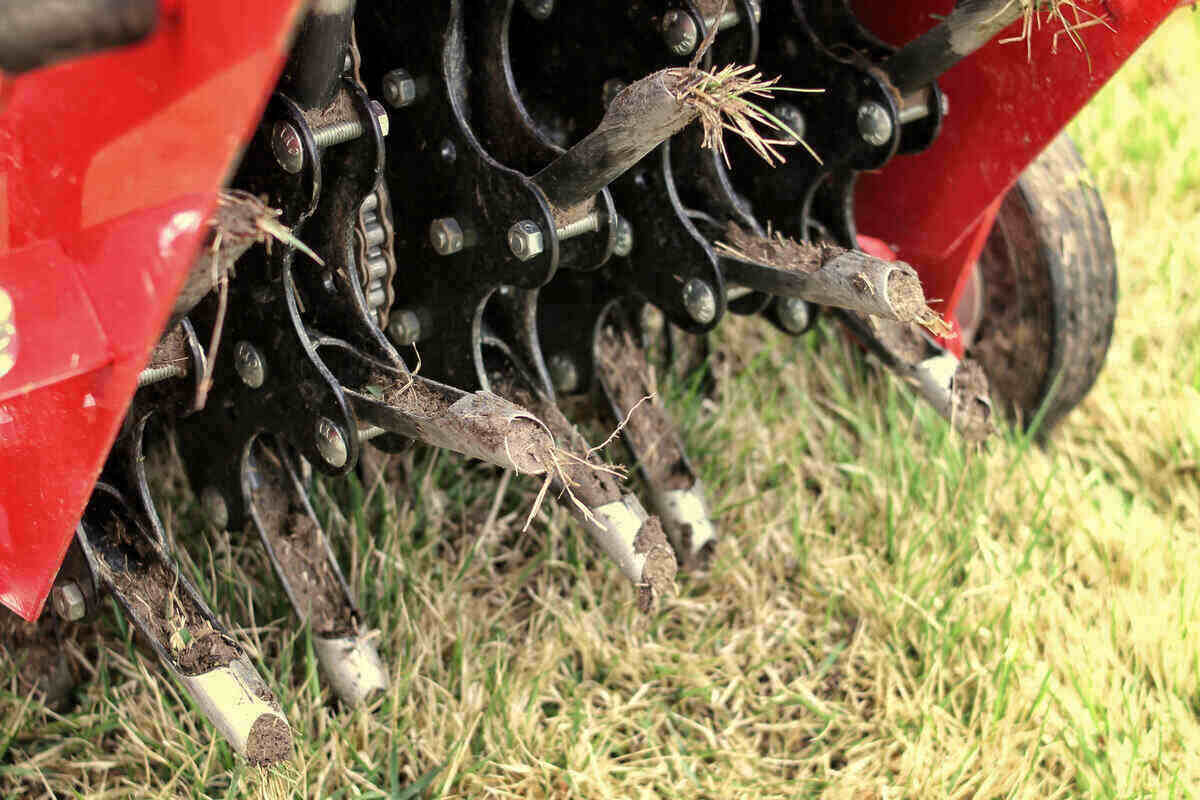
Once the ground has thawed and dried out from spring showers, aerate your warm-season grass. Core aeration pulls plugs of dirt out of the ground, relieving compaction and allowing oxygen to reach the roots.
Immediately after aerating, topdress the lawn with a quarter-inch layer of high-quality organic compost. This inoculates your yard with billions of beneficial microbes that will start breaking down thatch and feeding the grass.
Phase 4: Organic maintenance begins (late spring)
When the grass enters its peak growing season, you can start your organic maintenance routine:
- Fertilizer: Apply your first round of organic, slow-release fertilizer.
- Mowing: Keep the blade height at 1 to 4 inches, depending on your grass type.
- Watering: Water deeply but infrequently to encourage the roots to chase moisture down into your newly amended soil.
Organic alternatives to common lawn products

Fertilizers:
- Compost and compost tea: Compost adds organic matter, and compost tea gives a boost of beneficial microbes directly to the root zone.
- Corn gluten meal (pre-emergent and fertilizer): It provides a mild dose of nitrogen while disrupting weed germination.
- Blood meal, bone meal, and alfalfa meal: These are excellent targeted organic supplements for nitrogen, phosphorus, and potassium deficiencies.
- Slow-release organic blends: Packaged organic lawn fertilizers utilize biosolids or plant derivatives to feed the lawn slowly over several weeks.
- Application rates and timing: Add organic fertilizers during periods of active growth (late spring and early fall).
Weed Control:
- Manual removal: The most environmentally friendly way to manage broadleaf weeds is to pull them by hand using a specialized weeding tool.
- Corn gluten meal: Aaron Strickland, owner of Mr. Trim Lawn & Garden Services, in Bowmanville, ON, explains how this works: “Unlike synthetic pre-emergents, organic options like corn gluten work by preventing root development, and must be applied early and correctly to be effective. These products typically last 6 to 8 weeks.”
- Timing: Rice says “a common mistake is applying them too late. They need to go down before soil temperatures consistently reach the low-to-mid 50s, and they must be reapplied on schedule to remain effective.”
- Natural herbicides: For spot treatments on driveways or patios, you can use vinegar as a weed killer.
- Cultural practices that prevent weeds: Maintain a mowing height of 3 to 4 inches, and growing dense turf naturally blocks sunlight from reaching weed seeds.
Pest Management:
- Beneficial nematodes: Instead of harsh chemicals, use beneficial nematodes that kill grubs.
- Diatomaceous earth: Spread diatomaceous earth to control crawling insects.
- Neem oil: It works as a natural repellent and lifecycle disruptor for various pests.
- Attract beneficial insects: Plant native plants around your yard to attract beneficial insects like ladybugs and predatory wasps.
Disease Prevention:
- Proper watering practices: Fungal diseases thrive in damp, dark environments. Aim for the best time to water your lawn (early morning) and water deeply and infrequently.
- Air circulation: Dethatch your lawn periodically to ensure that water and oxygen flow freely to the soil.
- Disease-resistant grass: If your lawn constantly battles fungus, you should overseed with disease-resistant grass seed adapted to your specific climate.
The Economics: Cost comparison
“Organic care can feel pricey at first, mostly because you’re investing in good compost, top-quality amendments, and slower-release fertilizers,” explains Olberding.
“Usually after a season or two, the soil starts doing more of the work itself, and you need less product overall. That’s when the cost starts to balance out compared with constant synthetic inputs,” Olberding says.
Here is the breakdown:
- Upfront investment vs. long-term savings: Rice says that “in many cases, the break-even point shows up after two to three seasons. Once soil biology improves, lawns usually need fewer corrective treatments, less product overall, and recover faster from stress, which brings long-term costs down.”
- Cost of organic products vs. synthetic: The cost of fertilizing your lawn with the average price of synthetic products is between $100 and $300, while organic products range from $200 to $500.
- Reduced water usage over time: Outdoor watering uses 8 billion gallons daily. Moving to natural care prevents 50% of water wasted through evaporation and runoff from overwatering.
- Potential increase in property value: Sustainable landscaping offers a fantastic return on investment.
What to expect during the transition
When you stop applying synthetic fertilizers, your lawn will likely go through a withdrawal phase.
“It’s also normal for a lawn to look a little off during the transition. Growth may slow, or color may fade for a few weeks as the soil’s natural biology resets,” Strickland explains.
“The good news is this phase doesn’t last long, and with regular mowing, increased mowing height (3 to 4 inches), consistent watering, and support from compost or microbe-rich organic fertilizers, the lawn typically rebounds stronger and more resilient than before,” he says.
Here is exactly what you should prepare for:
- Appearance changes: While the synthetics wear off, the grass may look a bit pale. This is the period when the natural soil microbes take over the feeding process.
- Weed presence during adjustment: Without a chemical barrier, you may see a temporary spike in weeds. This is completely normal. As your turf thickens over the next year, it will naturally crowd them out.
- Soil improvement signs: Dig a small hole after a few months. If you start seeing earthworms returning, softer ground that is easier to penetrate, and less water runoff during rainstorms, your soil is healing.
Spring maintenance schedule for organic lawns

Photo Credits: Aeration: Dziurek / Adobe Stock. Overseeding: Shutterstock
To help your lawn through the transition and keep it thriving organically, follow this maintenance schedule:
March (early spring):
- Soil test: Take a soil test to know exactly what your lawn needs before you add anything to it.
- Clean‑up: Rake up leaves, branches, and any debris left over from winter so sunlight can reach the grass again.
- Inspection: Walk your lawn and take note of thin spots, compacted areas, and heavy weed patches so you know where to focus later.
April:
- Aeration: Spring aeration works best for warm-season grass to loosen compacted ground.
- Topdressing: Spread a thin 1/4-inch layer of screened compost over the whole lawn, then water lightly so it works its way down into the soil.
- Pre‑emergent: Apply corn gluten meal before weeds start to sprout when the soil temperature gets to around 55°F.
May:
- Fertilizing: Add the first round of slow-release organic fertilizer depending on the soil test results.
- Mowing: Cut at 3 to 4 inches for cool-season grass, or 2 to 3 inches for warm-season grass. Never cut more than one-third of the blade at once, and leave the clippings on the lawn.
- Spot‑weeding: Pull broadleaf weeds by hand after it rains (they come out easier). For bigger problem areas, spot-treat with a natural herbicide.
June:
- Watering: Switch to deep, infrequent watering. Aim for about 1 inch per week from rain and irrigation combined, and adjust up during heat waves or if your soil drains quickly.
- Overseeding: If you have warm-season grass, now is a good time to fill in thin spots after aeration. If you have cool-season grass, wait until early fall.
- Monitoring: Keep an eye out for early signs of pests or disease.
Common mistakes to avoid
- Over-fertilizing with organic products: Excessive organic matter can still throw off your soil’s nutrient balance. Always follow package instructions and base your applications on your soil test results.
- Expecting instant results: Organic amendments take time to break down, and you should trust the biological process.
- Abandoning the process too early: The withdrawal phase can be discouraging. Many homeowners panic when the grass fades and revert to synthetic fertilizers, resetting all their progress.
- Neglecting soil testing: You need a baseline to know precisely what organic amendments your soil requires.
- Using “organic” products that aren’t truly organic: Unfortunately, greenwashing is real, and you need to read the labels carefully. If a bag claims to be natural but contains urea or synthetic chemical salts, it will disrupt your soil biology.
- Scalping the lawn in spring: Cutting too short stresses the grass, exposes the soil, and provides sunlight to dormant weed seeds.
FAQs
Early spring and early fall are the optimal times. Spring allows you to get ahead of weed germination with organic pre-emergents, while fall is perfect for core aeration, topdressing with compost, and overseeding cool-season grass.
You can switch mid-season (like in summer), but it can be difficult because the summer heat already stresses the grass, making the withdrawal phase harsher. If you really want to switch mid-summer, you should focus on deep watering and wait until fall to apply heavy compost or fertilizers.
You can easily find organic lawn products at regular hardware stores and big-box retailers. Your local nurseries and specialized online retailers are much better sources for advanced organic treatments.
It can create some challenges. Chemical runoff or pesticide drift from a neighbor’s yard can temporarily impact the microbes at the immediate property line.
You can create a buffer zone by planting a small border of native plants or slightly raising your mowing height along the shared property line.
OMRI stands for the Organic Materials Review Institute. When a product is “OMRI Listed,” it means an independent organization has verified that it is approved for use in certified organic production.
The OMRI seal is one of the easiest ways to ensure you aren’t falling for greenwashing and are buying genuinely organic products.
The grass is greener on the organic side
Switching to organic lawn care is one of the best decisions you can make. You eliminate all the harsh chemicals, create a safe environment for your children to play and for your pets to roam, and also protect local waterways from toxic runoff.
If you are ready to embrace a greener yard but want to skip the research, Lawn Love’s local professionals can guide your lawn to success.
Main Image: Finished compost beside organic food scraps. Image Credit: Vera Kuttelvaserova / Adobe Stock
Related Posts: