If you want to know how short you can cut your grass, a general approach is to cut cool-season grasses 3 to 3.5 inches short and warm-season grasses 2 to 3 inches short. This keeps a neat, healthy lawn for most turf types.
However, the best mowing height depends on the grass species and cultivar (especially for summer grasses), the lawn’s health, season and personal preference. We cover all these factors in our guide.
How short can you cut cool-season grasses?
A 3 to 3.5-inch mowing height is best to keep your cool-season lawn healthy while still looking neat.
David Smitley, professor emeritus at the Michigan State University Department of Entomology, recommends using the taller mower setting.
“The top setting for most mowers gives a cutting height between 3.25 and 4 inches. This is best for your lawn, but at a setting of 4 inches, you may sometimes see some ‘laying-over’ of turf blades that some people find undesirable. For this reason, some people prefer to mow at 3 or 3.5 inches.” Dr. Smitley says.
Cool-season grass cutting height chart
Below are the standard cutting heights recommended for common cool-season grasses. Aim to mow 3 to 3.5 inches tall, near each turf type’s maximum recommended mowing height. The low end of the interval is the shortest you can mow without risking damaging the grass.
| Name | Standard Cutting Height for Home Lawns |
| Fine fescue | 2 – 3.5 inches |
| Kentucky bluegrass | 2 – 3.5 inches |
| Perennial ryegrass | 2 – 3.5 inches |
| Tall fescue | 2.5 – 4 inches |
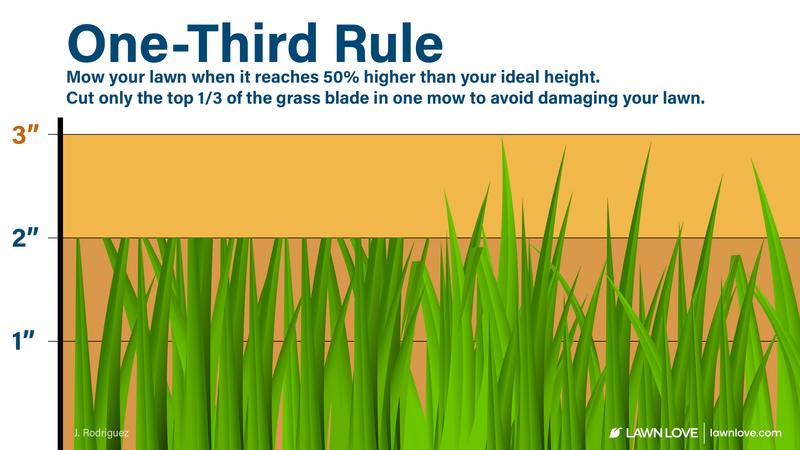
Mow the turf before it reaches 4.5 inches tall to keep it at 3 inches. For a 3.5-inch cut, don’t let it grow over 5.25 inches. This way, you keep the one-third rule (you’ll only cut a maximum of 30% of the blade length) and avoid scalping the lawn.
How short can you cut warm-season grasses?
The general recommendation is to mow warm-season grasses 2 to 3 inches tall. However, it is important to know your grass-type requirements since it’s quite a diverse group. For example, Bermuda does well at 1.5 inches, while some St. Augustine varieties should never be cut lower than 3 inches.
Warm-season grasses cutting height chart
| Grass type | Optimal Mowing height |
| Bahiagrass | 3.0 – 4.0 inches |
| Bermudagrass | 0.5 – 1.5 inches |
| Buffalograss | 2.0 – 4.0 inches |
| Carpetgrass | 1.5 – 2.0 inches |
| Centipedegrass | 1.5 – 2.0 inches |
| St. Augustinegrass | 2.5 – 4.0 inches |
| Zoysiagrass | 1.0 – 3.0 inches |
Experts say to mow the lawn tall
According to the Texas A&M AgriLife Extension, the best approach is to keep the lawn close to the highest recommended mowing height for the specific grass species and cultivar. Taller grass comes with valuable benefits:
- More blade surface for photosynthesis
- Deeper, more robust root systems that can better handle heat, drought and root pests like grubs
- Shades the soil, keeping it cool and moist
- Keeps weed seeds from germinating and weed sprinklings from growing.
Can you mow shorter than that? You can, and many homeowners do, but ensure you do it for the right reasons and at the right time.
Good reasons to cut grass shorter:
- To prevent mold
- To overseed the lawn
- To cut off damaged blade tops
Good times to cut grass shorter:
- During the growing season
- When the weather supports healthy growth and doesn’t stress the lawn
- When weeds are under control
Here are some related articles on mowing:
- “How to Mow Your Overgrown Lawn”
- “Do You Really Have to Mow Your Lawn?”
- “How Much Does Lawn Mowing Cost in 2024?”
What determines the mowing height

Experts at the University of Florida explain that mowing height is determined by the leaf width and the growing habit of each turfgrass species:
- Low-growing grasses that spread horizontally (Bermuda, Zoysia) can be mowed shorter than bunch-type species that grow upright (tall fescue, perennial ryegrass, Bahia)
- Turfgrasses with narrower blades (Bermuda) can be mowed closer to the soil than grasses with wider blades (St. Augustine).
According to Kansas State University, grass health and environmental factors also count:
- If the grass is healthy and actively growing, you can cut it shorter at the lowest recommended level.
- You should raise the height to a higher level when the grass is stressed by drought, heat, shade, cold, disease, insects, or traffic.
How short to mow each season

If you hit a soft spot where your lawn is thriving through the year without you making any changes in mowing height, keep it up and don’t change a thing. This often happens in states with milder summers and winters, with less snow.
If you’re still struggling to keep the lawn healthy and testing trimming heights, here are a few tips that can help.
Mowing height during spring
During spring cool-season grasses are actively growing. Keep the lawn 3 to 3.5 tall or cut it a bit short if you want. However, don’t go below 2 inches. Short grass has shallow roots and less surface for photosynthesis, making grass weaker, thinner and less resilient to pests, drought and diseases.
For warm-season grasses, the University of Missouri recommends mowing at 1.5 to 2 inches right before green-up to increase the green-up rate, remove dead leaves, and reduce thatch.
Mowing height during summer
You can keep the warm-season lawn at 2 to 3 inches or mow a bit lower. Experts at Oklahoma State University say a shorter cut makes for a more attractive, “tight” look since, during the growing season summer species respond by lateral spreading and improving density.
However, as soon as a heat wave and the drought season approaches, increase the mowing height to improve stress resistance.
Keep cool-season grasses 3 to 3.5 inches tall (you can even mow at 4 inches) during summer. Winter grasses are more vulnerable to heat, and tall mowing helps them grow deeper roots and better tolerate high temperatures and drought.
Mowing height during fall
As you prepare for the last mow of the season, gradually increase the mowing height for warm-season grasses. Aim to reach a 2 to 2.5-inch mowing height before winter and dormancy. Warm-season grasses are more sensitive to cold and a taller canopy protects the roots better from winter temperatures.
To prepare a cool-season lawn for winter, gradually decrease the mowing height to reach 2 to 2.5 inches by the time of the first frost. In the northern states, winter is moist and snowy and tall grass is more exposed to snow mold and other fungal diseases.
Here are some related articles:
FAQ on how short to cut your grass
How short should you cut new grass?
Let new grass grow ⅓ higher than the regular mowing height for your grass species. Then, mow at the standard mowing height.
How do you mow the lawn correctly?
To mow the lawn correctly, follow these rules:
- Don’t mow wet grass.
- Keep the blades sharp.
- Alternate the mowing pattern.
- Mow early morning or mid-afternoon.
- Only mow during the growing season.
How much does lawn mowing cost?
Professional lawn mowing costs $35 to $100 per visit, depending on the lawn’s size and how tall the grass is.
Get the perfect cut with lawn care professionals
Leave it to our lawn care pros to mow the lawn at the perfect height every time. Find a lawn care company near you with Lawn Love and enjoy perfectly cut grass year-round!
Sources:
- Smitley, D. (2023, December 21). Raise the Mowing Height for Weed and Grub Defense. Michigan State University. https://www.canr.msu.edu/resources/mow_high_for_weed_and_grub_control
- Reicher, Z., Patton, A., Bigelow, C., Voigt, T. (2006). Mowing, Dethatching, Aerifying Mowing, Dethatching, Aerifying and Rolling Turf and Rolling Turf. https://www.extension.purdue.edu/extmedia/ay/ay-8-w.pdf
- Walton, R. (2023, May 15). Basic Lawn Care Tips. Georgia Tech. https://news.gatech.edu/features/2023/04/tech-lawn-and-garden-basic-lawn-care-tips.
- Oklahoma State University Extension (2022, June 12). Mow At The Right Height to Maintain Turf. https://extension.okstate.edu/programs/gardening/grow-gardening-columns/grow-columns-2022/june-12-2022-mow-at-the-right-height.html
- Trenholm, L.E., Unruh, J.B., Cisar, J.L. (2001). Mowing Your Florida Lawn. https://gardeningsolutions.ifas.ufl.edu/lawns/maintenance-and-care/mowing-your-florida-lawn/
- Kansas State University (n.d.). Mowing. https://www.k-state.edu/turf/resources/lawn-problem-solver/maintenance/mowing/
- Grubbs, B. (2019, May). Mowing Recommendations for Warm-Season Turfgrasses. Texas A&M AgriLife Extension Service. https://aggieturf.tamu.edu/wp-content/uploads/sites/24/ESC052-1.pdf
Main Image Credit: rh2010 | Adobe Stock Free | License
Related Posts: