| Key takeaways |
|---|
| • Raise mowing height by ½–1 inch in summer, depending on grass type, but stay within the recommended height range. • Taller grass leads to cooler soil, fewer weeds, and stronger roots, requiring less watering. • Never cut more than ⅓ of the blade in a single mowing, especially when hot. |

Yes, you should raise your mowing height in summer. Recommendations suggest raising it by ½ to 1 inch for cool-season grasses and by ½ inch for warm-season grasses, staying within the recommended mowing height range.
The benefits are critical when your lawn is under summer heat stress. Taller grass shades the soil, keeps roots cooler, retains moisture, and outcompetes weeds like crabgrass and dandelions. Just remember to never remove more than one-third of the blade in a single mowing.
A lawn that is looking thin, brown, or weedy, may just need a height adjustment. A local Lawn Love pro can mow at the right height for your grass type and get it back on track fast.
Why mowing height matters more in summer
Summer heat and drought push your lawn to its limits. When you cut too low in summer, you’re adding to your lawn’s stress:
- Cuts off energy supply. Grass blades are essentially solar panels. Cutting them too short removes your lawn’s ability to photosynthesize and make its own biological fuel.
- Roots weaken. Without sufficient leaf surface to photosynthesize, your grass directs its limited energy toward regrowing blades rather than building roots. You’re left with a shallow, weak root system that can’t absorb water and nutrients as well.
- Soil heats up. Without a canopy of grass blades, soil temperature spikes. Overheated soil dries out faster, stressing your lawn’s roots.
- Weeds move in. Bare or thin areas left by scalping your grass invite crabgrass and other summer lawn weeds to establish.
- Disease risk rises. Short-cut lawns are more susceptible to fungal issues like brown patch and dollar spot, which thrive in hot, humid conditions.
Dr. Manuel Chavarria, Texas A&M assistant professor and turfgrass physiology extension specialist, says, “Mowing height is one of the simplest tools homeowners have to help their lawn handle summer stress.”
As Dr. Grady Miller, professor and extension turfgrass specialist at North Carolina State University, puts it: “Stresses that kill turfgrass are often chronic and cumulative. So, wear, compaction, drought, shade, and pests… all these stresses can accumulate and persist for extended time periods, ultimately resulting in turfgrass damage/loss.
“It can be a bit like human health. The continuum of escalating respiratory and systemic infections — common cold can progress to pneumonia to sepsis. I’m not saying that keeping turfgrass mown low will result in death of the turfgrass, but it can be a significant contributing factor in turfgrass health.”
Summer mowing heights by grass type

How much you adjust for summer temps depends on your grass type and how high you’re already mowing.
“Cool-season species experience significant physiological stress during summer because their optimal growth occurs under cooler temperatures,” Chavarria says. “Warm-season grasses are adapted to high temperatures and are typically growing actively during the summer months.
“Warm-season grasses generally tolerate lower mowing heights. The need to substantially increase mowing height is usually less critical than it is for cool-season grasses because warm-season species are naturally better adapted to summer conditions.”
When asked about how much to raise your mowing height, Chavarria said that “even a modest increase of half an inch can make a noticeable difference during hot weather.”
“While increasing the height by a full inch may provide additional benefits, homeowners generally don’t need to go that far. In most cases, simply mowing at the upper end of the recommended range for your grass type is enough,” he says.
| Grass Type | Recommended Mowing Height* |
| Cool-Season Grasses | |
| Kentucky Bluegrass | 2-3 inches |
| Tall Fescue | 2-4 inches |
| Perennial Ryegrass | 2-3 inches |
| Fine Fescue | 1.5-3 inches |
| Warm-Season Grasses | |
| Bermudagrass | 1-2 inches |
| Zoysiagrass | 1-2.5 inches |
| St. Augustine (dwarf & semidwarf) | 2.5-3 inches |
| St. Augustine (standard) | 3-4 inches |
| Centipedegrass | 1.5-2 inches |
| Bahiagrass | 3-4 inches |
| Buffalograss | 2-4 inches |
*Check with your local cooperative extension office for your area’s most accurate recommendations.
Cool-season grass mowing height recommendation
These grasses grow best when air temperatures are between 60 F and 75 F, making summer their most stressful season.
Many extension publications recommend raising cool-season mowing height by 1 inch in mid-summer. The University of Minnesota Extension is among them, citing improved tolerance to heat and dry, windy conditions.
Michigan State University Extension research supports this. Lawns mowed at 3.5–4 inches out-compete weeds, tolerate grubs better, and may eliminate the need for herbicides and grub control applications compared to lawns cut at 2.5 inches.
Miller cautions, however, that a height increase should keep your grass within its recommended range. Cool-season grasses mowed above that range during wet or rainy periods may face an increased risk of disease, since a taller canopy retains moisture longer.
Warm-season grass mowing height recommendation
Warm-season grasses thrive between 80 F and 95 F, making summer their most active growing season. That said, they do still benefit from being allowed to grow a little taller, especially during periods of extreme heat or drought stress.
“A temporary increase in mowing height can help reduce stress by providing additional shading of the soil surface, conserving moisture, and promoting deeper root growth,” Chavarria says.
The standard recommendation is to raise the mowing height of warm-season grass by ½ inch in summer. Given that these grasses have narrower recommended mowing ranges, you may need to simply mow at the higher end of that range.
Pro tip: Not sure what type of grass you have? The region is a big clue:
- Northern states (Midwest, Northeast, Pacific NW): likely cool-season grass
- Southern states (Southeast, Gulf Coast, Southwest): likely warm-season grass
- Transition Zone (Virginia to Kansas): may be either, so check with a local expert
The one-third rule: Critical in summer heat
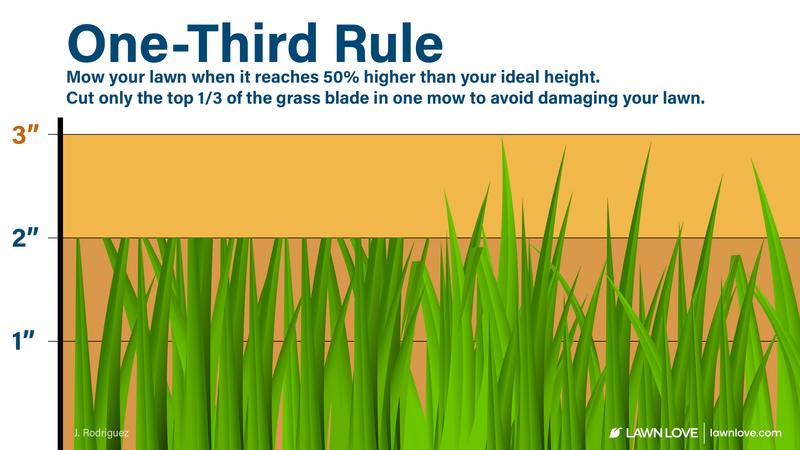
Regardless of your mowing height, removing too much at once stresses your lawn. In summer, when your lawn is already pushed to its limits, that extra stress can do real damage. Never cut more than one-third of the grass blade in a single mowing.
Dr. Bryan Unruh, turfgrass specialist at the University of Florida IFAS Extension, reminds homeowners that the one-third rule may affect how often you cut your grass.
“If grass growth slows due to drought, the mowing height remains the same, but the frequency diminishes. In hot, rainy weather, grass growth generally increases, and the mowing frequency also increases to avoid removing more than ⅓ of the leaf at a time.”
Quick reference: When to mow based on your desired height
| Grass Type | Desired Height | Mow When Grass Reaches |
| Cool-Season Grasses | ||
| Kentucky Bluegrass | 2-3 inches | 3-4.5 inches |
| Tall Fescue | 2-4 inches | 3-6 inches |
| Perennial Ryegrass | 2-3 inches | 3-4.5 inches |
| Fine Fescue | 1.5-3 inches | 2.25-4.5 inches |
| Warm-Season Grasses | ||
| Bermudagrass | 1-2 inches | 1.5-3 inches |
| Zoysiagrass | 1-2.5 inches | 1.5-3.75 inches |
| St. Augustine (dwarf & semidwarf) | 2.5-3 inches | 3.75-4.5 inches |
| St. Augustine (standard) | 3-4 inches | 4.5-6 inches |
| Centipedegrass | 1.5-2 inches | 2.25-3 inches |
| Bahiagrass | 3-4 inches | 4.5-6 inches |
| Buffalograss | 2-4 inches | 3-6 inches |
Pro tip: If you’ve let your lawn grow tall because of rain, vacation, or a busy week, resist the urge to cut it down in one pass. Remove one-third, wait 2 to 3 days, then mow again.
Signs you’re mowing too low
Mowing height could be the culprit if your lawn is struggling in summer. Watch for these red flags, which often appear within a week of scalping your lawn:
- Yellowing or browning that isn’t drought-related
- Spongy or bare patches where soil is visible
- Sudden weed explosion, especially crabgrass filling in thin spots
- Your lawn feels hot when you walk on it mid-day, a sign that the soil isn’t getting enough shade
- Increased irrigation needs, since unshaded soil dries out faster
Seeing these signs is your cue to raise your mower deck now. Hold off on fertilizing until temperatures drop, and make sure your lawn is getting enough water for your grass type and soil conditions.
For more on summer lawn health, see Summer Lawn Care Tips and Mowing in Extreme Heat.
When to call a professional lawn mowing service
Sometimes the smartest move is to hand mowing over to someone who knows your grass type and adjusts height accordingly. Lawn Love’s local lawn mowing pros mow at the right height for your grass, keep blades sharp, and follow the one-third rule every visit.
It’s especially worth getting help if:
- Your lawn is thin, brown, or weedy, and isn’t improving
- You’ve been mowing too short and want to start fresh with a corrective plan
- You’ve recently completed lawn aeration or overseeding and want careful mowing while the grass establishes
- You’re dealing with a lawn disease or pest problem and want to avoid spreading it to healthy parts of your lawn
FAQs
You can raise it anytime, and you should if your lawn is showing signs of stress. Adjust the deck up by ½ inch per mowing session rather than jumping straight to max height, especially if your lawn has been cut short for a while.
Yes, significantly. Taller grass blades shade the soil, reducing evaporation. This helps your lawn retain moisture longer, so you can go longer between waterings.
Use the setting closest to the high end of your grass type’s recommended range. Erring on the taller side is safer than shorter in summer. If you’re in the market for a new mower, look for one with at least 5 to 7 height positions for more flexibility.
A lawn mower tune-up can also help ensure your current mower’s height settings are accurate.
Yes, as temperatures cool, gradually lower the deck back to pre-summer heights. Think of it as the reverse of the summer adjustment. Just as you shouldn’t exceed the upper end of the range in summer, avoid dropping below the lower end in fall, even for the last mow.
Hire a local lawn mowing pro
Adjusting mowing height is one of the easiest wins in lawn care, but it’s only effective if your mower blades are sharp, your timing is right, and you understand your grass type’s needs.
Rather leave the guesswork to the pros? Lawn Love connects you with top-rated local lawn mowing services in hundreds of cities. Book online in minutes, with transparent pricing and no long-term contracts.
Main Image: A ruler measuring the height of grass in a healthy lawn. Photo Credit: JJ Gouin / Adobe Stock
Related Posts:


