If the grass looks greener on the other side of your neighbor’s fence, you might be making some common lawn mowing mistakes, like mowing too short or using the wrong mower.
Some mowing mistakes are more common among lawn care novices, like not overlapping rows and mowing in the same direction. But even seasoned mowers can mow incorrectly when they are in a rush or get careless.
I’ll walk you through some common lawn mowing mistakes and show you how to fix them easily.
Just know that one mistake can set your lawn back months, so if you’re unsure how to mow or don’t have the patience to do it correctly, consider hiring a Lawn Love lawn care pro.
- 1. Mowing grass too short
- 2. Cutting more than one-third of the grass
- 3. Using dull blades
- 4. Mowing wet grass
- 5. Always collecting grass clippings
- 6. Mowing during the heat of the day
- 7. Not mowing frequently enough
- 8. Always mowing in the same pattern and direction
- 9. Not overlapping rows when mowing
- 10. Using the wrong lawn mower
- 11. Ignoring lawn mower maintenance
- 12. Mowing at a high or low speed
- 13. Pulling the lawn mower
1. Mowing grass too short
Solution: Mow at your turf’s recommended mowing height, adjusting for the season.
It’s important to mow your grass at the right height. Justin Stultz, a Lawn Love pro in Texas, says, “Mowing too low shocks the grass and invites weeds, while letting it grow too high can trap moisture, cause fungus, and give pests a place to hide.”
Mowing grass too short weakens your lawn overall. Shorter grass can’t produce as much food, which means less energy for growth and repair, making your turf more susceptible to weeds, pests, and thinning.
Each type of grass has a recommended mowing height. Homeowners who prefer shorter lawns should choose cool-season fine fescue or warm-season Bermudagrass.
| Cool-season grass | |
| Fine fescue | 2.5 to 3.5 inches |
| Tall fescue | 3 to 4 inches |
| Kentucky bluegrass | 2.5 to 3.5 inches |
| Perennial ryegrass | 2 to 3 inches |
| Warm-season grass | |
| Bahiagrass | 3 to 4 inches |
| Bermudagrass | 1 to 2 inches |
| Buffalograss | 2 to 3 inches |
| Carpetgrass | 1.5 to 2 inches |
| Centipedegrass | 2 to 2.5 inches |
| St. Augustinegrass | 2.5 to 3 inches |
| Zoysiagrass | 2 to 3 inches |
Mow on the higher end of the recommended height during hotter months, as taller grass shades the soil, needs less fertilizer, and grows deeper roots.
Read related:
- The Best Height to Cut Your Grass
- How Short Can You Cut Your Grass?
- Guide to Cool-Season Grasses
- Guide to Warm-Season Grasses
2. Cutting more than one-third of the grass
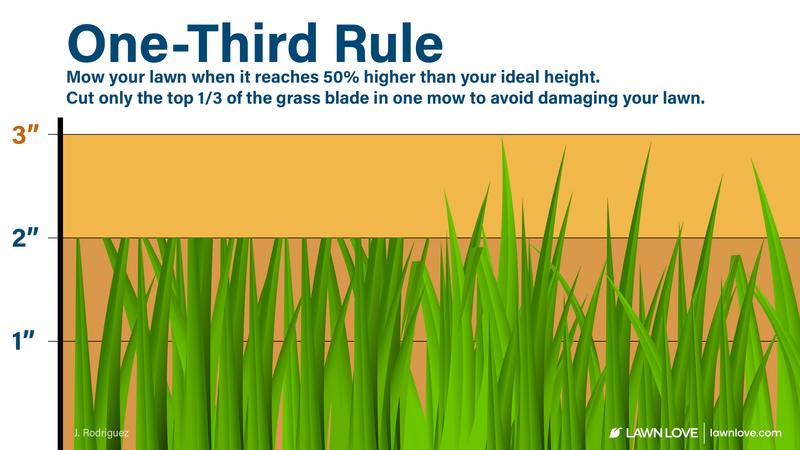
Solution: Mow only the top third of the blades when the grass is 50% taller than the ideal height.
Always follow the one-third rule when mowing your lawn. Cut your turf when it’s 50% taller than the ideal height, and remove only the top third of the grass. If you let your grass grow too tall, continue trimming the top third every two to four days until it reaches the ideal height.
“Scalping the grass in a single mow isn’t likely to kill it, but it can make your turf look rough for a few weeks and leave it more susceptible to environmental stress,” says Michael Goatley, turfgrass extension specialist at Virginia Tech, says,
By cutting more than one-third of the grass, you remove half of the grass’s photosynthetic capability, which slows down recovery and causes thinning and bare patches.
Read related:
- What’s the One-Third Rule of Mowing
- What Is Scaping a Lawn and When Should You Do It?
- How to Cut Long Grass
3. Using dull blades

Solution: Sharpen your mower blades after every 25 hours of mowing, or about once a year for an average homeowner.
Dull blades make mowing harder and tear your grass instead of cutting it cleanly, resulting in jagged, brown edges. Tearing grass is more stressful, and ragged edges are more susceptible to pests, diseases, and sun damage.
I recommend using a hand file to sharpen the blade, as it’s the easiest method.
If there are cracks or multiple notches in the blade, replace it.
Read related:
- How to Sharpen Lawn Mower Blades
- How Often Should You Sharpen Lawn Mower Blades?
- How to Change Your Lawn Mower’s Blade
4. Mowing wet grass
Solution: Wait until your lawn is dry before mowing.
Mowing wet grass can cause several problems. It sticks to your mower blade and deck, leading to torn grass, grass clumps in the mower, and rusted blades. When thrown on turf, the clumps choke the grass beneath and invite lawn fungus.
Wet grass is also a slipping hazard. According to the American College of Foot and Ankle Surgeons, losing control while mowing wet lawns causes most mower-related foot injuries.
“Occasional mowing of wet turf isn’t usually a problem, but it shouldn’t be done regularly,” Goatley says. “Another important consideration is footing or wheel traction on a wet surface, which can pose a safety risk for the operator.”
If your lawn is overgrown and won’t dry quickly because of frequent rain, you can mow by raising the mower by at least an inch and applying deck spray to keep grass from sticking. Mow slowly and overlap each pass by 50% instead of the usual 20 to 30%.
Read related:
5. Always collecting grass clippings
Solution: Leave grass clippings on your lawn
Bagging clippings is extra work and robs your lawn of free fertilizer. Clippings contain nitrogen, potassium, and phosphorus, which provide about 25% of your lawn’s total fertilizer needs. Grass clippings also help retain soil moisture.
“The only time to bag them is when the lawn is so tall that mowing leaves a mass of clippings that blocks sunlight or promotes disease by increasing moisture and temperature in the turfgrass canopy,” Goatley adds. “If you do bag clippings, consider composting them.”
Mow over clippings or use a mulching mower so they become small enough to decompose quickly. As they decompose, they improve soil structure and increase microbial activity.
For more information, check out our article on Bagging vs. Mulching Grass Clippings.
Read related:
6. Mowing during the heat of the day
Solution: Mow during mid-morning or late afternoon
Don’t mow during the hottest times of the day. The grass will already be under stress, and mowing compounds the stress and can cause it to wilt.
It’s also not great for you – think dehydration, heat exhaustion, and sunburn. Plus, your lawn mower can overheat, reducing the life of the engine.
The best time to mow your lawn is from 8 a.m. to 10 a.m. or late afternoon (4 p.m. to 6 p.m.), when your grass is dry and there’s enough time for it to recover before nightfall.
7. Not mowing frequently enough
Solution: Mow weekly during the growing season, following the one-third rule.
“You need to mow your lawn weekly in peak growing season,” Stultz says. That’s spring and fall for cool-season grass, and late spring and summer for warm-season grass. Always follow the one-third rule when cutting.
He adds, “When the growth slows down, you can reduce the mowing frequency to once every two weeks.”
Mowing infrequently can also cause your turf to produce seedheads. Grass with seedheads looks thin and stemmy.
Read related:
8. Always mowing in the same pattern and direction
Solution: Change mowing direction every other session.
Mowing in the same direction encourages grass to grow that way. Over time, your turf will look like it’s leaning to one side, and your mower will have trouble cutting this leaning grass unless you mow from a different direction.
It can also compact the soil and leave wheel tracks in your lawn. Here’s a diagram that shows recommended mowing patterns:

If you want to get creative, you can try lawn stripes, zig-zags, or even circular patterns.
Read related:
- Why Should You Change Your Mowing Direction?
- 6 Different Lawn Mowing Patterns
- How to Stripe Your Lawn
9. Not overlapping rows when mowing
Solution: Overlap your rows by about 4 inches.
If you don’t overlap, you risk leaving thin strips of uncut grass between passes, creating an uneven, striped appearance. This is especially likely if you’re not walking in perfectly straight lines or if the terrain is slightly uneven.
In addition, most mower decks discharge clippings to one side, which means the grass on that edge may not be cut as cleanly or as short as the grass directly under the blade path. Overlapping compensates for this.
10. Using the wrong lawn mower
Solution: Self-propelled lawn mowers are the best choice for most homeowners. Choose a riding mower if your lawn is over 20,000 square feet.
The wrong lawn mower can make mowing more difficult. For example, riding mowers are too big for small lawns, while push mowers are too small for large yards.
Self-propelled and push mowers are the most popular choices among homeowners. The former has a drive system, so you just have to steer and don’t need to push. The latter requires you to push from behind, so be ready to sweat more.
You’ll also have to choose between electric and gas mowers. Electric mowers are quieter and eco-friendly, best for small to medium lawns. Gas mowers can handle large lawns easily, but require more maintenance.
Read more:
- Best Lawn Mowers for Small Yards
- Best Lawn Mowers for Big Yards
- Self-Propelled vs Push Mowers: Which Is Best for Your Lawn?
- Electric vs. Gas Lawn Mowers: Which Is Best for Your Lawn?
11. Ignoring lawn mower maintenance

Solution: Clean your mower after every mow and service it once a year.
“Dull mower blades don’t cut, they tear the grass,” Stultz says. “That tearing leaves your grass looking ragged and hazy after a mow, and those frayed edges are more vulnerable to disease and fungus. Inspect your blades regularly and sharpen them whenever they start to show wear.”
You should also make sure to change the oil, replace spark plugs, and replace the air filter once a year in the spring. If you have a self-propelled mower, make sure to also check the belt. When it’s winter, don’t forget to winterize your mower to prevent expensive repairs.
If your mower needs major tune-ups or repairs, I recommend hiring a professional, which can set you back $10 to $275, depending on the type of mower and repair.
Read related:
- How to Clean a Lawn Mower Deck
- Best Lawn Mower Maintenance Practices
- How to Change Oil in a Lawn Mower
- How to Change Spark Plugs on a Lawn Mower
- How to Clean and Replace Your Lawn Mower’s Air Filter
- How to Winterize Your Lawn Mower
- How Much Does Lawn Mower Service Cost?
12. Mowing at a high or low speed
Solution: Mow at the speed your mower was designed for
Rushing your mower through your lawn results in an uneven, messy cut with lots of missed spots because it doesn’t have enough time to properly slice your grass. It may sometimes end up tearing the turf.
Some homeowners run their mowers at half speed because they think it prolongs engine life. That’s not true, as mowers are designed to run most efficiently at specific speeds.
If you’re worried about not running the right speed, choose a single-speed self-propelled mower. It runs at the exact speed it works best at; all you need to do is steer.
13. Pulling the lawn mower
Solution: Always push your push mower.
Many beginners pull their mowers while cutting grass. It’s a common mistake, which cuts grass in different directions, making your lawn look messy and uneven.
Pulling a mower is also a safety hazard. You’re putting yourself in the direct cutting path of the mower. You can also cut the cord of a corded mower, which can electrocute you.
Maintain a healthy lawn all season long
These are some common lawn mowing mistakes many homeowners make. Avoid them to keep your turf healthy, lush, and looking its best all season long.
Mowing can be tiring and time-consuming. Lawn Love’s local lawn care pros can take yard work off your to-do list . Our pros have the knowledge and equipment to make your neighbors green with envy at your beautiful yard.
Main Image: Cut your grass more frequently to avoid mowing issues. Photo Credit: Findley Watt / Adobe Stock
Related Posts: