| Key Takeaways |
|---|
| • Choose triclopyr for cool-season lawns or metsulfuron/Celsius for warm-season lawns to ensure effectiveness. • Applications in September and October have a 95% success rate compared to only 50% in the spring. • Plan for 2 to 3 treatments spaced 3 to 4 weeks apart to fully kill the root system. • Always add surfactant to liquid concentrates to penetrate ground ivy's waxy leaf coating • Prevent the weed’s return by keeping turf thick through proper mowing, fertilizing, and overseeding. |

Ground ivy, known as creeping Charlie, is one of the trickiest lawn weeds to eliminate because it spreads aggressively through creeping stems and has a waxy leaf coating that repels many herbicides. The most effective removal method combines a broadleaf herbicide applied in fall with consistent lawn care that creates dense turf the weed can’t penetrate.
Use triclopyr for cool-season turf or specialized alternatives for warm-season grasses. You’ll need 2 to 3 herbicide applications spaced 3 to 4 weeks apart to fully eradicate ground ivy.
For persistent infestations covering large lawn areas, professional weed control services use commercial-grade products and treatment schedules that deliver faster, more complete results than DIY approaches.
What is ground ivy?

Ground ivy is a perennial broadleaf weed in the mint family that forms dense mats and spreads rapidly through creeping stems.
Here are ground ivy’s main characteristics:
- Round to kidney-shaped leaves with scalloped edges
- Square stems that root at nodes
- Small purple-blue tubular flowers in spring
- Forms dense mats 4-6 inches tall
- Strong minty odor when crushed
- Thrives in shady, moist areas with compacted soil
Why it’s so hard to kill: Ground ivy is highly aggressive. A single plant spreads several feet in one season, quickly dominating thin turf. Its waxy leaf coating resists most herbicides, and extensive roots regenerate from fragments, making it extremely difficult to control without early intervention.
Read more: How to Identify and Control Broadleaf Weeds
Step-by-step: How to kill ground ivy
Step 1: Mow your lawn first
Mow the grass to your normal height 2 to 3 days before applying the herbicide. This exposes ground ivy’s leaves for better herbicide contact. It also allows you to see patches clearly. Don’t mow for at least 3 to 4 days after applying the herbicide to let the product absorb.
Step 2: Choose the right herbicide
Basic weed killers with only 2,4-D (such as Southern Ag Amine 2,4-D or Hi-Yield 2,4-D), often fail against ground ivy; it’s simply too tough to tackle alone. To win the battle, you need a specialized ground ivy killer for lawns that matches the right chemical “weapon” to your specific grass.
1. For cool-season lawns (Kentucky bluegrass, fescue, ryegrass)
You need a product containing Triclopyr. Tim DiAngelis, owner of Lawn Care Plus in Roslindale, MA, has battled ground ivy in New England for over a decade. He calls triclopyr the “gold standard” because, unlike 2,4-D, it travels down to kill the underground runners.
Pro Pick: DiAngelis recommends Ortho Weed B Gon Chickweed, Clover & Oxalis Killer. Buy the concentrate, not the ready-to-spray hose-end bottle, so you can mix it strong enough to work. Check the labels.
2. For warm-season lawns (St. Augustine, centipede)
Warning: Do not use Triclopyr. It can damage or kill these sensitive southern lawns.
St. Augustine or centipede: For ground ivy control in warm-season lawns, you can use professional-grade products containing Metsulfuron (Manor, Blade) or Celsius (thiencarbazone + iodosulfuron + dicamba), which are safe for these sensitive grasses when applied at labelled rates.
For Bermuda or Zoysia: You can use professional-grade products like Celsius or Manor (Metsulfuron-methyl), which are safe for the grass but deadly to ground ivy.
Read more:
Step 3. Add surfactant
Ground ivy’s waxy leaves shed herbicide like a raincoat, so Cory Bettinghouse, owner of Cory’s Lawn Service in Reno, NV, recommends adding a surfactant. This “spreader-sticker” breaks surface tension, allowing the chemical to stick and penetrate the weed rather than beading up and rolling off.
“A good spreader-sticker turns a 60% control rate into 90%+ control,” Bettinghouse explains. “We burned through product trying to skip this step early in my career.”
Note: Bettinghouse warns that granular weed-and-feed fails against ground ivy because pellets won’t stick to stems. For success, use a liquid spray mixed with a surfactant to ensure the herbicide clings and penetrates the leaves.
Pro tip: Concentrates cost less and allow better coverage control, but require mixing. Add non-ionic surfactant at 0.25% by volume (1 teaspoon per gallon) to penetrate the waxy leaves. Ready-to-spray products already include surfactant but cost more per application.
Read more: How and When to Apply Weed and Feed on Your Lawn
Step 4: Apply herbicide to ground ivy
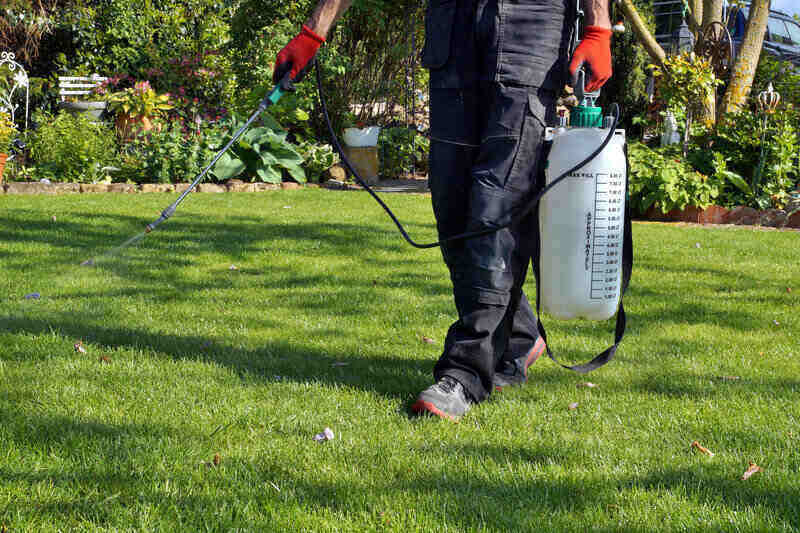
The best time to spray ground ivy is in late fall (mid-September to October) when daytime air temperatures are consistently in the 60s or low 70s. For warm-season grass, delay treatment until dormancy to avoid lawn damage (avoid applications above 85 degrees F).
Fall timing works because ground ivy shifts from leaf growth to root storage, pulling nutrients—and herbicide—downward into underground stolons where dormant buds survive.
Pick a calm, sunny day with no rain in the forecast for 24 to 48 hours to ensure the chemical dries and absorbs completely.
Pro tip: Many experts recommend waiting for the first frost. “The frost damages those waxy cuticles just enough that the herbicide can finally penetrate instead of beading off like water on a car hood,” DiAngelis explains.
- Spot treatment (recommended): Use a hand-held pump sprayer for precision. Spray the ground ivy patches until the leaves are glistening wet but not dripping. Mark treated areas with flags so you can monitor progress.
- Broadcast method: If the infestation covers more than 30% of your lawn, use a hose-end sprayer to apply the product evenly across the entire area following label rates.
Safety warning: Keep people and pets off the treated area until the spray has dried completely.
Spring option: If you must treat in spring, you should apply herbicide in late spring (May) after ground ivy has flowered but before summer heat arrives.
Read more:
Step 5: Wait and monitor
Herbicides take time to kill the entire root system. You likely will not see immediate results, so resist the urge to respray if the weeds look green after a few days.
- Mowing: Wait 2-3 days before mowing again. This delay gives the plant ample time to absorb the chemical and move it from the leaves down to the roots.
- Visual signs: Watch for stems that curl or twist like a corkscrew within the first week. Leaves will slowly turn yellow and then brown over 10-14 days.
How long does it take to kill ground ivy? Complete eradication typically takes 6 to 8 weeks with multiple applications.
Step 6: Reapply after 3-4 weeks
Ground ivy requires persistence. Do not expect one spray to finish the job.
- First application: Kills most visible growth
- Second application: Kills regrowth from surviving roots
- Third application (if needed): Eliminates stubborn patches
“We’ve found that two applications spaced 3 to 4 weeks apart in fall gives near-total control by the following spring,” DiAngelis says. “One treatment might knock back 60% to 70%, but that second hit when the survivors are trying to recover finishes the job.”
Step 7: Rebuild lawn density and prevent weeds

Killing ground ivy leaves bare patches that nature quickly fills with new weeds. To prevent ground ivy from returning, you must fill that space with thick, healthy grass that crowds out invaders.
- Aerate compacted soil to improve drainage. Late August to September, sometimes into early October (cool-season) or May to June after green-up (warm-season) for recovery.
- Overseed thin areas with quality grass seed. Late August to September (cool-season, same year) or next spring’s late April to June (warm-season) for optimal germination.
- Apply fertilizer based on soil test results to thicken existing grass. Cool-season grasses should be fertilized when the soil reaches 55°F (spring and fall); warm-season grasses when the soil reaches 70°F (May through August).
- Raise mowing height to 3 to 4 inches. Maintain height year-round to strengthen roots and naturally suppress weed reinfestation in both grass types.
Good to know: Monthly inspections during the growing season catch ground ivy early—treat small patches immediately before they spread. Deep watering combined with soil pH adjustment (6.0 to 7.0) and thatch reduction favors thick grass over shallow-rooted weeds.
Create border barriers by installing edging between lawn and garden beds, maintaining buffer zones along property lines, and monitoring edges where lawn meets woods or unkempt areas.
Note that for ground ivy in flower beds, metal or concrete edging works best to physically block creeping stems, while landscape fabric underneath prevents underground runners from spreading into surrounding planting areas.
FAQs
Herbicides with triclopyr (like Ortho Weed B Gon Chickweed) kill ground ivy without harming your grass. These products target broadleaf weeds while leaving your lawn safe. Always check the label for your grass type first.
Look for round, kidney-shaped leaves with scalloped edges growing on square stems. The leaves grow in pairs and smell minty when crushed. You’ll spot small lavender-blue flowers in spring. Ground ivy creeps along the ground, forming dense mats that choke out healthy grass.
No. Vinegar, boiling water, and salt only kill the leaves but leave roots untouched, so ground ivy grows back. These DIY methods won’t work—ground ivy needs herbicides with triclopyr to eliminate it completely.
Remember, hand-pulling works for small patches if you remove all runners and roots, but it’s labor-intensive and rarely succeeds on established infestations.
Ground ivy itself tastes bitter and rarely causes problems if touched or accidentally eaten. The real danger is herbicide exposure—keep kids and pets away from treated lawns until the spray completely dries.
When to call in a lawn care pro
When ground ivy starts winning the battle against your DIY efforts, it’s time to call in the professionals.
Local pros use commercial-grade herbicides with higher concentrations, schedule treatments at optimal times based on ground ivy’s growth stage, and typically include fertilization, aeration, and overseeding to prevent reestablishment.
Professional ground ivy control typically costs $49 to $200 per treatment, with most properties requiring 2-3 treatments. Get a quote from Lawn Love for ground ivy removal and ongoing prevention. Our local experts handle everything from diagnosis to treatment.
Main Image: Ground ivy spreading through lawn with dandelions. Image Credit: An-T / Adobe Stock
Related Posts: